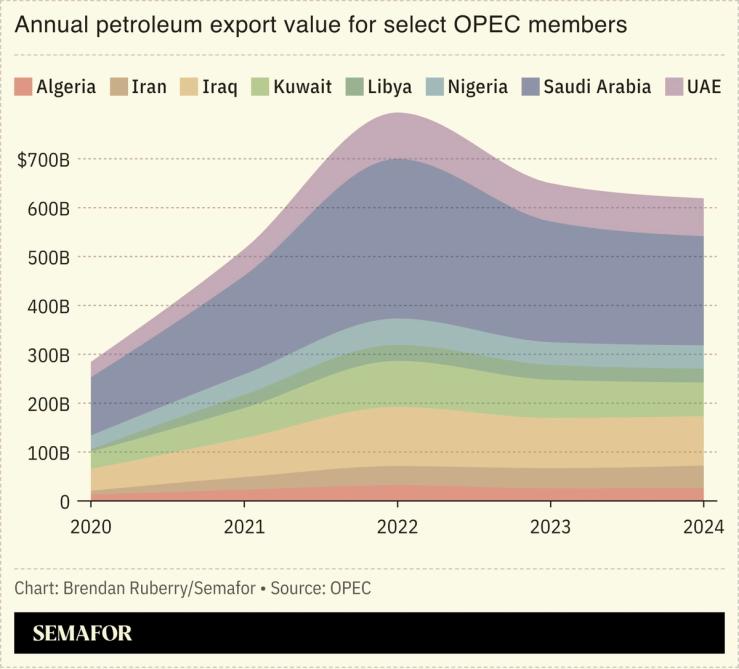
African oil producers face a more volatile future after the United Arab Emirates exits OPEC on May 1 — a move that could weaken a cartel many of them rely on to support prices.
The immediate impact may be muted, but over time a looser OPEC — as well as a UAE that feels empowered to pump more crude — could erode the oil-price floor underpinning the economies of top African producers Nigeria and Angola. Smaller ones, such as Equatorial Guinea and South Sudan, are especially exposed, with limited buffers against sustained price declines. Algeria, which relies more on gas, and Libya, which is temporarily not subject to OPEC quotas, may prove more resilient, while Nigeria’s growing refining ambitions, with expansions at the Dangote Refinery, could offset some upstream losses.
The exit of the UAE, the world’s third-largest oil producer, reflects a deep rift with Saudi Arabia over production limits. Once free of quota constraints, the Emirates can up its production by more than 40% to 5 million barrels per day, intensifying competition in markets where sub-Saharan Africa’s higher-cost producers are already vulnerable.