




The News
JD Vance sent his last mean tweet Feb. 3 about Rep. Jerry Nadler, D-N.Y. His last really hair-raising retweets were the week in January he amplified attacks on the slain Alex Pretti.
This is, two people close to the vice president told me, because he deleted X from his phone for Lent, which began Feb. 18; it’s unclear if he’s put it back. Does this mean that he views it as a personal pleasure he will temporarily forgo, or a bad habit he’s trying to purge? His allies aren’t sure. But in any event, he seems to have less time on his hands and less to talk about, what with the surprise portfolio of ending a war that President Donald Trump helpfully announced Vance opposed.
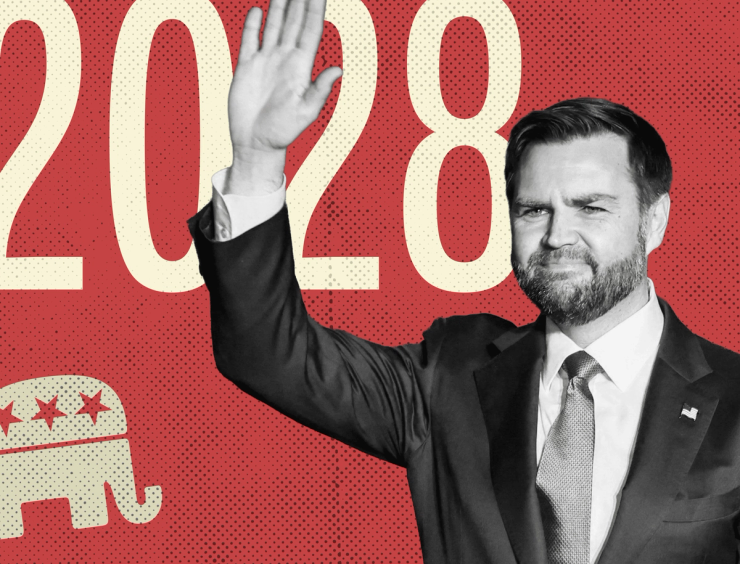
A year ago, Vance was the presumptive 2028 Republican nominee. Now, Washington conventional wisdom, a 50-50 blend of dinner-party chatter and possibly sponsored social media posts, holds that the prize is slipping a bit from his grasp. Polymarket, a reliable measure of conventional wisdom, has his odds of winning the nomination down below 40% from the November high near 60%. Former Barack Obama aide Dan Pfeiffer wrote Saturday that his confidence in a Vance nomination has “waned.” Washington insiders of various categories would really love to return to the relative normalcy suggested by a Marco Rubio presidency.
And Vance doesn’t seem to mind deflating the balloon. One of his biggest cheerleaders recently wrote that he might skip the contest. The Washington Post hinted he might choose to spend more time with his growing family. And it’s been a hard year for everyone in the Trump administration with future political aspirations.
But after a round of conversations this past week with Vance’s circle and people close to his putative rivals alike, I emerged surprised that his given odds aren’t higher. (NB: Semafor employees aren’t allowed to bet!)
Much of this is just the obvious political reality of Trump’s Republican Party. But there’s also a kind of sneering conventional wisdom toward Vance that doesn’t seem to have much basis in political reality. In his short public career, he’s been a bestselling author and an effective political performer who won a Senate seat and mopped the floor with Tim Walz on the debate stage.
As important, he has managed the Republican coalition more deftly than his critics imagine: He has loyally served its most important constituent, Trump, and remained close to Donald Trump Jr. And yet the elements of the party who now loathe or, at best, roll their eyes at Trump hold out hope for Vance. He has been working the Republican coalition hard and, essentially, alone.
Vance has maintained his deep ties with the new Republican business class in California, but also quietly deepened his relationship with the old Republican power center of Wall Street. He has won friends on the hard right by refusing to criticize their excesses, and by opposing the war. Vance continues to talk and text with Republicans well outside the increasingly hawkish “Trumpian bubble,” an associate said.
And no other would-be 2028 contender has amassed anything like his book of favors with its elected political class. The New York Times recently detailed the two dozen fundraisers at which he’d raised $60 million. On March 3, he and Trump Jr. headlined a fundraising dinner at the home of an adviser, Arthur Schwartz, that raised $6 million, the record for a sitting vice president, a Republican said.
He’s stumping in Iowa for Rep. Zach Nunn, a super-competitive race in a swing district — Cook moved it from “leans Republican” to “toss-up.” He campaigned a few months ago for Derrick Van Orden in Wisconsin, one of the best Democratic opportunities. And he was in North Carolina, where Republicans are trying to flip a seat.
Vance has problems, of course. While he comfortably leads primary polls, he is nationally very unpopular — he activates Trump’s haters without carrying Trump’s unique bond with his fans — and could only be elected in the usual scorched earth, closely divided contest. (Fortunately for him, neither party’s primary process seems able to produce a widely acceptable candidate.) If Trump’s numbers continue downward, they could pull the veep (and Rubio) through the floor — nobody wanted a Cheney or Condi campaign in 2008. And Trump is a free radical, and could simply choose someone else, or torch Vance for fun.
But no other Republican has made any serious move toward the job, or toward building the kind of partisan coalition Vance holds together. At best, other ambitious figures like Rubio and David McCormick, the junior senator from Pennsylvania, appear ready to jump in if Vance doesn’t.
And now the vice president will relaunch his public identity June 16, with a book about his personal faith. He hasn’t yet disclosed the advance, and a spokesperson declined to — but publishing executives speculate in private on how far into the seven-figures he got. His first book was an honest-to-God bestseller, and the Murdoch family, which owns HarperCollins, isn’t known for stinting on its payments to political allies. In a more innocent century, then-House Speaker Newt Gingrich’s $4.5 million HarperCollins deal was a scandal. In this one, the book advance probably immunizes Vance from charges and temptations of Washington’s ubiquitous graft.
In this article:

Ben’s view
The political figure Vance reminds me of most is Obama, not for their vaguely similar life stories or intellectual credentials, but for the way they drive both their own parties and their enemies crazy.
It’s easy to forget now that in 2007, Obama was not the candidate of the intellectuals of the Democratic left — that was the populist John Edwards — or of the leaders of the older Black establishment, many of whom backed Hillary Clinton. To this day, a portion of the left-wing Democratic elite views Obama as a charlatan who hoodwinked their voters into supporting him. The voters, however, viewed him as a nice young family man, and remain hoodwinked to this day. Republicans, meanwhile, hated everything that Democrats loved about Obama and often tilted into grotesque smears. Democrats loathe Vance and constantly attack his physical appearance, though normal people could also be forgiven for seeing him as a nice young family man.
I learned from covering that race that the intraparty friction and distrust that journalists love to cover is sometimes the mark of a successful candidate. Was Obama ever a man of the left or of the blob? A secret radical or a secret Republican? Who knows. His gift was to keep everyone guessing and to be — as he wrote of himself in 2006 — “a blank screen on which people of vastly different political stripes project their own views.”
Vance offers his own party the same blank screen, and can pull in MAGA populists, business-first capitalists, and suburban moderates alike. We’ll still be arguing in 2035 what he really stands for. And that’s why he’s the overwhelmingly likely Republican nominee in 2028.

Room for Disagreement
Some Vance allies think the Iran War could scupper his prospects. “Everybody knows he hates this war. But he is, of course, loyal to the president. He’s in an impossible bind: If he dissents from the president, MAGA primary voters will despise him. But if he stays loyal, as I expect he will, he will pay a political price for a war he did not support,” said Rod Dreher, an American conservative writer known recently for his support for Hungary’s Viktor Orbán, who said he hasn’t spoken to Vance since November. “I don’t know how he threads that needle.”

Notable
- Vance has expressed doubts about the Pentagon’s depiction of the Iran war in closed-door meetings, The Atlantic reported.