




The Signal Insight
Dave Ricks does not know how many of his fellow CEOs are on Mounjaro and Zepbound, but the answer is “not zero,” Lilly’s CEO said at Semafor World Economy last week.
The popularity of the two GLP-1 treatments has made the Indianapolis-based drugmaker one of the world’s most valuable companies. It has leapt ahead of Novo Nordisk, its closest rival in the weight loss drug market, and attained a market capitalization exceeding that of ExxonMobil or JPMorgan Chase. A 10-fold increase in Lilly’s stock since 2018 has made millionaires of some of its employees — and several realtors and car dealers in the midsize Midwestern city it calls home.
That has posed a leadership challenge for Ricks that other CEOs might love to have: How to keep people from basking in their success, and focus them instead on advancing Lilly’s GLP-1 offerings and finding the next Mounjaro or Zepbound.
Ricks, who has run the company since 2017, is setting a restless tone at the top: For all the success GLP-1s have had, they still only reach about one in 10 people in a country where 40% of all health spending goes to treating obesity-related complaints. “So we look at that as disappointing on one hand,” he says. “On the other hand, if you’re valuing the stock or worried about growth for Lilly, there’s a lot of growth ahead.”
Here’s how he’s pursuing that growth.
This interview has been edited for clarity and length.
Andrew Edgecliffe-Johnson: You’ve been with the company for 30 years; to what extent has this one category of drugs transformed Lilly?
Dave Ricks: It certainly has. I think the nature of industry is one of home runs. And those home runs tend to produce a huge surplus in profitability and so forth, but also in the capacity to do more research. The trick in the industry is can you, like stepping stones across a pond, go from one to the next in a time cycle that allows you to keep the reinvestment going?
Lilly will celebrate our 150th year this spring. [We’ve] had other big home runs in their time, like Prozac or Cymbalta for neuropathy, and Cialis for erectile dysfunction. So we’ve kept that going. There’s companies that miss a beat, you miss the stone, and then you’re [after] the hyphen at the back end of another company.
The FDA recently approved your GLP-1 pill, Foundayo. What impact do you expect that to have?
There are three big opportunities. One is reducing the friction daily: A lot of people take polypharmacy; they take pills in the morning. Here, you can just put it in that pill case and it’s just in your routine. That is different from taking something out of the refrigerator and injecting it on a once-a-week schedule. That’ll make it more accessible.
Secondly, production systems: No matter how hard we try, we cannot reach the planet. There are a billion people on the planet who are potential candidates. Let’s say 500 million [are potential customers]. Today we’re treating 21 or 22 million. Can we increase that production 20-fold? Not anytime soon. There is no real efficiency gain left. We just have to put in more units of capacity, and we will do that, but that capex rollout is expensive and slow. But [with the pill], we can provide a single-acting GLP-1 [that] can meet the needs of a lot of people at huge scale.
The final thing is maintenance, and I think a lot of people want to graduate from injectables when they reach their goal. A lot of people are trying stopping — that often doesn’t work — or spacing out doses — that can work. But I think here’s a new option that feels like we’ve graduated to something that’s just part of [their routine].
You recently announced the acquisition of Centessa Pharmaceuticals, which focuses on sleep disorders. Is sleep the new obesity?
It has some parallels that are attractive to us. First of all, Lilly, as an old company, is maybe not as fast-moving as we want sometimes, but we are quite patient and diligent on opportunities.
If you look at the GLP-1s, we launched the first one in the world in 2006. This is not a new story, but we refined it. We’re on our fourth generation now of this class, and they’ve gotten better and better.
We think sleep is like this. It’s a nodal health condition. If you can improve your sleep, you can improve a lot of other things, from aging and dementia to just mental health. We all know when we don’t sleep well what that does throughout our day. And there’s evidence that even things like ADD and ADHD can be affected by sleep. We think this is a very interesting new pathway. We have a long history in neuroscience, and we think we’re the right company to explore this. Will it work? We don’t know. But if you could think about something like sleep improvement in a safe way, that would have a profound effect on human health.
What do you think the economic impact of GLP-1s is?
Pretty substantial. Goldman Sachs did a pretty good analysis last year. They estimate that, deployed at scale, [GLP-1s] could have something like a 1% or 2% lift on the GDP of an economy. If you make a list of the things that could do that, it’s pretty short.
But, right now, most employer plans offer pretty patchy coverage of GLP-1s.
This is the story I’d like to work on this year. [Health insurance coverage] has really been for people with means and not for people without means. And I think we need to change that. I think it’s a moral imperative, but also it’s a cost imperative. Obesity flows with poverty. So right now, we see a lot of use in banks and software companies and pharma companies and high-wage companies and a lot less in Walmart and retailers and light manufacturing.
When a company like yours goes on a streak like it’s gone on, what do you have to do as CEO to guard against complacency and keep people looking for that next great hit?
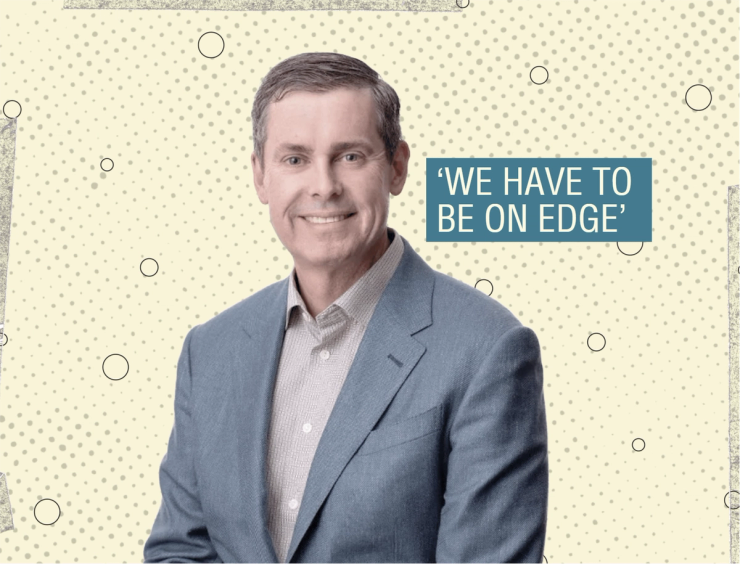
That is my wake-up-and-obsess-about issue every day. One of the great things about our company is we have a lot of dedicated people who have been there a long time, and we’re kind of geographically isolated. It’s kind of surprising that the most valuable biopharma company in the world is based in the Midwest of the United States. But I think actually the isolation helps because we can focus and not chase the whims of the day. But of course, the flip of that is speed and complacency. So I think we have to be on edge. And the good news is, I’m on edge, so I can infect my team with that.
But also we have to never be satisfied with the progress we’ve made, and keep pushing for technical advancements that can move human health. That will be, of course, in the weight loss story, where we have many more chapters to go. But also in new areas like sleep, and other very common conditions. We’re attracted to that kind of thing, where millions or hundreds of millions of people’s lives globally could be improved.

Notable
- Lilly this week agreed to spend as much as $7 billion to acquire Kelonia Therapeutics, which is developing a new treatment for the blood cancer multiple myeloma. Ricks told Semafor World Economy that smaller biotech companies that could not negotiate the same US tariff and “most favored nation” deals as Lilly had could be disadvantaged, but “they haven’t gotten cheaper as a result of these changes.”