




Reed’s view
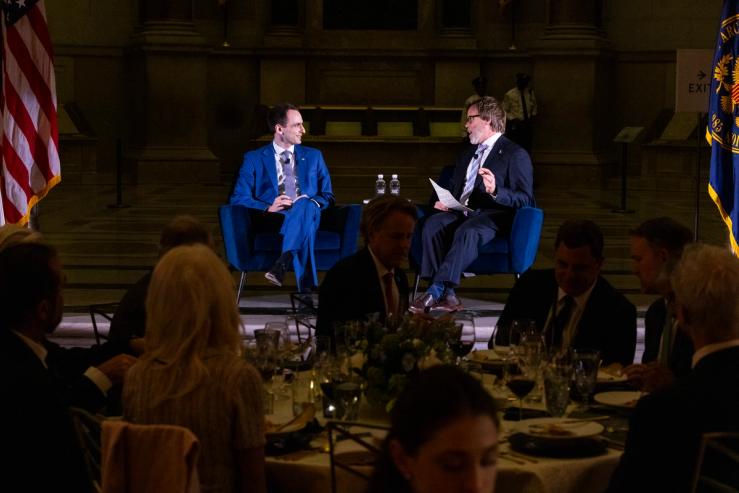
I had two big questions this week for Michael Kratsios, director of the White House Office of Science and Technology Policy, at Semafor World Economy in DC.
If the administration’s policy is to cut funding for the wrong research, how do you determine which scientific endeavors lack merit? And even if you agree the current system of government-funded academic research is in need of reform, why not fix it rather than take a sledgehammer to it?
What I took away from our conversation is that it’s easy to identify good, or important, scientific research. But it’s nearly impossible to identify the “wrong” things to study. Unless, of course, there’s been a breakthrough in time travel.
The US government’s job when it comes to scientific research is to grease the wheels of new tech that’s critical to economic and security interests, but that isn’t quite far enough along for private investors. It’s also to fund research that might prove useful many decades in the future.
Kratsios identified some of those areas, like AI, quantum computing, and nuclear fusion, and has some good ideas for how to better track research and faster results. And as we talked just feet from the Declaration of Independence in the National Archives on the eve of the country’s 250th birthday, Kratsios waxed poetic about the uniquely American mixture of public-private partnerships, free capital, and swashbuckling entrepreneurship.
But if the US wants to have the same technological success for another 250 years, it needs to be okay with funding the “wrong” scientific research. Look at G.H. Hardy, a mathematician whose work ended up being crucial in biology, genetics research, computer encryption, and quantum computing.
“No discovery of mine has made, or is likely to make, directly or indirectly, for good or ill, the least difference to the amenity of the world,” Hardy wrote in a 1940 essay titled The Mathematician’s Apology.
Likewise, many people might have considered Stanford’s $4.5 million National Science Foundation grant for “digital libraries” a waste of money. But that grant became PageRank, which led to the creation of Google, which generated about $2,700 in economic value per American last year alone, according to Google’s estimates.
It doesn’t take a math genius to do a cost-benefit analysis on scientific research. But one thing is true for Kratsios — you miss 100% of the shots you don’t take.

Notable
- OpenAI has launched a new AI model, GPT-Rosalind, for life sciences research, Axios reports.