




The News
Democrats are in an unusual situation: Republicans need their votes on two key national security matters. That has Democrats weighing how to use their ample leverage on expiring surveillance powers and Iran funding.
On Thursday, the House will once again try to pass the 18-month FISA extension over the opposition of conservatives to the warrantless surveillance powers, likely requiring Democratic votes. Republicans will need more assistance in the Senate.
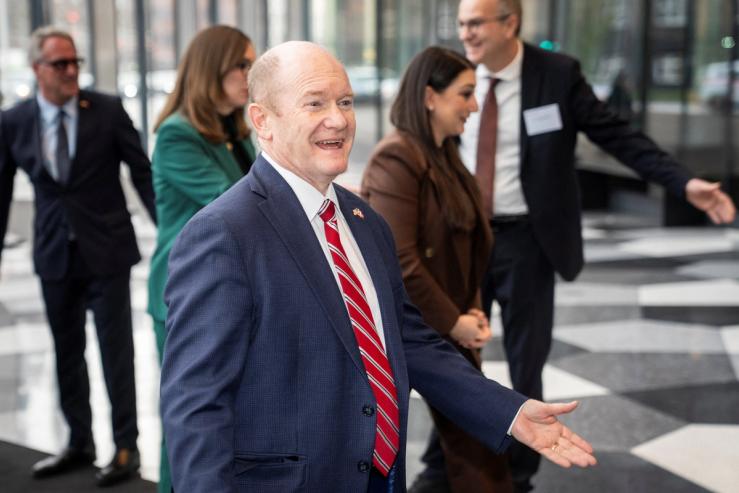
The Trump administration seems to recognize the need for bipartisan outreach on defense funding, inviting Sens. Mitch McConnell, R-Ky., and Chris Coons, D-Del., for a meeting with Defense Secretary Pete Hegseth on Tuesday.
While Coons seems open to that discussion, he said extending FISA is harder for him given the lack of engagement from the administration.
Still, one Senate Democrat predicted there will be 60 votes for it next week given the national security importance.

Know More
Democrats are likely to fracture over the FISA vote in the Senate. Sen. Mark Warner, D-Va., the top Democrat on the Senate Intelligence Committee, said he’s unsure how the vote would play out in the upper chamber but “it would have been really productive” if the administration had better explained the reforms from 2024 and made its position clear earlier.
“I barely voted for it last time on the promise of a lot of reform. I am not confident that the current FBI director and Department of Justice leadership is fully implementing those reforms,” Coons said. “I will have a hard time bringing myself to support it, if I’ve had nothing, no briefing.”
Still, Sen. Jeanne Shaheen, D-N.H., told Semafor she expects to support extending FISA into next year, while Sen. Sheldon Whitehouse, D-R.I., noted he usually supports it. But Sen. Ron Wyden, D-Ore., who has long taken issue with the surveillance powers, said he’s going to “fight like hell to get protection for the innocent Americans whose information is sucked up in these searches.”
When it comes to Iran war funding, Republicans have decided, for now, to leave out Pentagon spending from a party-line spending bill that will focus instead on immigration enforcement funding. Unless the party pivots on that strategy or tees up yet another party-line bill, that means they’ll need Democratic votes in the Senate — and maybe the House.
“I will not vote for a $200 billion supplemental as a backdoor way of authorizing the war. If what we’re actually talking about is restocking munitions … I’m open to the conversation,” Coons said. He added he was “encouraged” by the meeting this week but warned the Trump administration not to stonewall him.
Shaheen said she’s had no engagement with the administration about the forthcoming request. And top Democrats are hardening their opposition. Sen. Brian Schatz, D-Hawaii, in line to be Democrats’ No. 2 leader next year, called himself a “hard no” on the war supplemental.
“It’s hard for them to argue this is a war that doesn’t need authorization, but it is a war that needs funding,” Schatz told Semafor. “I think if they got a war authorized, they would get more funded, but it’s hard to fund a war if it’s not authorized.”