


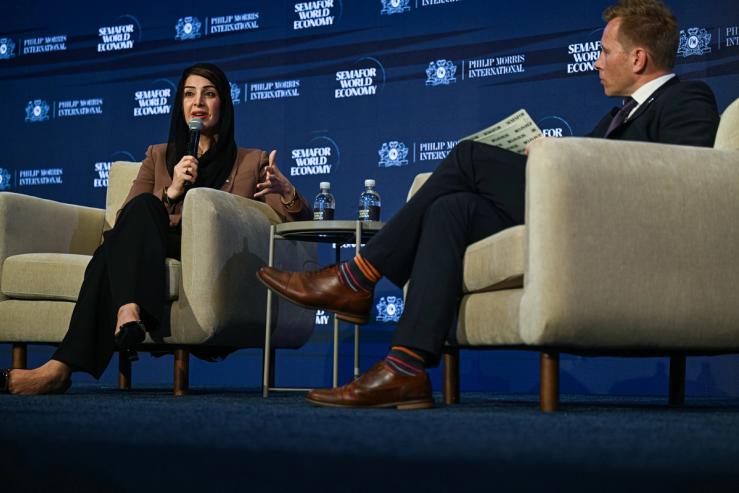
The Strait of Hormuz should not be under anyone’s control, and reopening it as a free and open waterway is the UAE’s top priority in any security agreement between Iran and the US, a UAE official said on Wednesday.
The emirates will also not accept an agreement that “does not actually put a clear and final conclusion to [Iranian] missile and drone technology,” Reem Al Hashimy, the UAE Minister of State for International Cooperation, said at Semafor World Economy.
She added that Iran’s naval and uranium enrichment capabilities need to be addressed as well, reiterating the UAE’s position.
“Nobody should control the Strait of Hormuz. That’s the whole point. International passageways are a public good,” Al Hashimy said.
The UAE dealt with a barrage of some 2,800 missiles and drones from the time the US-Israel war on Iran began on Feb. 28, and the Strait of Hormuz remains choked off.
Al Hashimy noted that nearly a third of global fertilizer exports and a quarter of its oil and gas come from Gulf countries, with much of it relying on the strait for passage to international markets.
“What is far more important to us right now is highlighting that this is not a regional issue, that the Strait of Hormuz and the continuous weaponization of that strait is impacting everybody you know,” she said. “You’re going to feel that impact if you haven’t already.”
Economic ripple effects from the war are raising the risk of global recession, but the sharpest slowdown will be felt by Gulf economies, according to the International Monetary Fund’s 2026 forecast.
Al Hashimy said the war has also revealed “fault lines” in the strength of the Gulf bloc of nations, which includes Kuwait, Saudi Arabia, Qatar, Oman, Bahrain, and the UAE.
“It has been an eye-opener for us to realize not just different capabilities across the Gulf, but also different orientations across the Gulf,” she said, without providing specific examples.
Prior to the war, the UAE and Saudi Arabia had been in a diplomatic rift as the Gulf’s two largest economies were openly at odds after the collapse of their coalition in Yemen. The public sparring was the sharpest between Gulf countries since the embargo of Qatar ended in 2021, but has been set aside during the war.
Al Hashimy reiterated the UAE’s commitment and relationship to Israel, normalized through the Abraham Accords in 2020, alongside Bahrain. “I see us continuing to work closely with them about how we avert some of the bigger challenges that our region faces,” she said.