




Andy’s view
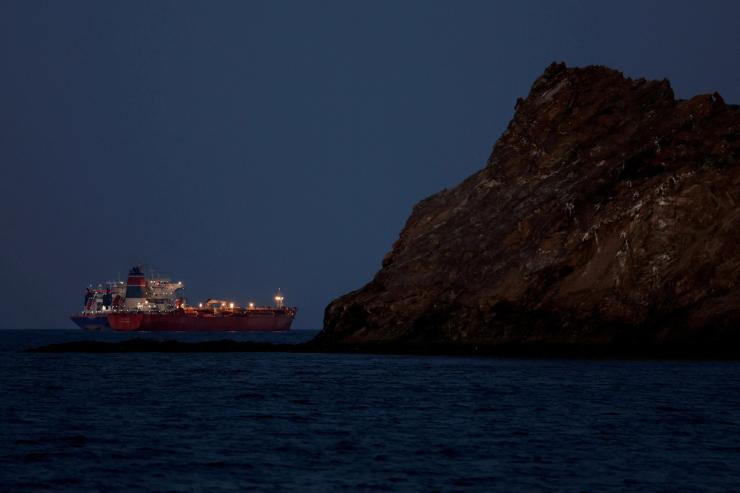
Iran’s closure of the Strait of Hormuz — and its efforts to set up the “Tehran Toll Booth” to collect shipping fees — underscore the perils of complacency. US war planners either didn’t see the blockade coming or underestimated the risk; economies around the world have few buffers to absorb the energy shock; and commodity markets have been thrown into upheaval.
Yet beyond the immediate chaos it has triggered, Hormuz should also be a wake-up call. A far bigger crisis is on the horizon — one for which global businesses are hopelessly unprepared.
China has for years been rehearsing a blockade or invasion of Taiwan: The island is the source of 90 percent of the world’s high-end semiconductors, the devices that power smartphones, guide precision missiles, run modern cars, and are the brains of AI.
US Treasury Secretary Scott Bessent says Chinese military action would trigger an “economic apocalypse.” Japanese Prime Minister Sanae Takaichi believes it would constitute an “existential threat” to her country, since Taiwan sits alongside vital shipping lanes. Countries as far afield as Europe have voiced worry, fearful of the risk to their economies.
The Rhodium Group research firm calculates that disruption from a blockade would cost the global economy $2 trillion, while Bloomberg Economics estimates that an actual shooting war — a real possibility if the US Navy started escorting vessels to break a blockade — would cost $10 trillion, or 10% of global GDP. That would plunge the world into a 1930s-style depression. In reality, the cost of such a move would be incalculable: So much of our modern world runs on chips produced in Taiwan that innumerable products and services, big and small, would grind to a halt.
Silicon Valley, in particular, needs to draw lessons from the closure of the Strait of Hormuz.
Over the years, US tech giants have stubbornly resisted efforts to diversify their chip supply, prioritizing short-term profits instead. That’s left them vulnerable to a crisis that could crash the AI boom, destroy the S&P 500, and cripple the US economy. A New York Times investigation showed that tech executives have treated the Taiwan problem as an afterthought; a 2022 study showed their firms would have enough semiconductors on hand to keep going for only a few months before breaking down. Global manufacturers in just about every other industry, from autos to medical devices, are similarly unprepared.
Taiwan is at the apex of a dilemma that the global economy seems unable to come to terms with: The very interdependence that underpinned the success of globalization is now the world’s chief source of risk. The COVID-19 pandemic, Russia’s invasion of Ukraine, and now Hormuz have demonstrated that companies, as well as countries, have yet to face up to the dangers of chokepoints.
If there is a saving grace, it is that when it comes to Taiwan, there’s still time.
Indeed, part of the reason China keeps practicing a blockade is to demoralize the island, which Beijing regards as a renegade province and is determined to “reunify” with the mainland — by force if necessary — so that it gives up without a fight.
Ely Ratner, a Biden-administration defense adviser, told me that Chinese leader Xi Jinping is “in a wait-and-see mode.” He argues (and most analysts agree) that Xi would prefer a peaceful solution, believing that time is on his side as China’s relative power increases and America’s ability and willingness to intervene in Taiwan declines. For now, says Ratner, the war in Iran has demonstrated to China a revolution is underway in military affairs, especially the integration of AI into warfighting — an area in which the US is “way far ahead” — and “China ought to be worried about that.”
Last week, Xi met the leader of Taiwan’s main opposition party, the China-friendly Kuomintang, which is holding up a $40 billion special defense budget to purchase US weapons. Next month, at a summit with President Donald Trump in Beijing, Xi will likely try to convince the US leader to weaken American military support for Taiwan and declare active US opposition to its independence; Washington currently states that it does not support a separate Taiwan. Xi’s goal is to undermine Taiwan’s president, Lai Ching-te, whom Beijing lambasts as a dangerous “splittist,” and add to doubts among the Taiwan public about whether Washington really would intervene to save the island in an emergency.
But Taiwan is holding out. Its people — who lived under their own autocrat within living memory — treasure their democracy, most identify as Taiwanese rather than Chinese, and they overwhelmingly want to maintain the status quo, where they have de facto independence but do not otherwise rock the diplomatic boat.
The next several years will be decisive.
Some analysts suggest that 2027 is the fateful year. Xi has declared he wants the military to be capable by then of taking over Taiwan, even though that doesn’t imply he’s actually planning to pull the trigger. Others believe that Xi will hold off on any action until 2028, an election year in Taiwan, hoping that the Kuomintang will retake the presidency and be open to negotiating a cross-Taiwan Strait settlement. If Lai wins a second term, all bets are off: That result could convince Xi that further delay would risk a permanent rift between Taiwan and the mainland. Any timeline is, in any case, opaque.
If a blockade does come, nobody should be surprised. In fact, it would be among the most telegraphed acts of war in history. Global investors, shippers, and insurers — indeed everybody with a stake in ensuring freedom of navigation through global waterways — should start planning.
The Strait of Hormuz crisis offers yet another opportunity to get ready.

Room for Disagreement
The US government is well aware that Taiwan represents the single most important point of failure in the global economy, and has invested significant sums in onshoring chip manufacturing. The Biden administration made $50 billion available through the CHIPS Act, while the Trump administration has sought to use tariffs to encourage domestic production. The use of carrots and sticks is working: TSMC, Taiwan’s chip giant, is now producing leading-edge devices in Arizona, and hundreds of billions of dollars in investments are in the pipeline. Still, the US will account for only 10% of global chip production by 2030, about the same as in 2020, when the drive to boost the domestic industry started picking up, according to the Semiconductor Industry Association.