




The Scene
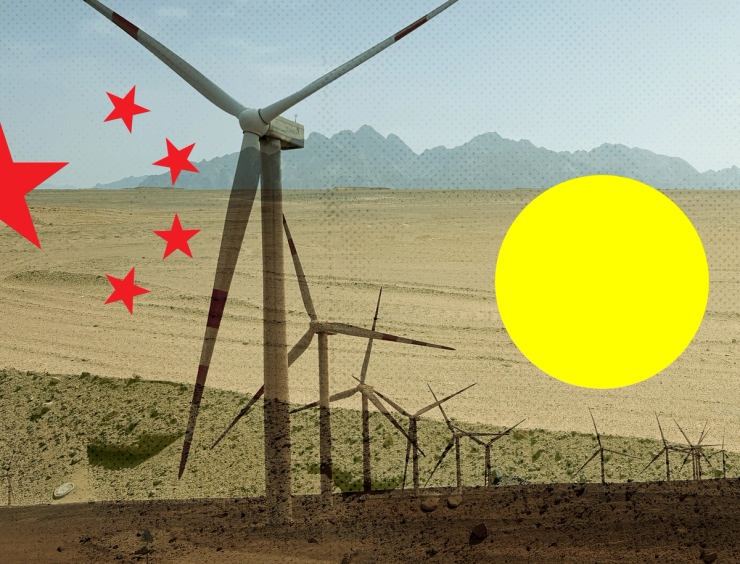
RAS GHAREB, EGYPT — In a vast stony tract of desert a three-hour drive south of Cairo, tucked between jagged black mountains and the glittering Gulf of Suez, a group of Chinese engineers is quietly rewiring Egypt’s energy strategy.
So far there’s nothing at the site other than a few mobile office units, a concrete mixer, and the occasional horned viper. But by next summer, this will be Egypt’s newest wind farm, a 200-megawatt project with a 25-year contract to sell power to the grid.
It can’t come soon enough.
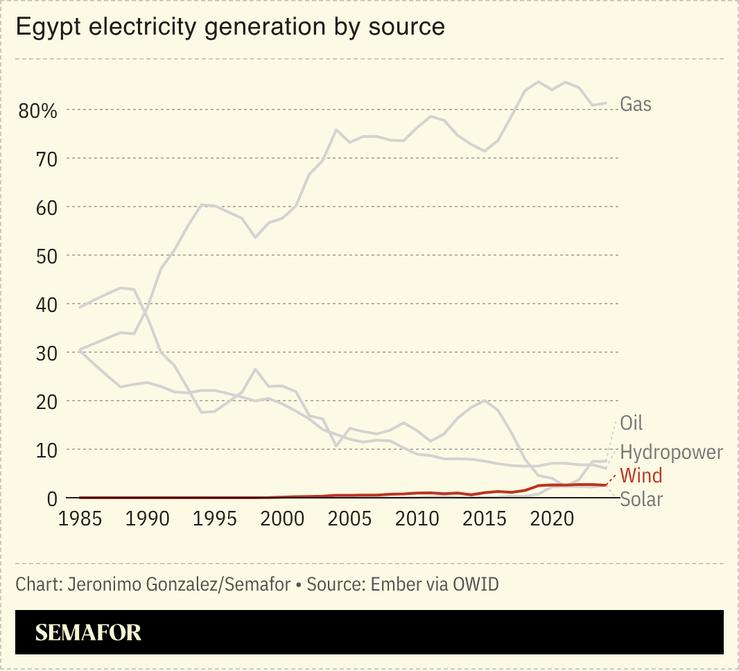
As the energy shocks from the Iran war reverberate worldwide, countries like Egypt are left dealing with the consequences. Gas supplies 75% of the country’s electricity. When the US and Israel began bombing Iran, the offshore Israeli gas field that is one of Egypt’s most important suppliers shut down and halted exports. Iran struck the massive liquefied natural gas export terminal in Qatar, with which Cairo had just concluded a long-term deal, and it, too, was taken offline. Forced to compete for limited LNG shipments, mostly from the US, Egypt’s energy import bill more than doubled from January to March. Electricity prices skyrocketed, and the government instituted strict rationing measures. In Cairo, a famously nocturnal city, shops and restaurants are now forced to close at 9 pm, with police brigades sweeping through the broad downtown avenues to urge everyone to go home.
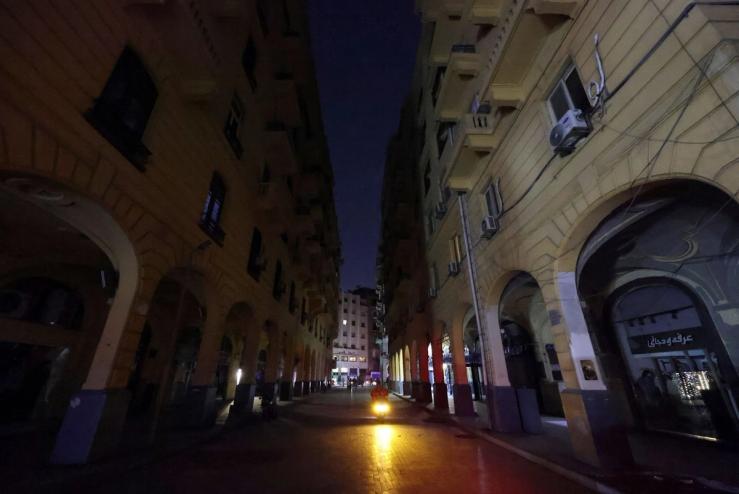 Mohamed Abd El Ghany/Reuters
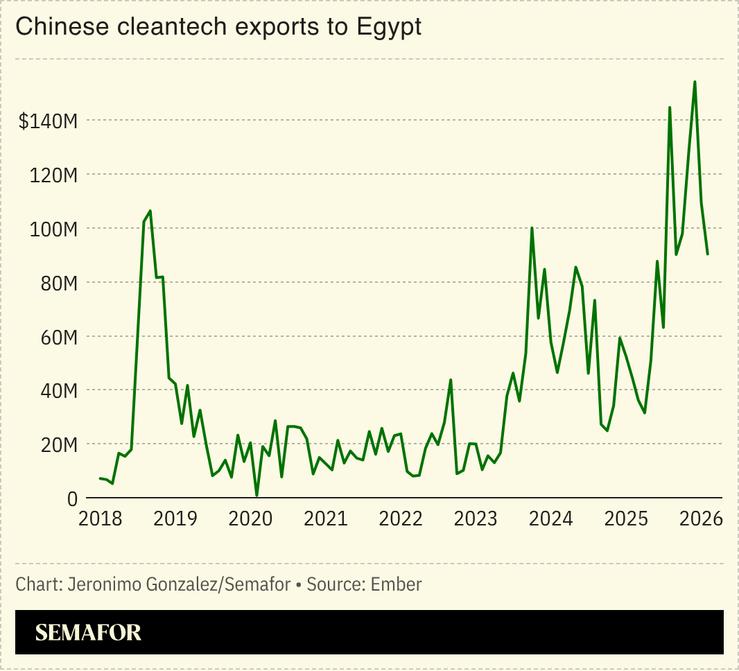
Now, Egypt — the most populous Arab country, chaotic but richly endowed with history, struggling to build a modern economy after decades of political turmoil — is joining a number of countries banking on Chinese clean technology, from the China-made solar panels blanketing Pakistan and Nigeria to the China-made EVs joining traffic in Brazil and Mexico. Egypt wants to increase the share of electricity coming from renewables in its grid from around 10% today to 45% in just the next two years. And it can’t happen without help from Beijing.
The new wind farm at Ras Ghareb is being built by the Egyptian developer Infinity Power, with financing from development banks in Europe and Japan. But it hinges on engineering services and turbine hardware from China, making it a crucial test of whether the world’s dominant “electro-state” can prove a more reliable partner for Egypt’s energy security than the US and its allies, countries it has mostly relied on up to now. It’s a step forward in China’s drive to re-power the entire Global South — and a sign that the shift to renewables could happen faster than many think, driven by the confluence of war in Iran and massive Chinese industrial capacity.
“If it were Europeans working on this project, you wouldn’t have a project at all,” Omar Nagi, a former Siemens manager who now helps oversee Infinity Power’s wind projects, said while looking out at the new site. “With the Chinese, you have a project.”

Tim’s view
No matter what happens in the Strait of Hormuz, one legacy of the Iran war will have been to lay bare the dire need for energy-importing countries to build new buffers from volatile global markets. No country is better positioned than China to thrive in that environment. As the supplier of more than 70% of the world’s clean energy hardware, the leading “electro-state” will move quickly to capitalize — both financially and geopolitically — on surging interest from countries like Egypt in breaking their long-term dependency on fossil fuel supply lines that can be severed or experience turbocharged pricing with little notice, outside their control.
Dependence on Chinese supply chains comes with its own risks, and “the type of power that a country can exercise through its dominance in the production of renewable energy hardware is really untested,” said Ilaria Mazzocco, deputy director for Chinese business and economics at the Center for Strategic and International Studies in Washington, DC. Still, she said, “this isn’t going to work in the same way as oil and gas. Imagine China blocking solar panel exports — it just won’t have the same shock on energy markets” as closing the Strait of Hormuz.
Partnering with China on renewables can bring lower prices, better customer service, and investments in local factories. Beijing and Cairo are “fully aligned about what’s really needed to upgrade the sector here in Egypt,” said Diaa Elsherbiny, an energy policy official in the Dutch embassy in Cairo with extensive experience in Egypt’s renewables sector. And when it comes to investment incentives, ranging from tax breaks to cheap land, he said, “everything is on the table.”
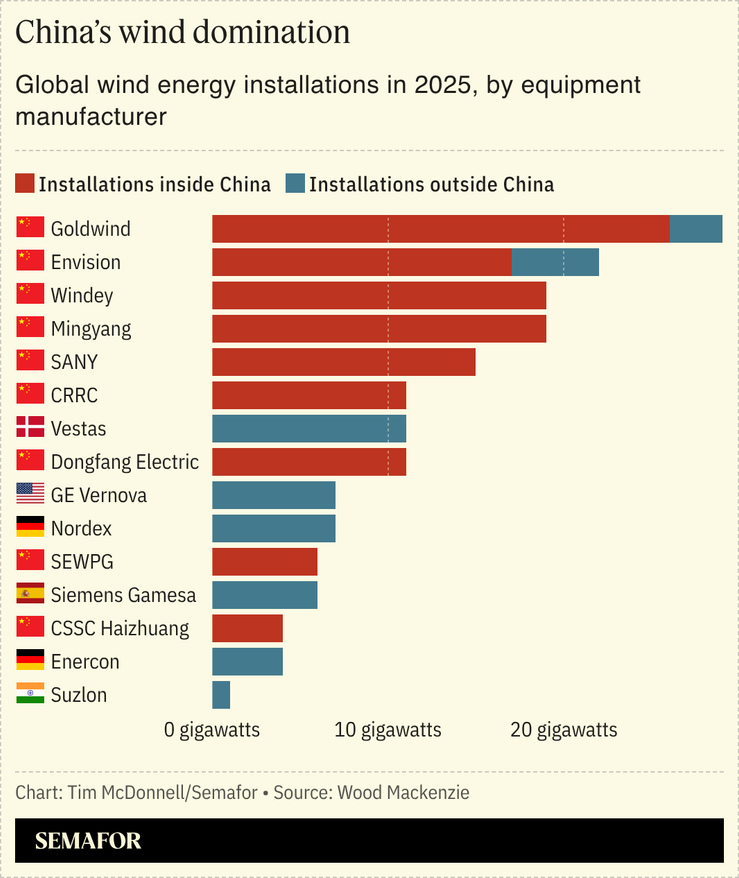
When Infinity Power began planning its first from-scratch wind farm in Egypt — it acquired an already-built one down the road in 2023 — it looked at bids from a range of European and Chinese suppliers, the company’s co-founder and chairman Mohamed Ismail Mansour said in an interview from his 15th-floor Cairo office with sweeping views of the Nile. While the Europeans’ offers — including Vestas, Siemens, and others — ranged from about $980,000 to $1.2 million per megawatt, the Chinese manufacturer Goldwind was able to offer a similar product for less than $800,000, Mansour said.
“That basically killed any argument,” he said, even though Infinity Power’s backers at the European Bank for Reconstruction and Development had pushed for European suppliers. “The quality is great, the service is good. It’s a no-brainer.”
For China, the partnership comes at an opportune moment. Clean energy projects produce roughly one-tenth of China’s GDP. But the domestic renewables market is “getting tougher and tougher” because of cutthroat competition and vanishing government subsidies, said Qu Jinwei, the top executive in Egypt for PowerChina. The Beijing-based engineering, procurement, and construction company with 130,000 employees building renewable and hydro energy projects in more than 100 countries is constructing the Ras Ghareb wind farm on Infinity Power’s behalf. International expansion offers a lower-resistence path to growth for Chinese clean energy companies — and a chance to outcompete the US in the global economy: China now earns more from exporting clean tech than the US earns from selling fossil fuels. Exports to Africa, in particular, are booming.
Egypt’s ability — with Chinese assistance — to reengineer its power sector could provide a template for the dozens of countries across the developing world that have been hit hard by the war in Iran.
“There’s a global interest in making sure countries like Egypt make it,” Rachel Kyte, the UK’s special representative for climate, told me after making her own visit to Egypt this month. “They’re in a difficult neighborhood, but they have the potential to be a green manufacturing base for the world if they get their energy security sorted out.”

Know More
Infinity Power traces its origins to Mansour’s privileged youth. A scion of one of Egypt’s wealthiest families — whose holdings include the local franchises for General Motors and McDonald’s — Mansour grew up competing in show horse events in Europe, where he saw solar panels for the first time.
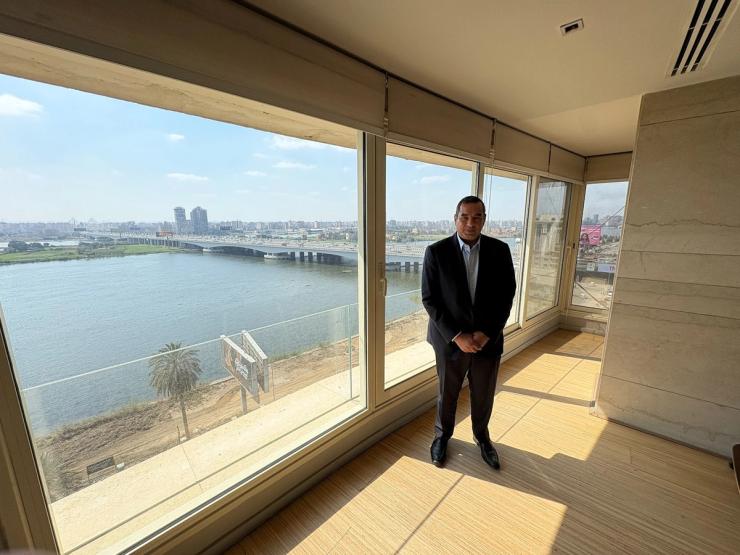 Mohamed Ismail Mansour. Tim McDonnell/Semafor
During the Arab Spring revolts of the early 2010s, Cairo was routinely racked by blackouts, and Mansour teamed up with an architect friend to experiment with rooftop solar on houses. In the years after Abdel Fattah el-Sisi seized power in a military coup, Mansour and his partner took advantage of newly implemented alternative power incentives to build the country’s first large-scale solar farm. Other projects and acquisitions followed, and what started as one 50-megawatt project is now one of the largest renewable energy portfolios in Africa, with 1.3 gigawatts of wind and solar in operation across Egypt, Senegal, and South Africa, with a target to have at least 10 gigawatts operating by 2032. (Infinity Power, a privately-owned joint venture between Mansour’s Infinity and the UAE’s Masdar, declined to disclose revenue figures.)
Along the way, the company began to shift from using mostly German-made solar panels and inverters to Chinese ones, which were both cheaper and tended to perform better in roasting Egyptian desert conditions, Mansour said.
Now, as Infinity Power applies the same logic to its wind portfolio, choosing Chinese suppliers is not just a question of improving the project’s profit margins, Mansour said: Egypt’s old renewable energy incentives have now been phased out, and the power price offered by the government — only a few cents per kilowatt-hour — is simply not viable with more expensive European equipment. Between the low offtake prices and high global interest rates (renewables projects are more reliant on debt than fossil-fuel equivalents), the rate of return on projects like the Ras Ghareb wind farm is too low to appeal to most rival Western project developers, he explained.
But he sees that as an opportunity to grow where others are hesitating. “I always say you take dollars to the bank, not percentages,” he said. “Little bits and pieces add up. It’s better to do something than to do nothing.”

Room for Disagreement
The odds are stacked against Egypt. The country faces a nearly maxed-out grid not set up to entice private investment; state regulations that compel power producers to sell electrons to the state-run grid operator at rock-bottom prices; a chronic shortage of hard currency and a deep-seated aversion to taking on more sovereign debt; and the persistent perception that it is a high-risk market meriting high interest rates. Entrepreneurs across many sectors in Egypt also routinely face off against military-owned enterprises, which the International Monetary Fund and other observers have flagged as a major impediment to growth. And while the desert corridor that government planners have chalked out for major new renewables projects near the Suez Canal has terrific wind speeds and little competition from other land users, it is among the world’s most high-traffic routes for migratory birds.
A spokesperson for the Ministry of Electricity declined to answer detailed questions on these issues but said in a statement that “renewables can help meet Egypt’s development, growth, and energy consumption needs, allow us to produce more of our electricity from our country’s rich solar and wind resources, and enhance our energy security.”
There are some upsides to the Egyptian government’s firm grip on the electric grid, Mansour said. For one, having a sovereign customer, rather than selling to another private company, helps improve the financing terms Infinity Power can attract (even if the sovereign is a troubled one like Egypt). And in Egypt’s electricity system, the biggest industrial power consumers effectively subsidize shared grid costs for the benefit of low-income households; if renewable projects could sell super-cheap power directly to heavy industries, retail power prices would inevitably rise, “which is not a dynamic we want to deal with right now,” he said.
For China, meanwhile, there’s a risk that the global expansion of manufacturers like Goldwind could eventually backfire for the country’s “electrostate” strategy by diluting what is today a highly concentrated supply chain, Mazzocco of CSIS said: “The really interesting question moving forward is how the government will position itself on the increasing outflow of Chinese foreign direct investment.”

The View From China
As companies like PowerChina look for more opportunities overseas — Ras Ghareb is PowerChina’s third wind project in Egypt — they’re now facing different forms of competition, Qu said. First, to compete against other engineering firms for skilled workers and managers, PowerChina has had to step up its salaries and packages for in-country accommodation and other benefits. And as the number of new projects cropping up — especially across Africa and the Middle East — still outpaces the company’s resources, it is becoming more selective about who it does business with. For Qu, the pipeline of future projects that Infinity Power and other developers have already locked in with the government is proof enough of the opportunity in Egypt. And in general, the war in Iran could be advantageous for Egypt, the UK envoy Kyte said, if investors begin to see it as a safer haven for capital that might otherwise have gone to the Gulf.
One thing Qu isn’t worried about is competition from European or US rivals: Because Chinese engineering contractors have privileged access to upstream Chinese suppliers like Goldwind, there’s just no way others can beat the deals they can offer.
“When it comes to renewable energy, I don’t want to use the word ‘dominance’ or something,” Qu said, “but the world is really relying on China.”

Notable
- The Iran war could pose a major political setback for Beijing, the Columbia University scholar Zongyuan Zoe Liu argues in Foreign Affairs. The war threatens China’s core strategic interests, she writes, “not because of acute dependence on Middle Eastern hydrocarbons but because an increasingly volatile Washington is destabilizing the global order on which Beijing depends.”
- Europe’s reliance on imported fossil fuels “has become one of the critical vulnerabilities of our economy,” Frank Elderson of the European Central Bank writes in the Financial Times. The recurring price shocks of the past few years have forced Europe to transfer huge sums of capital outside its borders for no lasting benefit, he argues.