




The News
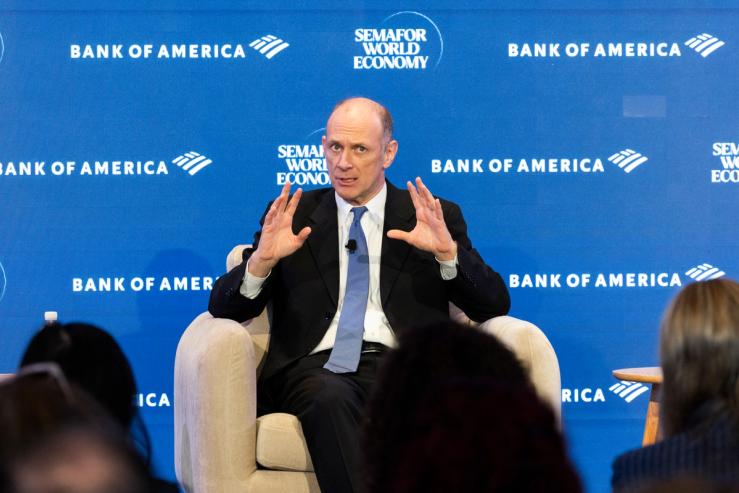
A prolonged conflict in the Middle East would reduce the chances of a US interest rate cut this year, Austan Goolsbee, president of the Chicago Fed, told Semafor World Economy on Tuesday.
Goolsbee said he was concerned that the potential inflationary impact of the energy-price shock caused by the war might take hold before policy makers could be sure that the effect of higher tariffs on consumer prices had worn off.
“That’s a dangerous, slippery spot to be in,” he said in Washington, DC. “The longer this inflation disruption goes, the more likely it is that the appropriate rate cutting would be put off.”
Before the US attacked Iran in late February, Goolsbee said, “I was on the more optimistic side that there would be more than one — multiple rate cuts — in 2026. I just wanted some evidence that inflation was headed back down to 2%, that the tariff inflation was actually going to prove transitory.”
The Fed is seeking to steer a course between its two mandates — full employment and low and stable inflation of around 2%, he said. The war in Iran complicates that effort by potentially slowing growth and stoking inflation at the same time, outcomes that would call for opposite policy responses.
Goolsbee said the energy shock is likely to have a bigger impact on growth than on inflation if higher prices prompt consumers to reduce their spending, which has been the driving force of the US economy.
Nevertheless, inflation remains a concern. “We need to be extremely careful,” said Goolsbee, who is not a voting member of the Federal Open Market Committee this year. “Any time inflation is above the target for an extended period, you’re already in a danger moment. We’ve been above the target in the US for five straight years.”

Know More
Goolsbee said that Fed policy makers will ignore pressure from the White House to cut interest rates. “It doesn’t say anything in the Federal Reserve Act about ‘make the White House happy, make the stock market happy.’”
The Fed held its benchmark interest rate steady for the second straight time at its March 17-18 meeting after cutting it three times in the final months of 2025. Minutes of the meeting, released last week, showed that the “vast majority” of Fed officials thought progress on inflation could be slower than expected, in part because of higher oil prices.
President Donald Trump has repeatedly threatened to fire Fed Chairman Jerome Powell, saying the Fed was too slow to reduce interest rates. In January, the Justice Department launched a criminal investigation into Powell over his testimony to Congress about a project to renovate the Fed’s headquarters. A judge later quashed two subpoenas stemming from the probe, saying the government had offered no evidence of a crime.