



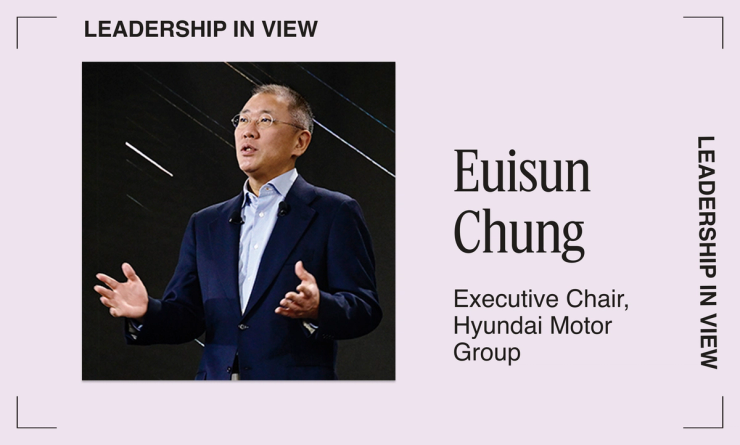

Leadership in View
The global economy is entering a period in which many of the most consequential decisions are being made inside companies rather than governments. From supply chains and energy systems to the future of mobility, global CEOs are navigating forces reshaping the world economy in real time.
I recently sat down with one of the leaders helping shape that future. Euisun Chung, Executive Chair of Hyundai Motor Group and a member of the Global Advisory Board of Semafor World Economy, leads one of the world’s largest and most technologically ambitious industrial companies, spanning automotive, robotics, hydrogen energy, and advanced manufacturing.
Our conversation explores Chung’s vision for Hyundai and how the company is navigating geopolitical fragmentation, expanding investment in the United States, and preparing for the next era of robotics, hydrogen, and mobility.
The Interview
Q: Hyundai Motor Group has pledged to invest $26 billion in the US through 2028. Why are you betting on the US right now?
A: The US is a core strategic market for Hyundai Motor Group. Our long-term confidence is reflected in our US investment strategy and the $26 billion commitment in America through 2028 that we announced last year. Changing domestic and global dynamics are something we all have to navigate, and we are well placed to do so thanks to our resilience and flexibility. This is in Hyundai Motor Group’s DNA.
We have invested around $20.5 billion in the US since Hyundai entered the market four decades ago. We are reinforcing that commitment with further investments that highlight our stategic focus, such as our software-defined manufacturing excellence at Hyundai Motor Group Metaplant America (HMGMA).
Shifting geopolitical situations today reinforce the importance of our agility. By integrating our US operations deeply into our global strategy – including advanced manufacturing and job creation – we can respond flexibly to changing conditions while delivering the highest-quality products and services for our customers. This is part of our promise.
We’re investing for American communities, too. The Group’s US presence supports more than 570,000 jobs today, and through our Hyundai Hope on Wheels charity we’ve donated more than $300 million to help children and families affected by cancer across America. For us, our US operations are a foundational part of Hyundai Motor Group’s long-term resilience and sustainable growth.
Q: Hyundai Motor Group has taken robotics from the lab to the factory floor. How important is robotics to the future of mobility?
A: Robotics and physical AI are central to Hyundai Motor Group’s evolution beyond mobility. This is our vision and we’re aiming to achieve this by partnering humans with co-working robots, all powered by advanced AI.
We announced our human-centered AI Robotics Strategy in January at CES, and we’ll deploy Boston Dynamics’ Atlas humanoid robots on sequencing processes at our manufacturing facilities by 2028, as well as producing up to 30,000 Atlas units per year by 2030.
Our human-centric focus is also for our customers. As their needs evolve, we see robotics and AI playing an increasingly important role in delivering manufacturing excellence and ultimately the highest-quality products for them.
We’re leveraging our capabilities across R&D, software and AI, design, and advanced manufacturing to reinforce our global leadership into the next era.
By connecting innovation with practical applications, Hyundai Motor Group is building a foundation where, in partnership with humans, robotics and AI enhance productivity and quality as we expand beyond mobility.
Q: How is Hyundai Motor Group competing in a changing global environment?
A: The global market is becoming more segmented – that’s the reality. The broader challenge is that customers, regulations, and supply chains are fragmenting by region. We are navigating a changing global environment with a strategy grounded in flexibility and resilience. Today’s landscape is shaped by evolving trade, energy challenges, and industrial policy that requires us to be both globally coordinated and locally responsive.
Our approach combines global expansion with localized agility. We build distinct competitive positions in each region we serve. It gives us the flexibility we need to adapt as conditions change.
We’re committed to this strategy with our manufacturing facilities in Korea, HMGMA ramping up, and expanding hybrid production at our US manufacturing sites. Our new production bases in India and Asia Pacific are also examples of this. This is how we stay relevant and face competition. In fact, we welcome competition. It keeps us pushing to innovate.
Ultimately, uncertainty does not change our approach, it sharpens it. As a top three global automaker we sell more than 7 million cars per year across the Hyundai, Kia and Genesis brands. We have sales networks across nearly 200 countries and 16 manufacturing facilities worldwide. Our competitiveness is built on quality, brand trust, and a customer-centric mindset.
Q: What’s behind Hyundai Motor Group’s strategic bet on hydrogen?
A: Globally, energy demand is rising significantly, from data centers to AI infrastructure and electrified transport. Energy security is an increasingly important topic we all have to face, and at Hyundai Motor Group we see huge potential in hydrogen as a solution to the world’s energy challenges.
It’s also a core pillar of our long-term vision for a sustainable future. That’s why we have centered our HTWO business brand around establishing a full hydrogen ecosystem – and we are addressing challenges across the value chain from supply to storage, transportation, and utilization. We believe hydrogen can play a key role in the global clean energy transition.
I think a lesson we can all agree on is that carbon reduction is a responsibility for humanity and our future generations. We have committed to reaching our decarbonization goal of net-zero emissions across all our operations. That means not just how we build cars, but how we source materials, power our plants, and even recycle vehicles.
In terms of mobility, we see hydrogen as a complementary clean technology alongside our full EVs, giving our customers choice. We’re building in optionality. That’s how you compete in an uncertain energy transition.