





Ben’s view
In 1980, Ronald Reagan defined the basic test of late 20th-century politics. Voters, he said, should choose between candidates based on the question, “Are you better off than you were four years ago?”
Today, the predictive power of that question has flipped. The party you vote for is indicative of how you feel about the economy, rather than vice versa. Polling by Semafor’s partners at Gallup showed Republicans’ confidence in the US economy improving 65 points on a 200-point scale in the week after the 2016 election; Democrats’ outlook rose 81 points after Joe Biden’s inauguration. The figures speak to a broader point: Through a turbulent decade of global politics, traditional, empirical economic measures have broadly failed to predict citizens’ feelings about wages, jobs, and well-being.
 Jared Oriel for Semafor
Even before the Iran war, leaders faced rising anger over the state of their economies, even as they tried to persuade citizens that, actually, things have rarely been better. The US continues to lead through one of history’s great global economic booms, powered by two revolutionary technologies, fracking and artificial intelligence. Real wages have grown, while inflation-adjusted rents have flattened. And yet the pitchforks appear to be out for politicians, corporate titans, and leaders more broadly. Maybe inflation is driving anger. Maybe it’s war or inequality. Maybe it’s the terrifying pace of change. Whatever the reason, people no longer feel like they are thriving and the percentage growth of people working in real, fulfilling jobs has lagged.
How should leaders pilot this flight in which the instruments no longer detect the emotional landscape? Our partners at Gallup have spent decades testing some of these provocative, alternate ways of seeing the world. What they’ve found reveals surprising trends in global growth.
There is more meaningful employment in emerging economies in the Gulf and South Asia, and thriving workers in Latin America. The data show a large percentage of workers don’t feel productively employed in the great global powerhouses of China and India. And perhaps most important, it offers a glimpse at the secret of enduring US success amid growing challenges: a persistent culture of ambition.
What follows is Gallup’s analysis and Semafor’s interpretations of that data — and of what it suggests about a shifting world economy.

The Indicators
Real Jobs
To gauge growth, look at the share of the population pursuing careers rather than just trying to make ends meet.
 Jared Oriel for Semafor
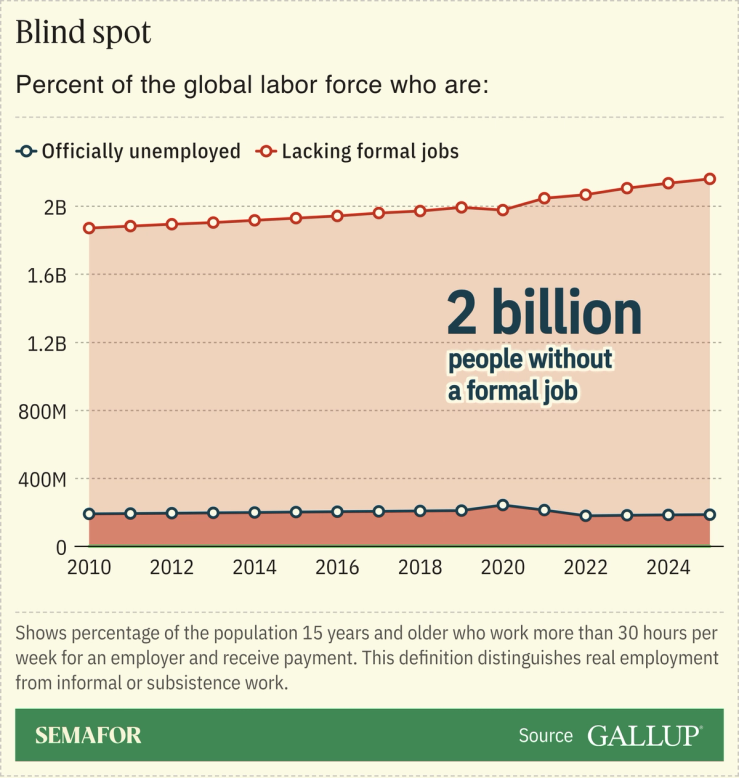
Current global jobs numbers peg unemployment at only 5%, suggesting that almost everyone who wants work has it. But that figure includes people who are just scraping by with informal jobs, “gig work,” and other ways of earning money.
Gallup strips out the roughly 2 billion people worldwide who are informally employed. Measuring the percentage of people over age 15 working at least 30 hours a week in full-time, formal jobs puts that global unemployment number closer to 50%. Focusing on what Gallup calls “gross domestic payroll to population,” or GDP2P, reveals a workforce actually pursuing careers and striving for upward mobility.
Core finding: The growth in formal employment in the US, China, and western Europe has flattened, while the share of rewarding work in emerging economies in Asia, the Gulf, and eastern Europe is improving.
View from the US
The US has hit a ceiling. For nearly two decades, the percentage of people 15 or older working full time for an employer has been stuck in a loop, bouncing between 42% and 46%. The old economic engine of “more people equals more output” has stalled, squeezed by a triple whammy — an immigration crackdown, a falling birth rate, and a manufacturing job boom that never arrived.
Even US Federal Reserve Chair Jerome Powell admitted this March that the country is facing something unprecedented: a labor force that simply isn’t growing. While official job numbers show most Americans working, Gallup’s data shows half the population without formal employment.
View from Asia
The percentage of people with formal employment in China soared from 25% in 2011 to a 42% peak in 2022, when the country’s post-pandemic economic engine roared back to life and state-sponsored enterprises kept payrolls full to ensure social stability. But as the economy has slowed, the property crisis has wiped out jobs, and formal employment among China’s younger generation has slipped, that number has dropped to 37%.
India faced a similar roller coaster ride, surging to 30% in 2018, then plunged to 17% following the shocks of demonetization and the pandemic. The rate clawed back up to 26% last year — but cracks in the growth narrative persist in the world’s largest democracy.
View from Europe
Europe is split. Job growth is flat (or down) across western Europe, but rising among eastern European countries. In the UK, waves of Brits are going abroad in search of better careers. Traditional powerhouses like Germany, France, and Italy are reckoning with rising energy and housing costs, declining manufacturing, and an aging workforce.
Jobs are growing in Poland, Croatia, and other eastern European countries that have benefited from a post-pandemic, tariff-fueled shift from China to nearshore manufacturing, logistics, and business services closer to home.
View from emerging economies
Vietnam is the standout performer in the new global economy, nimble enough to navigate a fractured global order, strong enough to resist superpower coercion, and open enough to capture the immense opportunities from growing South-to-South trade flows. Manufacturers are flocking to the country, escaping geopolitical uncertainty with a China +1 strategy. Vietnam’s experience underscores how growth in real jobs can translate into a positive outlook on the future.
Likewise, Saudi Arabia’s diversification has produced dramatic results: The percentage of Saudis with formal employment soared from 27% to 51% in a decade.
Do expect
- More job losses could fuel Republican defeats in US midterms
- Europe will resist a new China shock with tariffs, quotas, and minimum pricing
- AI may rewire workforces around the world
Don’t expect
- China’s property market to actually spur a wider economic collapse
- AI to wipe out jobs en masse — yet
- Governments to effectively usher in retraining or worker-protection programs
Quotable
- Chris Cocks, Hasbro CEO, told Semafor in March 2025: “If you think about where the next billion people are going to be born, the vast, vast majority of them are going to be born in Brazil, Mexico, Indonesia, India, not France or the US or the UK.”
- Paul Polman, co-founder of IMAGINE, told Semafor in November 2025: “[In Africa, there’s] a realization now that the help is not coming from outside, but they are in charge themselves.”
Thriving
To see what’s coming next, look at how people actually feel, not just what they do.
 Jared Oriel for Semafor
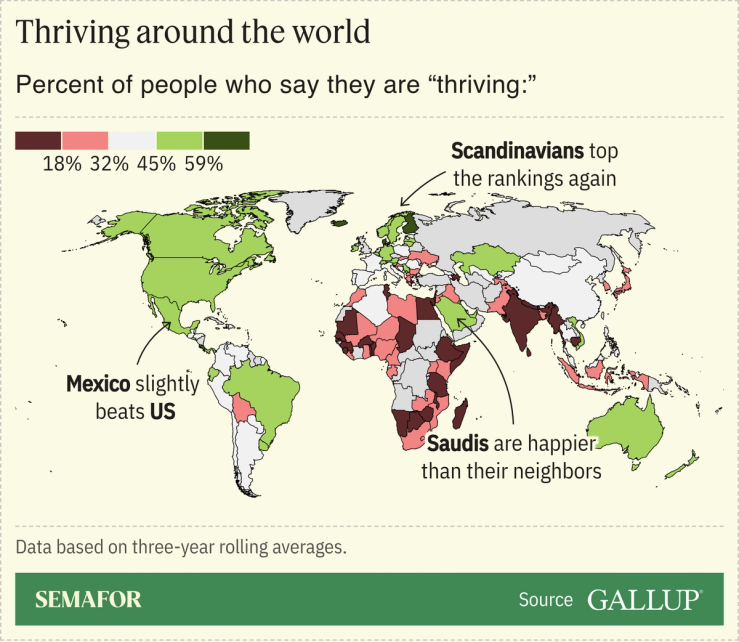
In place of incomes or economic output, Gallup’s “Thriving” measure tallies up the answers to a simple, powerful question: Rate your life today and in five years on a scale of zero to 10. A top rating is classified as thriving.
A country’s collective outlook can be a crystal ball for its financial future. When people feel secure today and optimistic about tomorrow, they take risks, start businesses, buy homes, and invest in their futures. In short, human emotion is a leading indicator. It also lets us track economic momentum — or a coming slowdown — before it shows up in official GDP. A drop, like during Brexit and the Arab Spring, signals instability.
Core finding: China’s workforce is growing more optimistic, if from a low base. American workers’ optimism has flatlined. A surprising bright spot: Latin America.
View from the US
It’s a truism that it never pays to bet against the US. The world’s largest economy has towering strengths, from the deepest capital markets to a vibrant innovation ecosystem. Yet, as the country’s fractious politics show, Americans are increasingly despondent. Affordability issues explain part of the apprehension; increasingly, young people have been priced out of the housing market, breeding a resentment that erodes faith in institutions — and in capitalism itself. For investors, the question isn’t whether the US is failing. It isn’t. But where does it go from here? The emotional malaise in the country, combined with a rising sense of optimism in emerging markets, may suggest a rebalancing is in the cards.
View from China
A third of China’s people are thriving, up from 10% two decades ago. But after a surge of economic optimism in the years leading up to the pandemic, the nation’s mood soured for the first time in over a decade. With job growth stalling, the ladder of economic mobility is starting to show cracks. If the optimism continues to slide, China risks falling into a “middle-income trap,” where growth stalls because the workforce is no longer striving for more, but simply trying to survive.
View from emerging economies
From Mexico to Guatemala, Latin Americans are feeling better about themselves and their future than ever before. A sense of thriving permeates a region with the world’s hottest stock markets — up 50% on average in 2025 — and strong financial inflows. A rising sense of well-being has accompanied economic reforms: Governments have responded to shocks over the past two decades from the 2008 financial crisis to the pandemic not with stimulus and handouts, which they can’t afford, but painful structural overhauls.
Do expect
- Emerging markets to build on last year’s 30% equity returns
- More rumblings about a “sell America” trend
- A softening of China’s growth targets
Don’t expect
- A huge Beijing stimulus
- The US affordability narrative to ease
- A quick comeback of the Venezuelan economy
Quotable
- David Rubenstein, chairman of Carlyle Group, told Semafor in January 2025: “The American Dream is alive and well in people who live outside the United States, more than sometimes people who live in the United States.”
- Per Franzén, CEO of EQT, told Semafor in October 2025: “There’s been a mindset shift where investors just say, even if I believe in that [US momentum], I still want portfolio diversification, so I don’t want to have all of my eggs in the US basket.”
Ambition
To see where a country is going, don’t just look at how hard people are working. Ask how much people want to achieve at work and whether they’re part of a culture of ambition.
 Jared Oriel for Semafor
Traditionally, a country’s productivity is measured by how many hours its workforce clocked. But that’s akin to looking in the rearview mirror — it tells you where you’ve been, but not where you’re going. Being “busy” isn’t the same as being driven.
If a country’s workforce is just “busy” without a sense of purpose, the economy can drag. When workers are highly ambitious — meaning they are engaged in doing what they do best — they dream bigger and take more risks. Couple that with clear roles, opportunities to develop and a chance to have a voice, and those systems convert human effort to productive output.
By measuring “gross domestic ambition,” Gallup’s metric can help predict when a country will see a surge in innovation, efficiency and economic expansion.
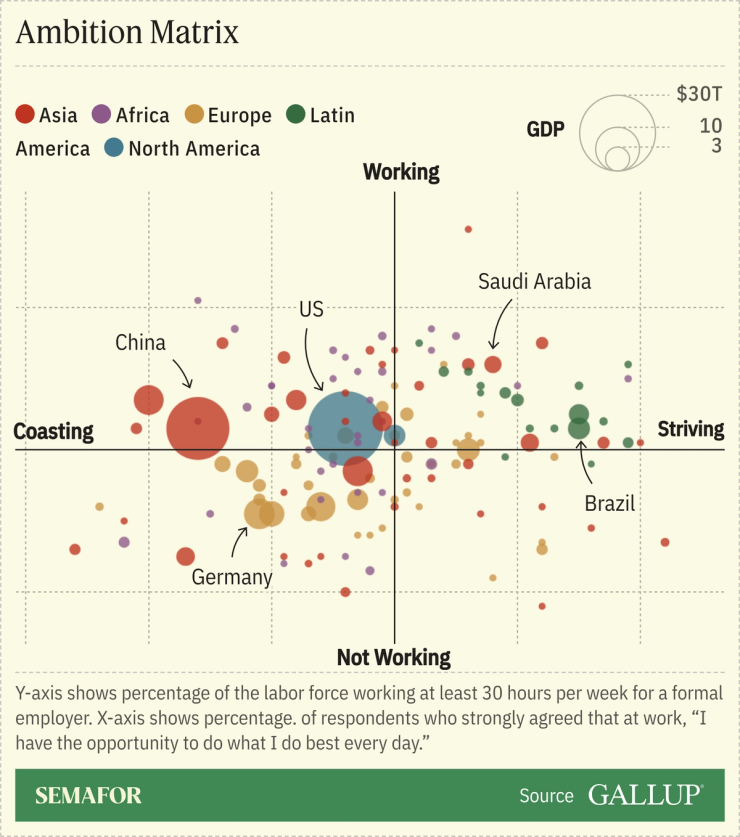
The US boasts, along with a handful of middle powers in the Gulf and eastern Europe, a culture of ambition — a common thread between countries whose economies are booming, despite other challenges.
View from the US and China
Despite the divisive partisanship washing over the US — and a universal sensation of economic unease — the country’s workforce continues to rank well above the global average in gross domestic ambition.
American workers aren’t just taking home a paycheck. They see their jobs as a way to build a future. And that has continued to keep the economy pumping, drowning out underlying stagnation: The Magnificent Seven’s market value exceeds the EU’s entire economic output. The US has 712 unicorns, far outpacing China (157) and India (69).
By contrast, the oft-cited poster child of productivity, China, ranks below the global average. In a country that coined the 996 workday (9 am to 9 pm, six days a week), only a fifth of workers feel well-utilized. That productivity paradox has translated into spikes in youth unemployment and burnout, and a drag on economic growth.
The question now is how the AI boom changes this calculus. As AI props up economic growth and productivity-maxxing companies downsize, will workers feel more or less engaged?
View from the middle powers
Western European workers are famously pampered in comparison to their transatlantic peers. Many French businesses shut down in August; the Dutch work a 32-hour week, while Austria, Denmark, and Germany clock in at 33 (China’s at 48). But even when they’re showing up for work, Europeans are mostly disengaged. Lacking a culture of ambition in the workplace has sapped the continent’s corporate energy, especially when coupled with heavy regulation: Europe produces relatively few unicorns, and is losing the global AI race, although it still dominates in a few specialist areas like chipmaking equipment.
View from emerging economies
Gulf countries including Saudi Arabia and the UAE also rank above the global average for gross domestic ambition, with high levels of job creation and workers who report that their employers are putting their strengths to use. Likewise, pockets of Latin America are benefitting from a greater culture of ambition, yielding higher levels of productivity and economic growth.
Do expect
- Strong US corporate performance driven by AI
- Latin America to continue to grow
- A potential Japanese boom as the “Takaichi trade” gathers momentum
Don’t expect
- China’s tech boom to slow
- Gulf countries to pull back on global investments
- Western Europe to come roaring back
Quotable
- Andrew Anagnost, CEO of Autodesk, told Semafor in July 2025: “We let them go home at night and say, ‘I feel good about what I’m doing,’ which matters a lot.”
- Chris Nicholas, CEO of Sam’s Club, told Semafor in October 2025: “Pay matters, but it’s the smallest part of the whole thing. The bigger part is the sense of community, the sense of development, the sense of growth, and that is, if you fix those things, your turnover drops.”