




The News
One of two American pilots detained in West Africa for months alleges that President Donald Trump administration’s quiet approach to his case has fallen woefully short.
The State Department has taken a low-key approach to the pilots’ detention in Guinea late last year, engaging with officials in Conakry behind the scenes while saying little publicly about the case.
Brad Schlenker, who has been stranded in Guinea for more than three months along with Fabio Espinal Nunez, told Semafor in an interview that the US government has been “useless” in helping them. “I voted for this administration because they were supposed to protect Americans,” he said.
A State Department spokesperson told Semafor that US officials regularly visited the men in prison and that Washington “remains engaged on this case.”
“The Trump Administration has no higher priority than the safety and security of Americans,” the State Department said. The White House added in a statement for this story that Trump “is always concerned about Americans detained abroad.”
The administration’s lack of public attention to the case has frustrated Schlenker. He told Semafor he has heard from people close to the situation, whom he declined to name, that “if someone from the State Department had simply called, if [Secretary of State] Marco Rubio or [Defense Secretary] Pete Hegseth or someone else just picked up the phone, we’d be out of here.”

Know More
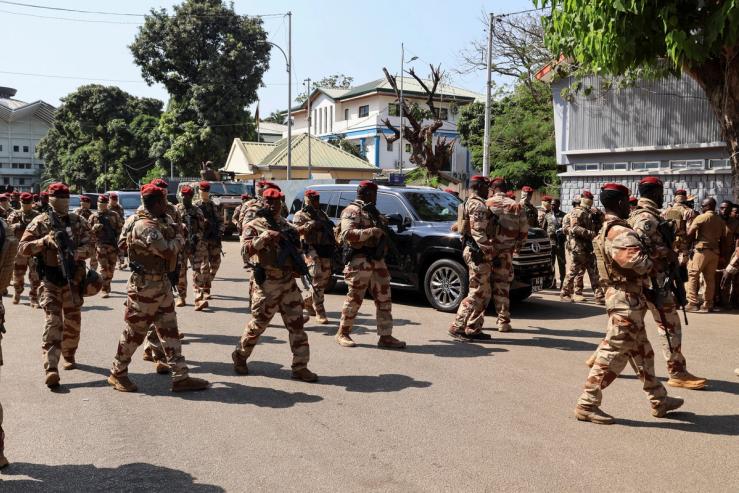
Espinal Nunez and Schlenker landed in Conakry, Guinea, for a fuel stop during a Suriname-to-Dubai charter flight in late December. On the ground, they were greeted not by a refueling truck but by dozens of heavily armed Guinean military personnel who took the pilots into custody on a series of charges, according to media reports.
The two were released on bail last month, required to remain in Conakry while awaiting trial.
Both the US and Guinea have strong incentive to take a low-key approach to the situation, according to Franklin Nossiter, an analyst at the Crisis Group focused on the Sahel.
Schlenker told Semafor that he thinks Guinea’s sought-after mineral resources “are weighing in on this situation,” prompting some of the light-touch US approach.
Guinea contains some of the world’s largest deposits of bauxite and iron ore, and the Trump administration has actively cultivated Conakry as a partner during a wider push to secure African mineral resources.
The two governments recently signed a bilateral critical minerals framework and are discussing a proposed railway from Guinean iron mines to the Liberian coast. That project is backed by Ivanhoe Atlantic — a group that includes several former Trump administration Africa officials — which has promoted it as an American-aligned alternative to the China-backed Simandou rail project.
Nossiter said Guinea is also sensitive to the possibility that the pilots’ case could get amplified publicly by anti-Western nationalists in the country who might frame it as a sovereignty violation at a moment when Conakry is already wary of internal dissent.
Unlike Mali or Burkina Faso, Guinea under President Mamady Doumbouya — who has led the nation since the 2021 coup — did not break sharply with the West, and has tried to navigate what Nossiter called a “middle path” that balances Washington, Beijing, Paris, and Moscow.

Step Back
The legal case against the pilots has shifted repeatedly since their arrest.
The initial searches of the aircraft appeared focused on finding drugs, according to Schlenker. Guinean authorities later brought charges of unauthorized landing and breaching national security — accusations the pilots dispute by pointing to radio transcripts they say confirm they received clearance to land.
Eventually, the pilots were told that Guinean authorities had determined that the Gulfstream IV aircraft the pilots were contracted to fly was likely stolen, and that its owner had a suspect background.
Schlenker insisted he and Espinal Nunez had no way of knowing any of that information: They were freelance pilots hired to fly a charter, he said, and the Federal Aviation Administration website had no indication of issues with the plane’s background.
The administration also has provided little information to Congress on the situation. The pilots’ home-state senators, from Illinois and New Jersey, sent a joint letter to the State Department in February pressing for action and further information. They did not receive a response, according to their offices.