



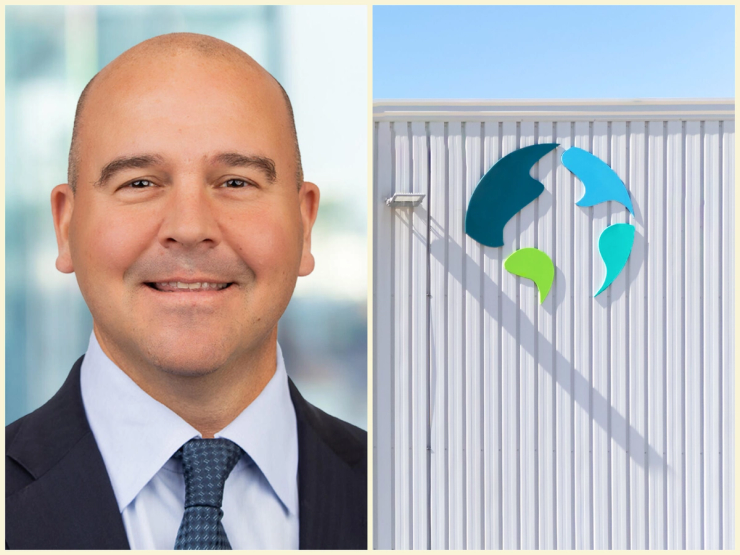

The Signal Insight
Dan Letter is in month four of his tenure as CEO of Prologis, the $130 billion REIT that manages 1.3 billion square feet of warehouses and data centers around the world. But, he says, it feels like the sixth year of a handover from Hamid Moghadam, the co-founder who spent four decades building Prologis into an S&P 100 company through whose properties more than $3 trillion worth of goods flow each year.
The reason is that Moghadam began the process back in early 2021, gradually giving Letter more responsibilities before January 1 this year, when his protégé became CEO and he stepped up to be executive chairman. It’s an approach to succession that few companies have tried — in part because they fear confusion about who’s in charge during the handover period.
Letter says Prologis avoided that trap because his predecessor worked to signal that a change was coming. Moghadam had seen too many other founders “mess up their legacy by staying too long,” he says, and told him: “Dan, if I wanted to be CEO, I would be CEO.”
Here’s how Letter describes the long handover, and where the logistics real estate leader thinks it can find growth in a turbulent global economy.
This interview has been edited for clarity and length.
Andrew Edgecliffe-Johnson: You succeeded someone who’d been CEO for decades. How did you define the task when you took over?
Dan Letter: I had the luxury of working for my predecessor for almost 22 years, and over the last five years we had a very methodical transition plan where he was essentially letting the leash out a little further every year.
Some people look at that and say, “Holy smokes, a five year transition?” But the reality was, I had proven myself on the deal making. I had proven myself on leading teams. And then it was a matter of taking on businesses that I hadn’t been focused on in my career. So, stepping into the role on January 1, I had a lot of confidence. I was very much a part of building and executing the strategy. So now it’s a matter of just doing that without Hamid in the room.
Very few companies get that kind of transition right. I think one reason is they fear a lack of clarity about who’s in charge. When you were taking on more responsibilities, but you weren’t yet CEO, how did you communicate that through the organization to make sure people weren’t working around you or working around your predecessor to get to the new boss?
If I think back to the last five years of Hamid and I working side by side, it was more nonverbal than it was verbal. He and I traveled around together a lot, but he wanted me to sit in the middle chair. He would sit on the side. He wanted me to conduct the town halls in all the offices that we would visit, so people would see that. I knew that the burden was on me to build that followership. You can’t be a leader without people following you, and you can’t tell people to follow you, and so it was on me to do that. So as we were transitioning out the prior executive committee [and] shepherding in my new leadership team, it was very clear to people who was making the decisions.
You talked about coming in with a clear idea of the strategy. How do you define Prologis’ strategy now?
There are really five engines for growth. We have our 1.3 billion square feet, and we have an 18% revenue [growth] opportunity by just churning through our leases. The second is our development business. We have a land bank of 14,000 acres, and we can [add] 240 million square feet by just building that out. Third is what we call strategic capital: we have about $65 billion of third party capital that we manage for sovereign wealth funds, pension funds, and others.
The fourth leg is our energy business. We surpassed one gigawatt of power generation in rooftop solar last year. One gigawatt is the electricity demand for the city of San Francisco, [but] that’s covering only 6% of our roofs globally so we have a huge runway for growth.
The fifth engine is data centers. We went through our portfolio and said, what land and which buildings are more suitable for data centers? And we have been poaching talent from the data center industry so we can do all of this in house. So we had the land experts and the construction experts, and we have this energy team because of our solar and storage business.
We’re in the middle of another supply chain shock with the war in the Middle East. How’s that showing up in your facilities?
We were at a conference March 1, which was the Monday after the attack, and we were sharing with investors how strong 2026 has been so far. 2025 was our second best leasing year ever, and in 2026 we were seeing customers continuing to lean in and make decisions.
So far, we have not seen much trepidation at all. Am I surprised by that? No. If you go back to the 2017 tariffs, when our customers really had to start ensuring they didn’t have any single point of failure in their supply chain, they had to think about diversification and building resilience. Then you look at Covid: it was a huge shock for our customers, and then it was the most robust period in any of their careers. And then another shock — interest rates increasing like they’ve [not done] in decades. Then geopolitical issues like war in Ukraine. Our customers see these as more features of today’s environment. They’ve built an endurance to deal with these issues, and they can’t just sit and do nothing, because when they’re working with us, they’re making five-year or 10-year decisions. [But] if this conflict goes on for months and months and months, and there’s $200 fuel, it’s anybody’s guess.
It sounds as though you’re trying to build a team that moves at speed and is responsive to customers. What you have found is most effective in doing that?
It’s all about execution. I have been impressing upon the team that we need to stay scrappy. Let’s not be a victim of our own success, Grit. I want to see grit coming. I don’t want to hear, “Oh, well, they said no.” I want to hear how many times did you get past that “No” and get creative. And I want to see that grit come in with every investment committee memo, for every investment, for every decision that we need to make. And then I think it’s really important for that empowerment to be really pushed as far down the chain as it possibly can.
What are the most critical parts of your role when you devolve that decision making?
The most important is to ensure that there’s a culture of transparency and safety, where there’s no surprises, and people that are accountable aren’t afraid to admit mistakes. They aren’t afraid to admit what they don’t know. I often say “I actually don’t understand this. Let me understand it better. I need to go learn this more.” And I think that the more we’re transparent that way, the more we’re going to hear, not about issues before they fester; we’re going to hear new ideas. We’re going to find that sixth [growth] engine from the field. The best ideas come from those interacting in the field.

Notable
- Prologis has struck a $1.6 billion joint venture with Singaporean sovereign wealth fund GIC to buy and build logistics facilities. The deal is the latest sign of developers pivoting toward specialized projects for customers such as Amazon to minimize the financial risk of building facilities on spec. Such “build-to-suit” projects accounted for 61% of Prologis’ development starts last year.