



The Signal Interview
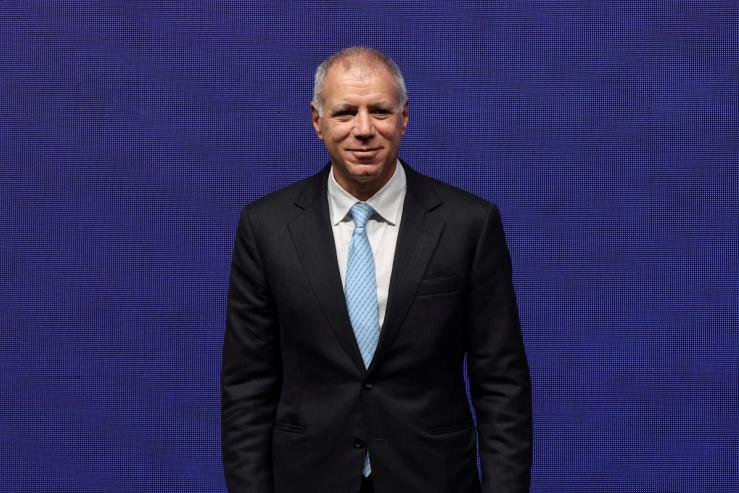
Georges Elhedery was hailed as a “safe choice” when global banking giant HSBC announced in July 2024 that it had picked him to become its next CEO. The former chief financial officer is an HSBC veteran, speaks eight languages, and has a reputation for being soft-spoken and methodical -- a sea change from the tumultuous tenure of his predecessor, Noel Quinn.
And yet, Elhedery has proved something of a radical, moving with surprising speed to roll out a far-reaching restructuring plan that included collapsing the bank’s complex matrix structure, reducing staff costs, implementing a sweeping AI program, scaling back investment banking in the West, and focusing on Asia and the Gulf.
Elhedery’s plan got off to a great start, beating earning predictions and sending HSBC shares soaring.
Then, on Feb. 28, the US and Israel began dropping bombs on Iran. The closure of the Strait of Hormuz choked off oil exports from HSBC clients in the Gulf States to HSBC clients in Asia — throwing Elhedery’s strategy of doubling down on both markets into tumult.
HSBC’s shares took a 15% hit after the conflict broke out. Elhedery says the bank will stay the course. HSBC, he declared, was born in China, has built strong relationships throughout Southeast Asia, and has operated in the Middle East for more than 130 years. “We are here for customers for good times and rough times,” he says.
This interview has been edited for brevity and clarity.
Clay Chandler: I want to talk about HSBC’s strategy and how you’re thinking about what’s going on in the global economy right now. But I wonder if we could start by inviting you to talk a little bit about yourself. You were born and raised in Beirut and educated in France as an engineer. How did you end up at HSBC?
Georges Elhedery: I spent my early years in Lebanon and moved to France for my studies. I had studied German also during my curriculum. I was looking for an internship in Germany so I studied engineering. But I didn’t find an engineering internship. I ended up finding an internship at a bank on the trading floor, and I got addicted. My first was at another bank in Japan. Then I moved to London for another bank. And that’s where I joined HSBC 21 years ago.
Is it true that you speak eight languages?
Well, I studied eight languages. Whether I speak them or not is for others to say.
You were appointed CEO 2024 and moved quickly to make some very big changes. You rolled out a very significant restructuring plan in about four months. How were you able to so quickly? And why the urgency?
I had spent 19 years in the bank. I had done more than eight jobs, worked in multiple geographies, operated in multiple businesses and functions. I’ve built an amazing network within HSBC colleagues and I’ve been building and taking feedback throughout these years. The consensus among everyone, from seniors to juniors, is that HSBC is a fantastic franchise with massive potential. But some of it has to be unlocked. There is this sense that we sometimes hold ourselves back or get in our own way because of historic complexity, historic bureaucracy. That needed addressing.
It was able to form a leadership team with a good view of what needed to be done and begin conversations with the board to start as soon as possible. Um, the momentum was good. We were growing, we were delivering record performance, profits, revenue growth, dividends. There is no better time to fix the roof than when the sun is shining.
In describing the plan, you’ve talked about changing how we do things, and changing what things we do. What’s the difference?
Let me start with what we do. It needs to matter for our clients. It needs to matter for our colleagues and it needs to matter for our shareholders and other stakeholders. And it only matters if we’re the best at doing it…So competitive edge is very important, and of course it needs to be areas where we generate the right returns for shareholders.
And we needed to focus on areas with the right growth opportunities, recognize and accept that there are some things that don’t meet those criteria. What we should stop doing is very important.
As for how we do things, the world is moving fast. Our customer’s needs and goals are evolving fast. And we need to move at their pace. And we’ve now put a moonshot effort with our generative AI strategy to be able to deliver for customers in the most personalized fashion in real time.
If we can deliver in real time superbly personalized, safe products and services. Then we are ready for the future. We needed to be simple, more agile, more automated. To have human judgment and human accountability where it matters. And we needed to be trusted.
HSBC has been known for having a culture of shared accountability, collective decision-making. But you’ve emphasized that, in order to be more agile, more decisions need to be made by individuals who are fully accountable for them.
HSBC is a very collegial organization. … Any individual making an important decision should be able to consult as many people around them as possible. Consultation, taking advice, taking feedback are paramount to getting to a good decision. But then ultimately what we want is that the decision and the accountability be taken by one individual who owns that decision and its outcomes.
What did you decide the bank needed to do more of?What did it need to do less of? You’ve emphasized the Middle East and Asia, especially China, as priorities. What are some of the things that you think the bank had to let go?
Well, first, what is happening today in the Middle East is terrible. We pray to see a speedy resolution. The immediate focus for us is the safety of our colleagues and our customers and the support we can give customers in these difficult times. We’ve been in the Middle East more than 130 years. We are here for customers in good times and rough times.
We strongly believe that for both Asia and the Middle East there are structural growth opportunities for the medium to long term that remain very strong. And our position as the powerhouse of Asia and the Middle East allows us to best serve our customers and deliver value for our shareholders.
The ASEAN economies have become very connected, very integrated, and we are seeing this in trade and investment. Asia buys Asia. These economies are upgrading, they’re innovating, they’re moving into advanced manufacturing, into technology. So collectively, we have a fantastic opportunity.
Do you see Southeast Asia and the Gulf States also creating new corridors of collaboration?
Yes, exponentially. We see it in the trade and trade financing opportunities. We are helping partners on both sides.
And what are you seeing in China?
China’s a very important pillar in, in our, in our overall strategy. We were born in Hong Kong and Shanghai 161 years ago. Connecting China with the rest of the world is muscle memory for us…But what we’ve been observing for the last decade is that Chinese companies are going international.
That could be anywhere—India, the Middle East, Europe, or the Americas. We are where our customers need us to be. So when our Chinese customers need us to support them in the outbound corridor, then we’re there to help them achieve their ambitions by going international.
A second major trend in the China economy is it’s less reliant than previously on infrastructure and real estate, and more reliant on innovation and advanced manufacturing. And, uh, these technologies are being exported. A third thing about China is that while domestic consumption remains weak, wealth in China has grown very fast. That’s a huge opportunity for a bank like HSBC, not just on the mainland but also in Hong Kong, which generates a third of our profit and is on track to become the world’s largest cross border wealth hub.
The Hong Kong stock market is in the midst of an IPO boom. Should HSBC be winning a larger share of that business?
We’re very pleased to see the recovery of the Hong Kong IPO market and for Hong Kong to regain its position as IPO center of the planet.
One of the decisions we took as part of the restructuring strategy was to shed our equity capital market activities in the UK and the US, recognizing that we haven’t been a top tier player in the space, while we doubled down on operations in Asia and the Middle East. But since 2025, we’ve been very focused on Hong Kong. Most of the IPOs that took place last year were IPOs that were mandated in 2023 or 2024. The mandates we have been winning in 2025, you will only see manifest in 2026 or 2027. So I would say let’s be a bit patient.
In late February, HSBC’s stock price hit a record high on the back of the strong financial results and the announcement that your restructuring plan is six months ahead of schedule. Then days later the US and Israel began bombing Iran. Your stock dropped about 15%. Are we headed for a long-term conflict, and if so, how does that affect your strategy?
We’re all very pleased about the share price but we don’t target share price, we target financial performance. In February, we set targets for return on tangible equity and for revenue growth for 2026, 2027, and 2028.
They’re ambitious. We think the bank can deliver 17% or better return tangible equity year after year as we did in 2025, and can continue growing its revenue because we’re sitting on these structural growth areas and we are investing to gain further market share.
What’s happening in the Middle East is tragic. There will be impacts from this war, and the longer the war lasts, the longer it will take for those impacts to be resolved.
And the impact will be felt beyond the Middle East. We’ll see shortages of oil LNG, LPG, cooking oil, gas, fertilizer. For any importing economy, it’ll be felt across Asia, in Europe, Latin America. We’ll feel it when we get into planting season and realize crops haven’t been as rich as expected. We are going to go through a rough patch.

Notable
- HSBC recently appointed its first chief AI officer, one of Elhedery’s goals.