




The Scoop
SpaceX’s IPO is primed to be the biggest in history. Its bankers are worried about what comes next.
At a $2 trillion valuation, the listing could raise as much as $75 billion for Elon Musk’s rocket company. The problem is what happens months later, when early investors start selling, turn hundreds of billions of dollars of paper gains into cash, and create a wall of selling that drives the stock down. One idea that’s making the rounds among Wall Street banks: Let insiders sell some of that stock before the standard 180-day lock-up expires — but gradually, tied to price and potential trading volume thresholds.
The idea, which SpaceX may choose not to pursue, would be to ease more than $1 trillion worth of stock into the market over several months, rather than all at once, according to people familiar with the matter. In recent weeks, bankers have been canvassing potential investors for feedback, trying to strike a balance that ensures a smooth path for an IPO that Wall Street is counting on to go well, these people said.
SpaceX didn’t respond to requests for comment.
In this article:

Liz’s view
Lock-up “cliffs” are a classic IPO problem. Heading into their expiration, investors short shares or delay buying, knowing a motivated group of sellers is about to emerge.
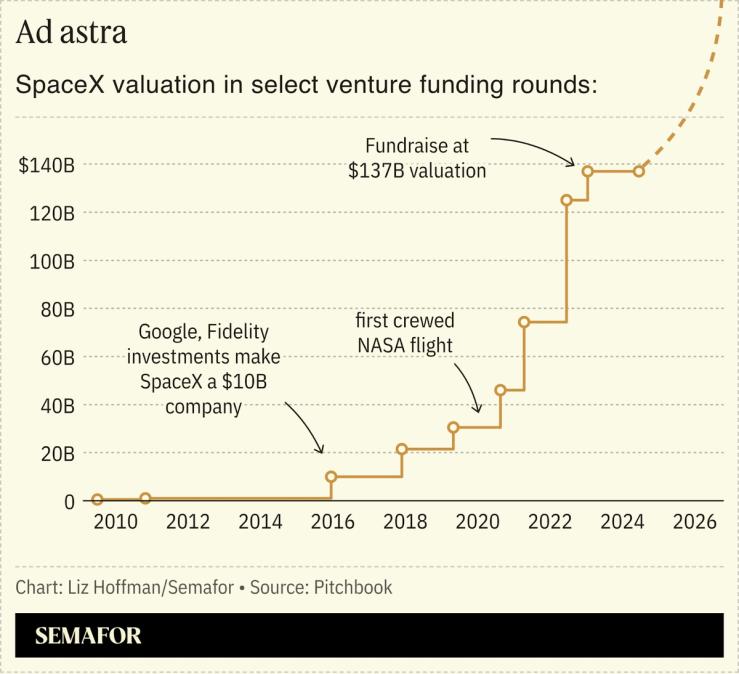
That’s a bigger risk than usual with SpaceX, because there’s nothing usual about SpaceX’s IPO. Right now, less than 5% of SpaceX’s stock is expected to be floated; the average IPO floats 20% or more. Adding to that extra pent-up selling pressure: SpaceX started raising outside money roughly 18 years ago — an eternity in venture capital — and even more recent investors are sitting on eye-popping paper gains. This will also be a problem for OpenAI and Anthropic, which are racing toward potentially trillion-dollar IPOs of their own, so Wall Street is smart to start workshopping a fix now.
One question is whether Musk would sell any of his estimated 40% stake in SpaceX. He testified in 2023 that he contemplated selling SpaceX shares back in 2018 to fund a buyout of Tesla: “It’s not that I want to sell SpaceX stock but I could have.”

Room for Disagreement
Variations on lock-ups have been tried before. Alibaba, whose 2014 debut was then the largest ever before being eclipsed by Saudi Aramco in 2019, released shares at three-month, six-month, and one-year intervals. Spreading out the selling pressure helped, but shares still sold off before the final cliff on expectations that Yahoo would dump its 15% stake. (It didn’t.) Tech company Datadog tied its lock-up to the share price, which resulted in some gamified, to-the-penny trading.
Even traditional lock-ups can be waived by the banks underwriting the IPO, as happened after Beyond Meat soared 800% in its first three months as a public company, to nearly $235. Beyond Meat’s shares now trade at 60 cents, raising the question as to whether the reputational risk in waiving the lock-ups is worth it.