




The News
The Gulf’s largest sovereign wealth funds more than quadrupled their private credit exposure between 2021 and 2025 — to $80 billion — with investment accelerating over the past two years, according to data from Global SWF. That puts them at the forefront of an asset class that is looking uncertain, although their overall exposure is still relatively small compared to their vast holdings.
Abu Dhabi’s Mubadala is the most extended, with 5% of its portfolio invested through partnerships with Apollo, Ares, Carlyle, Goldman Sachs, and KKR; Abu Dhabi Investment Authority holds the largest purse with $24 billion in the asset class. Sovereign funds from Kuwait, Qatar, and Saudi Arabia have also increased their allocations, albeit more cautiously — with the kingdom’s Public Investment Fund holding just 1% of its portfolio in private credit.
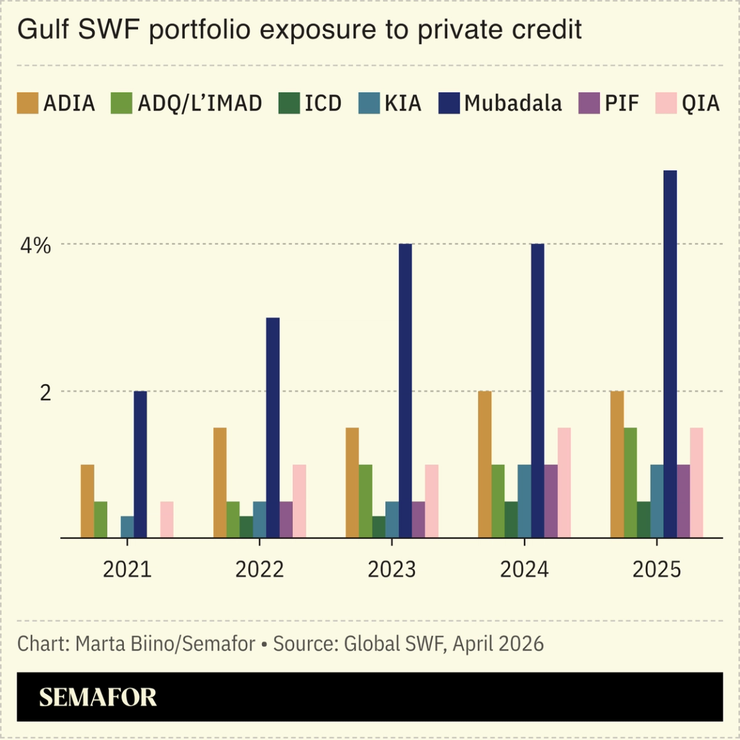
The regional build-up coincided with private credit’s boom years (and was Mubadala’s top performer for three years running). Rising interest rates pushed borrowers who couldn’t access public markets toward nonbank lenders — and made direct lending attractive for a growing pool of investors.
But cracks are beginning to show in the market. Defaults are rising and more investors are heading towards the exit. Ares, Apollo, Blue Owl, and Morgan Stanley have all limited investor withdrawals from some funds, amid fears about the prospect of AI disruption to economic activity. Investors in Blue Owl’s software-focused fund sought to pull 41% of assets in a single quarter before withdrawals were capped at 5%, as Semafor previously reported.

Notable
- The rush of investors looking to exit private credit funds at Apollo, Blue Owl, Blackstone, BlackRock, and Cliffwater has hit unprecedented levels, raising the specter of prolonged pressure on the firms, The Wall Street Journal reported.
- It can be tough to know what private credit assets are truly worth because the market can be opaque and illiquid, similar to subprime mortgages in 2007. That’s why “the more bearish assumptions often win out,” Jamie McGeever wrote for Reuters.