




Clay Chandler’s view
When the US and Israel attacked Tehran on Feb. 28, their targets were Iranian missile sites, leadership compounds, and nuclear production facilities. Yet, it is Asian nations with which the Trump administration says it wants stronger ties — and which Washington needs in its competition with Beijing — that are bearing some of the heaviest burdens worldwide.
Asia depends on shipments through the Strait of Hormuz for more than 80% of its oil and natural gas, to say nothing of less prominent commodities such as the helium necessary for chipmaking, the naphtha needed for manufacturing cars, and fertilizers needed for farming.
The biggest US allies are partially insulated. Japan and South Korea relied on imports shipped via the strait for more than 90% of their oil and natural gas. But both are estimated to have oil reserves equal to more than 200 days of demand. (Seoul is, however, looking elsewhere for helium and naphtha, including by buying the latter from Russia.)
Asia’s other economies look far more vulnerable.
India, the Philippines, and Thailand have reported oil reserves of between 60 and 75 days. Indonesia’s, Pakistan’s, and Vietnam’s are equivalent to demand of 20 days or less.
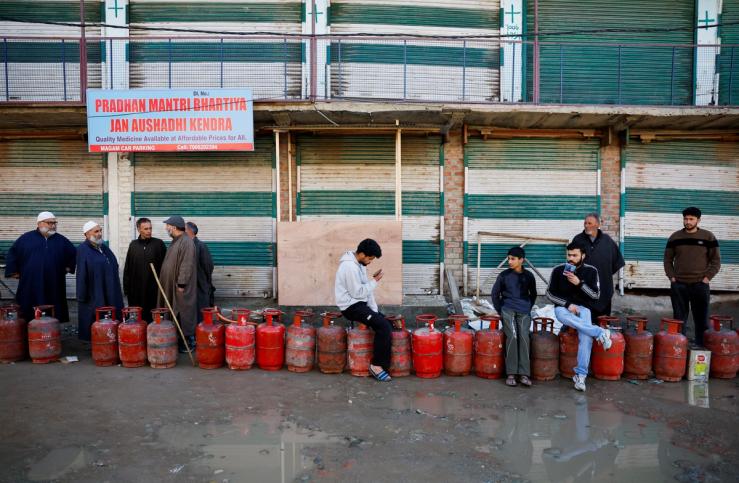
Many governments in the region have imposed crisis measures to conserve energy consumption. Manila has declared a state of national emergency, implemented a four-day work week for government employees, and ordered reduced operating hours at shopping malls. Bangkok, meanwhile, has told civil servants to take the stairs, wear short-sleeved shirts, and has set office air conditioners to higher temperatures. In Pakistan, schools have been closed and public transport is free for a month to encourage people to drive less.
To make matters worse, many Asian economies are having to contend with the declining value of their own currencies, too. Oil is priced in dollars but global investors, seeking safety amid economic turmoil, have bid up the price of the greenback. Since the start of the war, the dollar has gained more than 4% against the Indian rupee, the Korean won, the Indonesian rupiah, and the Thai baht, and more than 2% against the yen.
China is not immune. Sure, it aggressively stockpiled oil and natural gas before the war, and has estimated onshore crude oil reserves of 1.2 billion barrels — enough to cover at least 250 days of domestic energy demand. It also has close relations with Tehran, and at least some China-affiliated tankers seem to be moving oil through the strait. But it cannot hold out forever: Before the war, China imported about a third of its oil via the strait and was by far the largest buyer of oil and natural gas moving through the waterway. And as Alicia García-Herrero, chief economist for Asia-Pacific and the Middle East at Natixis told me recently, Beijing is also vulnerable to the collapse of its key export markets across Asia.
Still, it is far from most at risk in the region. Since the war began, Western headlines have largely focused on Europe’s coming inflation shock, the relative invulnerability of the US economy, and the long-term consequences to the Gulf’s diversification drive.
But companies globally had looked to Asia as a source of much-needed growth in a world that, even before the conflict began, was grappling with growing protectionism between the world’s two biggest economies. That bet now looks unlikely to pay off.
The consequences extend beyond the financial balance sheet to the geopolitical one. The war with Iran was meant to project US power. Six weeks in, the most measurable effect — at least in Asia — has been to weaken the very economies Washington says it needs to outmaneuver Beijing.

Notable
- The energy crisis could quickly become a political one, The Economist wrote: “Asians are sensitive to energy prices and willing to take to the streets over them.”
- After a month of war-related shocks, it is the “countries that bet on Chinese supply chains that are faring better than the ones that trusted Pax Americana,” a Bloomberg Opinion columnist argued.