



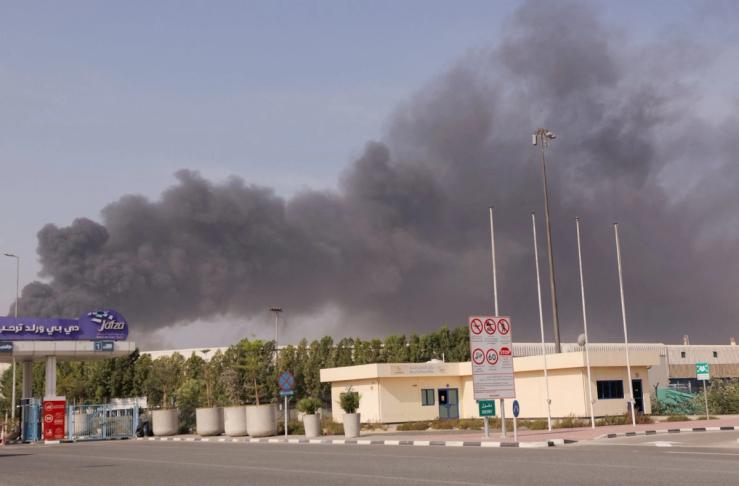

The Scene
For nearly five decades, Gulf Arab countries and Iran have had frosty, but pragmatic, relations. Historic ties between people, a shared geography, and the necessity of trade forced both sides to avoid outright enmity.
Tehran’s response to the US and Israeli war has shattered any remaining belief in the Gulf that the Iranian regime could be accommodated. By attacking airports, hotels, and factories across the Gulf, Iran dispelled a fantasy held by some younger Gulf citizens — who did not live through the early years of the Islamic Republic, or had tuned out Iran’s actions in Iraq, Lebanon, Syria, and Yemen — that Tehran could be brought into the fold.
That hope rested on the idea that Tehran might one day embrace the Gulf’s development model and unleash the potential of the Iranian people, many of whom have flourished abroad.
The message from Gulf leaders has shifted over the years, but avoiding direct confrontation has always been a strategic imperative. Before Feb. 28, there were periods of heightened tension — Saudi Crown Prince Mohammed bin Salman said in 2018 that Iran’s then supreme leader was “very much like Hitler” in seeking to expand across the Middle East — but Gulf governments still tried to de-escalate and maintain diplomatic channels.
Since the US and Israel launched their attack, and Iran responded with missiles and drones against the Gulf, views have hardened among regional leaders and become visceral among ordinary citizens.
In interviews over the past week with 13 citizens from Bahrain, Kuwait, Qatar, Saudi Arabia, and the UAE — ranging in age from mid-20s to mid-50s, some consultants, some public officials, and one an heir to a family fortune — there was a common response. Most said they had long viewed the Islamic Republic as a destabilizing force in the region, but they were still shocked that Iran had chosen to strike civilian infrastructure. (All requested not to be named so they could speak freely.)
The conclusion among many was that Iran was now an enemy to be confronted and contained.
That echoes what UAE ambassador to the US Yousef Al Otaiba recently wrote: “We want Iran as a normal neighbor. It can be reclusive and even unwelcoming, but it can’t attack its neighbors, blockade international waters, or export extremism.”
In this article:

Know More
This shift in sentiment is difficult to quantify given the lack of polling and restrictions on speech and assembly in Gulf countries. At last week’s Future Investment Initiative in Miami, many Saudis declined to discuss their views of the war or Iran. Qatari and Emirati business leaders have been similarly reluctant. In a region where rulers can quickly pivot from enemy to friend, there is little upside to speaking openly.
But strip away the veneer of diplomacy and it’s clear that Gulf citizens are demanding a forceful response, a sentiment that their governments may have to eventually address. One Emirati said people in the UAE want their military to impose a cost on Iran and are no longer satisfied with a purely defensive posture.
A veteran Saudi journalist told me there is no turning back among a younger generation that wants economic development and social reform, not sectarian politics or the “axis of resistance” rhetoric that has dominated the region for decades while delivering nothing but destruction.
And among the rest, many simply want to be left alone. Several of the people interviewed said they would prefer a thriving Iran next door, open to business and tourism. But they concluded that normal ties aren’t possible with the current regime.

Mohammed’s view
The most striking part of these conversations was not that Gulf citizens are angry at Iran for attacking them. It was how little appetite there was to blame Israel or the US for starting the war. There’s a tendency when analyzing conflicts to search for a grand strategy or ask who benefits, to understand the geopolitics and place a war in a historic narrative. But the people I spoke with were not focused on whether Israel, the US, or Iran emerged relatively stronger. They were worried about safety, schools closing, flights being disrupted, property values sinking, and businesses suffering. No one mentioned 4D chess.
I’ve long been flummoxed by the Gulf’s approach to Iran. Over my 16 years living in the region — in Qatar, Saudi Arabia, and the UAE — everywhere I looked there was some form of outreach. Trade and finance ties through Dubai, improving relations with Qatar, and a Chinese-brokered diplomatic breakthrough with Saudi Arabia all happened even as Iran and its proxies murdered a Saudi-backed prime minister in Lebanon, kidnapped Qatari hunters in Iraq, armed the Houthis in Yemen, and backed Bashar al-Assad’s extermination of Syrians.
This dichotomy has been going on for decades. In 2008, even as Saudi King Abdullah was privately urging Washington to “cut off the head of the snake” and destroy Iran’s nuclear program, according to leaked US diplomatic cables, the kingdom’s then-Foreign Minister Prince Saud Al Faisal was hosting with his Iranian counterpart.
I had recently arrived in Riyadh with The Wall Street Journal, an early posting in the region. I asked Prince Saud whether the visit signaled a thaw with Tehran. He gave an unmemorable diplomatic answer. But later, one of his aides invited me to see him privately. Prince Saud — patiently and graciously — explained that Saudi Arabia had no choice but to operate within a fragile regional order, filled with failed states, militias, terrorist groups, US and Israeli interventions, and an expansionist Iran. He told me that talking to an adversary did not turn them into a friend, but engagement could reduce the chances of the worst outcome: war.
Now that the war is here, the space for pragmatism has receded. On Gulf television, social media, and in private conversations, there is a level of anger toward Iran that I have never seen before. Commentators say the regime must be confronted because Gulf citizens can’t live indefinitely under the threat of missiles, drones, and militias.
As Saudi columnist Faisal Abbas wrote for Semafor: “What this war has proven is that Iran’s hatred is directed mostly towards its Arab neighbors as opposed to Israel… Tehran has shown that it is focused on remaining in 1979, and not progressing with us to 2030.”
However this war ends, the Gulf is unlikely to return to the uneasy accommodation with Iran that defined the past several decades. And Gulf citizens aren’t going to forgive and forget.

Room for Disagreement
Among those who support Iran’s attacks on the Gulf — or more generously, Iran’s right to defend itself — the narrative is reversed. They see Gulf Arab states as fundamentally hostile to Iran because of their ties to the US, their support for Saddam Hussein during the 1980s Iran-Iraq war, and the Sunni-Shia divide that has stoked tensions since 1979.
But it is not only Iranians and some Shia Muslims who are reluctant to blame Tehran. Khalaf Al Habtoor, the Dubai-based billionaire, argued in a since-deleted social media post that Israel and the US bore greater responsibility for starting the war and provoking Iran’s response. And a Qatari professor, speaking on Al Jazeera, made a similar argument, saying Israel stands to gain most from the conflict and that Gulf states should defend themselves without being dragged into an open-ended confrontation with Iran, even if Tehran is the belligerent actor.

Notable
- What does Saudi Arabia want from the Iran war? Bloomberg’s Sam Dagher explains the history of the rivalry, and whether the kingdom will enter the conflict.
- Rather than drive a wedge between the Gulf and the US, Iran’s attacks on the region will bring them closer because states in the region need American and Israeli technology to defend themselves, writes the Atlantic Council’s Jonathan Panikoff in the Financial Times.
- The Sunni-Shia divide has helped fuel conflicts in Muslim countries over the past 50 years, with tension often exploited by Iran and Saudi Arabia. This Council on Foreign Relations report breaks down the sectarian drivers of wars that have reshaped the Middle East.