




The News
Early St. Patrick’s Day morning, Reuven Fenton and I learned we’d be on pothole duty for the day.
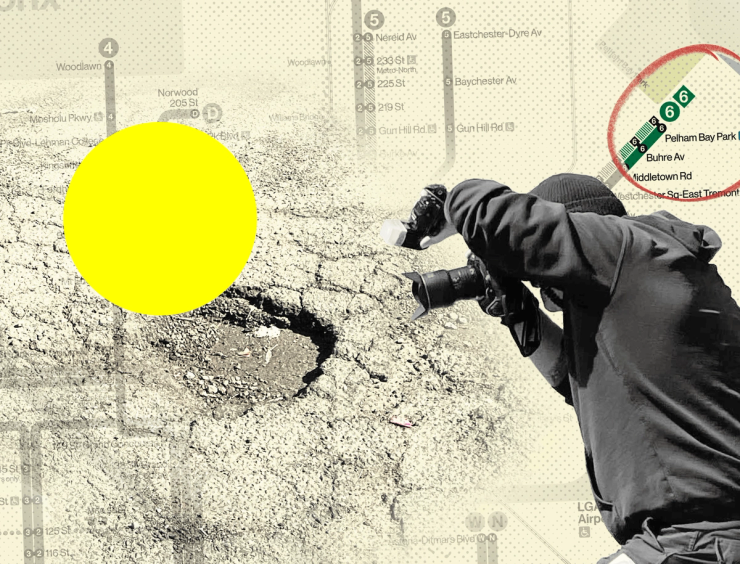
At 8:30 am, Lia Eustachewich, the managing editor of news at the New York Post, gave us our marching orders: She was dispatching us up to Pelham Bay Park, at the very end of the No. 6 subway line in the Bronx — the location, according to city records, of the oldest unpatched pothole in New York City.
I was just tagging along; this is Fenton’s job. Fenton is a runner. Every morning, he wakes up with no idea of what he’s doing, before being dispatched to one of the hundreds of stories breaking across New York at any given moment. Unlike most reporters, he doesn’t have a “beat” per se; the whole city is his beat, and he could be sent anywhere — like, for instance, an unremarkable roundabout in an unusually pastoral area of the Bronx on a particularly frigid March morning.
Fenton is 45, from Lexington, Massachusetts, and one of eight siblings, three of whom are rabbis. More comfortable in leafy New England, he’s “not really a ‘city guy.’” His great-great-great granduncle is the 22nd governor of New York, Reuben (with a b) Fenton. And he’s one of a number of people with arguably the oldest job in American journalism, and perhaps one of the only ones that will survive AI.
“In a day and age where AI is taking over,” the Post is “still doing basic journalism every day,” Eustachewich told me.
That means sending human beings to physical locations, which seems mind-numbingly obvious and fundamental. Yet in an age of shrinking newsroom budgets, mass layoffs, and an overreliance on AI and social media, it’s also something of a luxury. The runner offers a dynamic, and distinctly analog, example of what a human does best, and what LLMs can’t do at all — knock doors, form a connection, catch a vibe.
The stakes of these stories vary. The previous day, Fenton reported on a fatal three-story house fire in Flushing. Before that, he traveled to Minneapolis to cover protests after the killing of Alex Pretti and Renée Good. A few years before that, on a routine doorknock, a Hunter College professor held a machete to his neck.
Today, his story is potholes, which the Post will tell you (on a slow news day) cost New Yorkers millions of dollars a year in pulverized axles and thrown hubcaps. Fenton said he’d thrown three himself in recent years. And they can be lethal: A 46-year old man died after piloting his stand-up scooter into a hole. They’ve become Mayor Zohran Mamdani’s hobbyhorse, like rats were to his predecessor Eric Adams — a highly visible display of city government at work.
By 11 am (Pelham Bay Park is fairly remote), Fenton was behind the wheel of his Camry and I was riding shotgun, as our photographer trailed in a Jeep Cherokee, looking for the pothole. New Yorkers have called in some 23,000 pothole complaints so far in 2026 — the largest year-over-year increase on record, the Post reported.
So we took a turn around the roundabout, slowing down to check out a series of wash-outs, divots, craters, and ditches. But there was no single, obvious, most conspicuous candidate for the oldest and most cantankerous New York City pothole — and therefore nothing to write up, to interview people about, or for our Post-assigned photographer (or “shooter”), Matthew McDermott, to shoot.
McDermott is a minor celebrity — a garrulous, 6′3″, 250lb-photographer with 30 years experience in conflict zones and disaster areas. He shot the famous photo of a kneeling FDNY firefighter leaning on his axe at Ground Zero that launched a thousand murals. His impressive physical stature has meant that in addition to snapping photos, he’s often played the runner’s “bodyguard.” Once, McDermott and a reporter were sent to doorknock an alleged serial stabber (who wasn’t in).
Today’s story did not qualify for him as an exciting assignment.
“Poor Brendan, he’s shadowing us on potholes!” he observed.
“They could all be potholes,” Fenton said, gesturing toward the moonscape of the roundabout.
Was this the kind of assignment that more established runners ever tried to duck? Not really, Fenton indicated. If you had been a runner since 2009, like him, it wasn’t because other opportunities hadn’t arisen. “It works for me,” he said.
Besides, it would be a mistake for any reporter to write off a story’s newsworthiness at the jump, he told me: Successful scoops are “usually something that wasn’t likely to work out” to begin with.
Suddenly, as if the newspaper gods had heard our prayers, a shape appeared in the middle distance, growing steadily larger as it headed straight toward us: a man on a mobility scooter, wearing a fitted Yankees cap.
“This guy could have something,” I said, performing my first useful function of the day and gesturing to Fenton and McDermott. They moved in.
His name was Martin Moreira, he was 72, he had lived in the neighborhood for 50 years — and he could confirm that the pothole nearest to us had been there as long as he could remember. Fenton peppered him with questions: Did he have to be careful when riding his scooter? Was it loud? Why, yes: “Cars bang into it all day, every day,” Moreira said, perking up a bit.
Then a younger man pulled up in a customized sedan, holding his phone out the window and pointing to some kind of app that displayed real-time feedback from the vehicle’s shock absorbers. “My suspension, look at this — I can feel it right now with these potholes! For weeks I’ve been calling the city, trying to get them to pay—”
“Hold on, hold on,” Fenton said, still tuned toward Moreira. “I want to interview you, too. Can you just pull off to the side?”
The man pulled through the intersection, paused for a moment, and sped off while McDermott was snapping glamor shots of Moreira near the pothole.
“Repeat after me,” Fenton said when we got back in the car, laughing at the kind of leading questions he sometimes has to ask more reticent New Yorkers. “This pothole has been here since 2010…”
As we drove toward our next destination in College Point, I couldn’t help but notice that there were suddenly potholes everywhere.
Yes, there were, Fenton agreed. “But they’re not on the list!”
In this article:

Know More
The story ran the next day, titled Exclusive: Meet NYC’s oldest pothole — an ancient roadway crater that has plagued The Bronx for decades. After the story ran, the Department of Transportation sent a crew uptown and patched it, plus a few more nearby, giving our story a happy ending and providing an unusually stark example of what simple accountability journalism can achieve.
Runners are the “backbone” of the paper’s newsgathering operations, Eustachewich told me when I visited the tabloid’s offices in the Fox News building. “The New York Post puts boots on the ground.” (“Boots on the ground” was a phrase I heard from at least three different Posties.)
They employ a mixture of trickery and aggression to get the story. That could mean sneaking into hospitals, or bluffing their way into funerals. (One former runner told me they knew of a colleague who stashed a change of black formal wear in their vehicle for just such occasions.) And never, ever, are runners allowed to leave the site of a story before the reporter from the New York Daily News does.
The core of that identity emerged during the “Son of Sam” murders in the late 1970s — a string of killings that seemed like a lurid tabloid story come to life, and existed almost as an outgrowth of the rivalry between the Post and the Daily News.
During the tabloid wars, star News columnist Jimmy Breslin received a handwritten note directly from the killer, and the Post’s new owner, Rupert Murdoch, “could not stand the fact that the killer was writing to Jimmy Breslin and not to us,” a former Post editor recounted in the 2024 oral history, Paper of Wreckage. Hand-picked by Murdoch to help drive coverage, top crime reporter and Aussie import Steve Dunleavy — a “hard-hitting, hard-drinking journalist who helped define The New York Post,” the paper noted in its 2019 obituary — then passed himself off as a grief counselor to get close to the mother of the final victim. Dunleavy sent flowers and arranged cars for her.
“We had lines we wouldn’t cross,” said longtime Post editor Richard Gooding of Dunleavy’s deception. “They had no lines.” (“I lost count of the number of times I posed as a cop, a public servant or a funeral director,” Dunleavy later said.) After police caught the killer, a Post photographer, having scaled the fire escape, broke into his apartment, and the Post published exclusive photos from “INSIDE THE KILLER’S LAIR.”
It was a defining period for the Post, which racked up scoop after scoop over the course of the manhunt, massively outselling its previous circulation.
Then as now, the nature of the runners’ job is to operate inside legal and ethical gray zones. And, needless to say, you can’t do any of it from your desk. “It’s easy to hang up on somebody,” Eustachewich told me. “It’s harder to slam a door in their face.”

Brendan’s view
Last month, the Cleveland Plain Dealer’s editor kicked the hornet’s nest when he said that some of the paper’s reporters would be filing notes to an AI writing tool instead of writing stories themselves. Last week, Novara Media reported that LGBTQ+ publisher PinkNews had decided to “move away from having a reporter-led newsroom,” presumably toward something more algorithmically led.
The New York Post remains one of the few places still training up young human journalists. Each new intern is paired with a runner to start, before becoming runners themselves. In addition to Eustachewich, the Post’s upper editorial ranks are littered with former runners who say there is nowhere better to learn the ropes.
As I packed up and prepared to leave, I walked past dozens of the Post’s most memorable front pages hanging on the walls, and I told Eustachewich the runner’s job seems essentially unchanged from a century ago.
“I hope so,” she responded.

Notable
- “There’s nobody left to lay off, and no parts to strip from what’s left of the paper,” a New York Daily News staffer told Mike Jaccarino, himself a former runner and the author of America’s Last Great Newspaper War, in 2020. “All that’s left is turning out the lights.”