


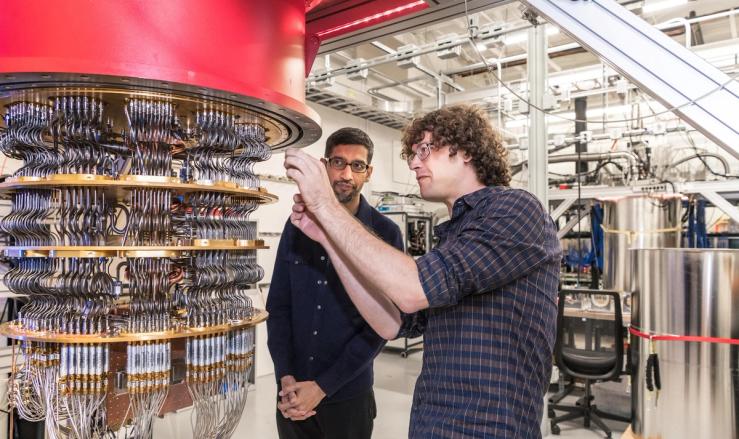
Google is hedging its bets on quantum. For years, the search giant has been all-in on superconducting qubits: Microscopic artificial circuits printed on chips and brought down close to zero degrees kelvin, requiring the iconic copper “chandelier” we’ve come to associate with the pursuit of quantum computing.
But there are other ways to do quantum computing. This week, Google announced a major investment in what’s known as the “neutral atom,” otherwise known less scientifically as just a regular old atom. Instead of building artificial circuits, you use arrays of actual atoms. By hitting them with highly specialized lasers, researchers cool these atoms to near-zero, hold them in place using “optical tweezers,” and push them into a quantum state. Lots of atoms can then be connected, or “entangled,” with one another in this way to create a working quantum computer.
Google announced it will work with the University of Colorado Boulder and researcher Adam Kaufman on the new approach, while continuing its superconducting computing effort near UC Santa Barbara.
The downside of the neutral atom approach is that it doesn’t perform individual calculations quite as quickly as a superconducting qubit. The upside is that it may be easier to get a lot of qubits connected and working together simultaneously.
But Google can’t afford to try and pick winners in quantum. It’s an AI-first company hell-bent on being the quantum lead, and while traditional chips are driving today’s generative breakthroughs, quantum computing is viewed as a foundational pillar for the long-term future of AI. And when traditional computing eventually hits its limit, quantum systems will be required to train the next generation of exponentially larger AI models and simulate data that classical machines simply can’t handle.