




David’s view
The Sunrise Movement, a nine-year old climate nonprofit, is politically inseparable from the Green New Deal that it organized hundreds of town hall meetings and rallies to promote.
Except that it barely talks about the idea anymore.
Instead, from Colorado to Illinois, Sunrise members are focusing their direct actions on letting Democratic candidates know how toxic AIPAC is with their party’s base.
So what happened to a group whose leaders were invited to help craft Joe Biden’s climate platform, whose activists called his 2022 Inflation Reduction Act a good start toward their lower-emissions future? It’s not just Sunrise — even as Donald Trump’s second term sees a remarkable reversal of the environmental movement’s hard-fought wins, the visibility of Green New Deal-style climate activism is on the decline.
In a recent teach-in for members, Sunrise shared its latest four-step plan: “Slow the authoritarians” through the midterm elections, win an “electoral breakthrough” in 2028, carry out a “political revolution” in a new president’s term, and inaugurate a “new system” in 2032.
“As Sunrise has pivoted to addressing Donald Trump’s authoritarianism, we see these [GOP] funders in our politics as ultimately tied to how we can build a Democratic Party that can fight back against Donald Trump,” said Sunrise spokeswoman Denae Ávila-Dickson.
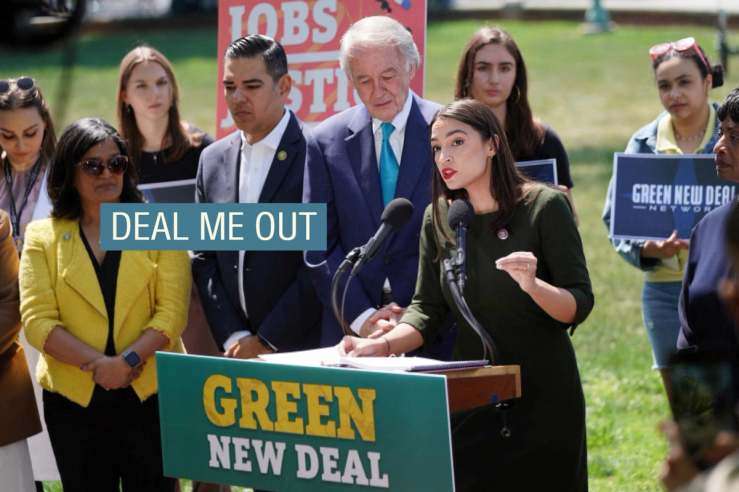
The Green New Deal has faded in Democratic politics, rarely mentioned in primaries. Rep. Alexandria Ocasio-Cortez, D-N.Y., and Sen. Ed Markey, D-Mass., who introduced a Green New Deal resolution in 2019, 2021, and 2023, did not introduce one in this Congress.
Its promise of a vast economic and environmental reorganization for the benefit of workers is now living on, somewhat, in the growing progressive blowback against AI data centers. Ocasio-Cortez and Sen. Bernie Sanders, I-Vt., released high-profile legislation imposing a moratorium on the data centers just this morning.
“We’ve been putting some final touches, particularly on re-introducing a Green New Deal for public housing,” Ocasio-Cortez told Semafor. “But of course, climate remains a priority and will continue to be a priority.”
This isn’t where Sunrise hoped it, or climate activism, would be by now. The Trump administration’s reversals of everything from Biden-era green energy funding to the EPA’s greenhouse gas endangerment finding have faced court challenges. But they haven’t rekindled the energy or media attention that climate grabbed during Trump’s first term.
“We’re already living in a world that’s going to hit a 1.5-degree Celsius increase, if we haven’t already,” said Saikat Chakrabarti, who shaped the 2019 Green New Deal resolution as then-chief of staff to Ocasio-Cortez. He’s now running to replace Nancy Pelosi in Congress, touting his work on it and the “Mission for America” that succeeded it.
“People are depressed at us having made some progress through the Inflation Reduction Act, when it seemed like we were headed in the right direction, and Trump rolled it back so far,” Chakrabarti continued. “People are feeling really defeated by that.”
In this article:

Step Back
Three trends in progressive politics contributed to the shift. The first was the social justice “awokening” of the first Trump term, which rumbled through every green group. The 133-year old Sierra Club lost donors and members with a focus on “antiracism” that paused some of its programs, like trips to Israel; the League of Conservation Voters apologized for a movement that “centered the experiences, wants, and needs of white folks while excluding and ignoring people of color.”
Sunrise joined that discourse, stating in 2020 that “if the Movement for Black Lives wins, it also advances our collective mission of ensuring that we enact a Green New Deal.” The 2023 Hamas attack on Israel added another mission of justice for Palestine. Some Sunrise affiliates had balked at working with “Zionists” before Israel started bombarding Gaza, aided by US taxpayers.
That was the second trend: After Oct. 7, Gaza activism drew in more progressives who’d spent their earlier youths working on climate.
“Wars, occupations, environmental degradation, ecocide, huge emissions — they go hand in hand, as Palestinians know very well,” Greta Thunberg said last year, when asked how she had transitioned from climate action to antiwar flotillas. “In what ways are Palestine and climate justice not connected? Why should I not care about Palestine? I am a human being.”
The shift was noticed, and often not appreciated, by major donors. Hundreds of millions of dollars are invested every year in environmental activism. How much of that, some wondered, had gotten redirected?
“We gave them money, and now all they do is talk about Palestine,” Alex Soros said of Sunrise to New York magazine last year. “It’s ridiculous.”
Donors adjusted better to a third trend: The reorganization of progressive and Democratic campaigning around “affordability.” The Green New Deal imagined a total economic transformation that would create millions of jobs while, necessarily, leaving fossil fuels in the ground. The Trump administration had reversed environmentalism’s biggest recent gains, but it wasn’t delivering cheaper energy as a result.
Campaigners now see a new opportunity, and a new brand, as defenders of affordable clean energy against an administration literally paying to dismantle those projects. And this has jibed with research from centrist Democratic groups, which finds that voters are skeptical of politicians who talk about “climate change” but open to hearing about lower costs. The looming catastrophe that motivated the activists of the 2010s does not move the voters of the 2020s.
“I don’t think a goal that ends in 2050 or 20-whatever has been especially motivating to people,” said David Kieve, the president of the Environmental Defense Fund. “We have an obligation to make sure that people understand that some of the solutions we’re pushing for are available immediately; we are not talking about the Jetsons here.”
Seven years ago, when Ocasio-Cortez and Markey offered their first Green New Deal resolution, Corbin Trent was handling the congresswoman’s press requests. AIPAC wasn’t even funding anti-progressive PACs yet. The world had changed. Campaigners would have to change with it.
“My thinking is that you now jettison the whole Green New Deal brand, because it’s tarnished,” Trent said. “I think it’s served its purpose of elevating the idea of big, bold change. It’s time to pivot on to the next phase of that: Economic affordability. Averting climate change, or reversing it, is a secondary yet important part of the new work.”
Nicholas Wu contributed.

Room for Disagreement
The Sunrise Movement achieved clear success driving up the salience of the climate issue; with other green groups, it had pressured Democrats running for president in 2020 to talk about climate plans that could remake the economy and meet a 2030 deadline for carbon reduction.
It’s entirely possible that, come the 2028 Democratic primary, it returns to the same aggressive rope-line tactics that helped move Biden to the left on greenhouse gas emissions.

Notable
- Back in November, Scott Waldman of E&E News studied how little last year’s Democratic winners had talked about climate.
- In Politico, Amelia Davidson and Kelsey Brugger talked to Sen. Sheldon Whitehouse, D-R.I., about resisting his party’s drift away from climate messaging.
- In the Baffler, green activists Rhiana Gunn-Wright and Maria Lopez-Nuñez talk about the lost promise of the Biden years and the IRA. “I was there at the signing. It didn’t look like America.”