




Andy’s view
This was supposed to be “America’s Pacific Century.”
That, at least, was what former US Secretary of State Hillary Clinton proclaimed a decade and a half ago, outlining a new era in which the US would use its unmatched power — military, economic, diplomatic — to expand its Asian interests and push back against Chinese efforts to dominate the world’s most dynamic economic region.
But the “Pivot to Asia” that Clinton promised — and that successive Democrat and Republican administrations endorsed — is once again stalled, bogged down in yet another Middle East campaign.
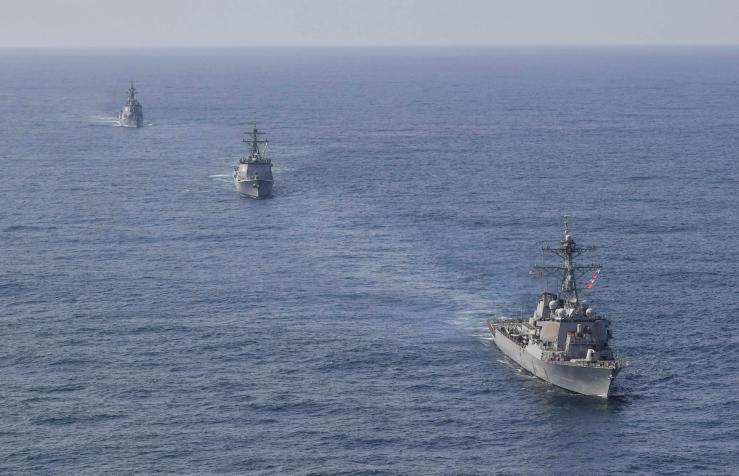
As the US scales up its war machine in the Gulf, giving itself options in order to reopen the Strait of Hormuz, the Pentagon is simultaneously running down its military assets in the Asia-Pacific. An elite rapid-response force of 2,500 marines from Okinawa, trained to overrun small Pacific islands, is now en route to join Operation Epic Fury. Parts of a missile-defense system in South Korea, intended to defend against a nuclear-armed North, have been whisked away. An aircraft carrier patrolling the contested sea lanes of the South China Sea has been diverted.
While these redeployments are limited, so far at least — the US has around 50,000 troops in Japan alone — they have unnerved US friends and allies, signaling to Beijing that US military power is thinly stretched.
Together with the rapid depletion of US precision missiles, interceptors, and radars in Iran, US President Donald Trump’s “little excursion” in the Middle East risks weakening the US in the Asia-Pacific for years to come.
Beijing already outguns the US in its own backyard, having built the world’s largest navy by numbers of ships and a missile force many times larger than Iran’s.
Now, with the US distracted in the Gulf, Taiwan — the prize that has so far eluded Chinese leader Xi Jinping — has arguably never been more vulnerable. Daryl Press, a professor of government at Dartmouth College and a regular consultant to the US Defense Department, warned that Taiwan leaders ought to be “quaking in their boots” after watching the success with which the US and Israel have taken out the Iranian leadership, since decapitation strikes are part of the People’s Liberation Army playbook. Japan and South Korea may be tempted to acquire their own nuclear deterrent if they determine the US can’t be counted on to take “extraordinary risks” to defend them, he told me.
Zack Cooper, an official in the George W. Bush administration and now a senior fellow at the American Enterprise Institute, a conservative Washington think tank, wrote recently in Foreign Affairs that a pivot was now “a practical impossibility.” He argued that Washington’s only viable option may be to abandon the East Asian mainland to Beijing and defend the “First Island Chain,” a string of heavily fortified archipelagos running from Japan to the Philippines through Taiwan.
Increasingly, Washington’s Asian allies are working together — Japan, for instance, is building stealth frigates for Australia — but the US remains the indispensable power in the region, the only credible counterweight to a rising China, so Asia-Pacific leaders can offer little pushback to an erratic, unreliable American president.
In fact, the price that Trump demands for defending US allies against Chinese coercion is deference. At a meeting in the White House last week, Japan’s Prime Minister Sanae Takaichi — a devotee of the late Margaret Thatcher, the “Iron Lady” of UK politics — complimented his looks, absorbed his joking reference to Pearl Harbor, albeit with pursed lips, and even broke into a dance in the State Dining Room.
Even so, Trump seems little interested in East Asian security, seeing the region largely through the prism of trade — he’s extracted a massive $550 billion investment pledge from Japan, using tariffs as leverage, and another $350 billion from South Korea — which only adds to nervousness in regional capitals. Tokyo fears he may be tempted to sell out Taiwan to get a commercial deal when he next meets Xi.
Ultimately, an enfeebled US in the world’s most consequential region — the one around which the future of the 21st century revolves — may turn out to be Trump’s lasting legacy. After all, as Press points out, Trump has shown that “when the chips are down, the United States prioritizes United States core interests.”
In this article:

Room for Disagreement
While Trump may be unreliable, Asia’s powerful economies are not without leverage themselves. Michael Green, the CEO of the United States Studies Center at the University of Sydney, writes in Foreign Affairs that Takaichi and powerful figures around her know that Japan is essential to US efforts to deter Chinese military encroachment in the Asia Pacific and to build a non-China rare earths supply chain. Even with all the uncertainties of the Trump administration, he states, “A strategy centered on working with the United States will allow Japan more opportunities.”

Notable
- The historian Phillips P. O’Brien argues that the US and Israeli attack on Iran “indicates a massive relative decline in US capabilities and strategic choices in the Western Pacific.”