




The Scoop
US President Donald Trump’s security strategy for the Western hemisphere — which has already seen him unseat Venezuela’s leader and threaten to overthrow Cuba’s regime — is tangled up in a legal battle over Puerto Rico’s electricity grid.
At least eleven projects aimed at improving power reliability for two US military bases on the island — both of which played a role in the capture of Nicolás Maduro and are expected to expand as part of a Pentagon effort to strengthen the US military’s presence in the Caribbean — have been frozen in early planning stages or suspended, according to public filings reviewed by Semafor. The suspended projects, which the territory’s top energy official blocked over alleged permitting “deficiencies,” are among a total of more than 200 grid-upgrades across Puerto Rico that are on ice amidst disputes with the private utility that manages the grid.
“Any delay in grid investments tied to areas like [the two bases] is a serious concern,” Rep. Pablo Hernández (D), the territory’s nonvoting member of Congress, told Semafor. “A reliable power system is not just an economic issue, it’s a national security issue.”
In this article:

Know More
At least six grid upgrade projects aimed at improving power reliability for the areas in which Roosevelt Roads Naval Station and Ramey Air Force Base are located were suspended, while another five are frozen in early planning stages as LUMA, the private utility that manages the grid, fights a legal challenge by Gov. Jenniffer González (R), a Trump ally, to cancel its contract. The suspended projects, which include transmission lines and substations, represent a total of roughly $480 million in potential investment. Josué Colón, the governor’s energy czar, said in a statement to Semafor that LUMA “has not proven to be either competent or efficient” at providing cheaper and more reliable power on an island that has gone many years without either.
LUMA, one of whose owners is North America’s largest grid services company, was hired by the territory’s government in 2021 to fix things up and conduct distribution and retail utility services. In a statement, the company said that pushing it out of Puerto Rico “would disrupt progress on taxpayer investments at a critical moment.”
As Puerto Rico’s hometown hero Bad Bunny artfully observed in his recent Super Bowl performance, the island’s grid is in tatters, and has been for years. The government-owned energy company PREPA, which owns the territory’s power plants and grid lines, filed for bankruptcy to restructure $9 billion in debt in 2017, a few months before Hurricane Maria swept in and devastated the already-fragile system. In the years since LUMA took over, conditions have only worsened: Customers in Puerto Rico experienced an average of 30 hours without power in 2024, up from 26 in 2021 and relative to about 2 on the mainland, according to federal data. Outages are also longer, and in general the territory’s power is among the most expensive in the US.
González seized on this issue in her 2024 election campaign and promised to sack LUMA, a move that is widely popular with her frustrated constituents. But LUMA has an unenviable task, said Daniel Hernandez, a private energy consultant who previously worked for both LUMA and PREPA.
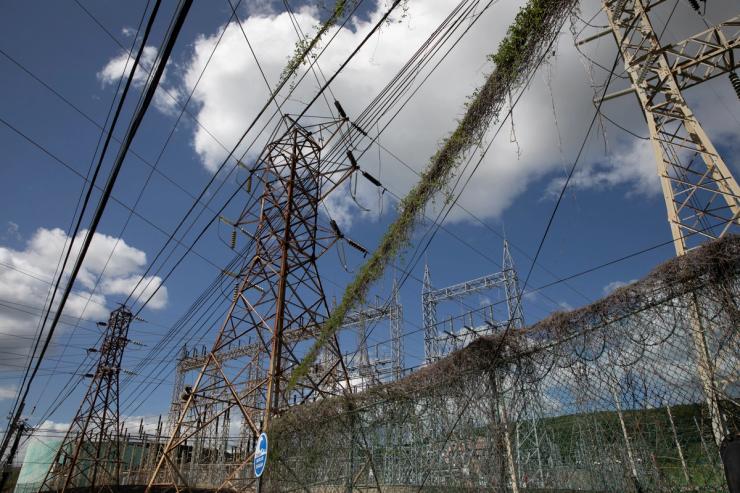
Despite the island’s relatively small size, its grid is exceptionally complex because it has to function without the benefit of long-distance transmission lines found on the mainland. It also has to cross the island between power plants and consumers in the capital at an orientation that leaves it highly exposed to incoming hurricanes. The steamy climate, which promotes overgrown plant life, doesn’t help. Any private operator taking over the reins would require years to come up to speed on how to make the system work, let alone to improve it, Hernandez said. LUMA, in a January press release, also blamed a “lack of access to sufficient funds” — most of which trickle down from the US Federal Emergency Management Agency — for its poor performance.
There are certainly areas for all parties to improve, Hernandez said. But firing LUMA is “a very, very painful way” that could create more problems than it solves, he argued. The government’s plan is to find a new private contractor to replace LUMA, Colón said. But it’s not clear that any alternative candidate is adequately up to the task, Hernandez said: “And in parallel, the system needs to keep in operation. We need to keep the lights on.”

Tim’s view
Puerto Rico’s case illustrates that the notoriously red-tape-bound grid management process — bain of investors, permanent headache of lawmakers, driver of higher power prices — can also be a gaping vulnerability for national security.
In a world where grids everywhere are increasingly at risk from physical and digital attacks, they are also themselves a vital military asset; bases need power like everyone else. Much more, in fact: The Defense Department is by far the largest institutional energy consumer in the US, and although a majority of that energy is consumed by vehicles and weapons systems, electric grid reliability for bases is perceived as enough of a liability that the Pentagon has been at the forefront of deploying microgrids, renewables, and other decentralized options.
In the area surrounding Roosevelt Roads — a naval base that was mothballed two decades ago but is now being rebuilt as a hub of the military’s Latin America staging ground — blackouts were experienced by 47% fewer customers and became 77% shorter during the past three years, according to planning documents reviewed by Semafor.
But at Ramey — an Air Force base that was closed 50 years ago but reopened in August, and where Maduro was reportedly transferred from special forces aircraft to the USS Iwo Jima — blackouts are becoming longer and more widespread.
Puerto Rico is strategically located, and has the benefit of being US territory, whereas other key US bases in Latin America are situated in countries with less reliable governments, such as Cuba, said Will Freeman, fellow for Latin America studies at the Council on Foreign Relations. “We’ve taken the relative stability and security of the Caribbean for granted for a long time,” he said, “but we’re moving to a place where our vulnerabilities are going to be more exposed. We may need bases on our own turf.”
Colón, the energy czar, said that the suspended base-adjacent projects were flagged in the course of normal due diligence, during which “inconsistencies and gaps were identified in the documentation, scope definition, and reconciliation of project data submitted across multiple workstreams, including materials prepared and submitted by LUMA in its capacity as system operator, as well as delays in the approval process by PREPA.” At no point, he added, “has the government taken or contemplated any action that would jeopardize electric service to critical federal installations or national security operations.” But while the legal battle between the government and LUMA continues, these projects could remain caught in the crossfire.
“Our strategic location in the Caribbean puts us at the center of US national security,” Rep. Hernández said. It’s essential, he added, to continue “investing in our ports, airports, and power grid, so our bases are better prepared to respond when they’re needed.”

Room for Disagreement
Hernandez, the consultant, said that if the Pentagon really wanted to steam ahead on powering these bases, it would almost certainly bring in the Army Corps of Engineers, as it has done for previous similar projects. In that case, the LUMA-PREPA dispute could become less of a meaningful barrier to construction. And in the meantime, the possible disruptions to grid improvement across the island could be a cost worth paying to evict a company that has lost much of the public’s trust, said Ruth Santiago, an environmental attorney based in Salinas, Puerto Rico: “I think there’s certainly a lot of social discontent with LUMA’s performance, and it seems to be a consensus here that they should step out of the picture.”

Notable
- The war in Iran is driving up global carbon emissions as well as oil prices, Marketplace reports. “When military spending goes up, military emissions increase,” a researcher observed.