




The Scene
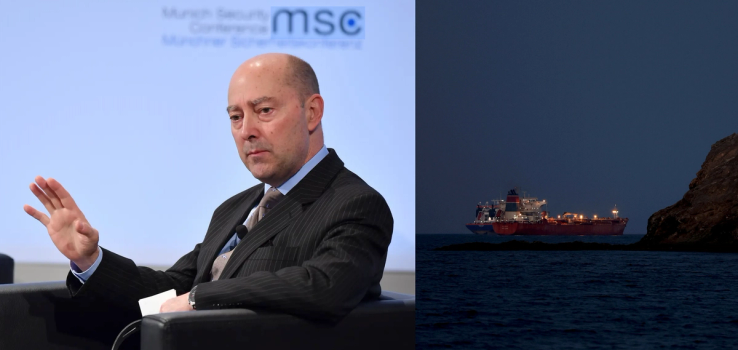
Iran could be the next big global investment opportunity — if and when the war ends, said Adm. James Stavridis, the former supreme allied commander of NATO and now vice chairman at investment firm Carlyle.
“If we’re allowed to have a tiny flicker of good news, we just had it,” he said Monday morning, after President Donald Trump announced a five-day pause in attacks on Iran’s electric grid, which had drawn threats from Iran to attack energy and water infrastructure across the Middle East. He sees two-in-three odds of a negotiated peace that would reopen the oil trade and “avoid cratering the global economy.” Though when that happens is anyone’s guess.
Longer term, he sees regime change from within that would make Iran an enticing draw for global investors. He compared the outlook for Iran and other geopolitical hotspots to the reconstruction of Korea after the 1950s war.
“Go forward 20 years, and [South Korea] is a powerhouse. Go forward 50 years and it’s the ninth-largest economy in the world. That’s reconstruction,” he said. “That could be [Iran], that could be Cuba, that could be Venezuela, that could be Ukraine. Those are investment opportunities that ought to be taken very seriously.”
This interview has been lightly edited for clarity.

The View From James Stavridis
Liz Hoffman: What is the state of play as you see it right now?
Adm. James Stavridis: It’s like two high-speed muscle cars going straight at each other. They both have powerful tools. The Iranians can keep the [Strait of Hormuz] closed and attack the Gulf energy infrastructure, and Trump can go after the electric grid. Perhaps both realized that they were getting kind of close to a collision. This represents at least pumping the brakes. Let’s figure out how to avoid cratering the global economy here.
If we’re allowed to have a tiny flicker of good news, we just had it. There are three things that I’m watching. Number one: What is the physical location of Steve Witcoff and Jared Kushner? These are the two absolute negotiators that Trump trusts the most. Are they in Geneva or another neutral site? Are they in a plane headed toward Europe? Are they parked in New York? Are they down to Washington for consultations? We don’t know at this moment.
On the darker side of the equation, watch the Marines. One expeditionary unit is chugging along toward the Gulf and it’ll be there in about seven days. Another one is two to three weeks behind. That’s 5,000 Marines. This could be the Trump administration putting pressure on the Iranians or a prelude to more military operations, potentially including limited boots on the ground.
And thirdly, continue to watch the Strait of Hormuz. How much oil is actually getting out? There are reports of Indian, Chinese, Russian, Brazilian [tankers] that appear to be flowing out with the permission of the Iranians.
Liz Hoffman: Does this look like a climbdown?
Adm. James Stavridis: You have two counterparties that are both unpredictable. But my best guess is that we have about a two-in-three chance that the talks do move in a positive direction. The core negotiating points are going to be what happens to Iran’s uranium, and that the strait has got to be open to all.
But that’s a one-in-three chance of continuing hostilities, more bombing campaigns, Iran’s striking out even more aggressively against infrastructure, the strait closed to 90% of the traffic, and Marines going ashore. That’s a group of dark concerns.
Liz Hoffman: When you look at markets, has anything surprised you?
Adm. James Stavridis: Going back to the very start of this, I’m surprised oil didn’t hit $150, bang, right then. It shows you that markets have seen this movie. Investors have been able to absorb shorter-term closures of the strait — for example, back in June in the 12 day war — but now with shortages really starting to stretch, the air gaps in the supply chains are going to start to hit.
And I’m surprised that investors are not more focused on fertilizer. A third of the world’s fertilizer comes through the Strait of Hormuz. Unlike oil, where you can top up those storage tanks anytime you want, if you miss a planting season, you’ll never recover that. So the crops will be smaller, more stunted, and therefore more expensive. You can’t reverse that.
Liz Hoffman: Do you think this prompts any rethinking from Western companies and financial firms about piling, physically, into the Middle East?
Adm. James Stavridis: I don’t think so. There’s always been a sense that there’s a looming tower of Iran out there and there was a sense of, “we’re going to invest anyway.” I think that tower’s been knocked down. Iran could still do damage, they could use terrorism, they could use cyber, they could continue to close the strait. But their capability is reduced to a point where, as an investor, I continue to be comfortable in getting into the region.
And all of this, I think, ultimately is going to move the Israelis and the Gulf Arab states closer together. Put those two things together, I think the Gulf remains highly investable.
Liz Hoffman: Talking to CEOs of big oil companies, I do not get the sense they have any desire to increase production until and unless prices are sustained and high. The president would obviously like them to drill more. What do you hear?
Adm. James Stavridis: If I’m an oil executive, I’m going into conservative mode. We’ve been talking about the uncertainties in the Middle East. There’s another package of uncertainties in Venezuela, where we don’t know how quickly could that [oil production] start to come online? How bad, really, is that infrastructure? And another big unknown is Russian oil. Could all this in some way start to unlock that situation, get to a ceasefire there, and then Russian oil comes out from under sanctions? So if I’m running BP Shell, ExxonMobil, I’m kind of in a bit of a wait-and-see mode right now.
Liz Hoffman: does a postwar Iran look like from an investment perspective?
Adm. James Stavridis: I believe firmly that the people of Iran, in the next two or three years, are going to flip this regime. It’s going to be done internally. You can just feel the discontent. If that happens, the investment opportunities in a post conflict Iran are very high. It’s three times the size of Texas, full of oil and gas, a highly educated population, and a deep sense of history.
Liz Hoffman: If that happens, and if Ukraine gets resolved, if Gaza in some way gets resolved, if Venezuela settles into a rebuild, that’s going to require an enormous amount of capital at the time when there’s a lot of pressure in countries all over the world to keep their capital invested domestically. What’s the investment appetite?
Adm. James Stavridis: And one you didn’t mention: What if Cuba flips? Talk about investment potential. This is a huge island. It’s got a population north of 10 million. The Cuban authorities couldn’t build an economy to save their life, but they had a pretty good educational system and for a time, a pretty good medical system. You have a population that’s underemployed, a potential agrarian powerhouse, and a Cuban diaspora just licking its chops to get back in there and reconstruct it. That’s a big investment opportunity near our shores.
Good investment firms like — I’ll say, in my capacity at Carlyle — we’re pretty good at that. My boss, Harvey Schwartz, doesn’t say, “Hey, we’re not going to invest in X, Y, or Z because of geopolitics,” but he’ll say, “We’re going to assess the geopolitical risk. We’re going to bake that into our investment thesis” – and in many cases, that leads us to pass on markets where the risk-return isn’t there.