





Reed’s view
After Meta’s reckoning with Horizon World, its virtual-reality platform, a chorus of “I told you so”s rang out from critics of Mark Zuckerberg’s more than $70 billion Metaverse bet — and, of course, his choice to rename his company after it.
It’s the right call, but the wrong takeaway. Virtual reality was a dead end for Meta, but not because Zuckerberg’s vision of the future is wrong. It’s because the technology needed to make it possible is too far off.
Virtual reality headsets still make many users physically ill if they keep them on for too long or use poorly built apps. To solve this problem, we’ll need faster computer processors, as well as scientific breakthroughs in optics, sensors, and batteries. This is an issue, not just for Meta but for future economic growth and technical progress. Scientific breakthroughs aren’t keeping up with our collective imagination and the availability of capital to fund new innovation. VR is just one example.
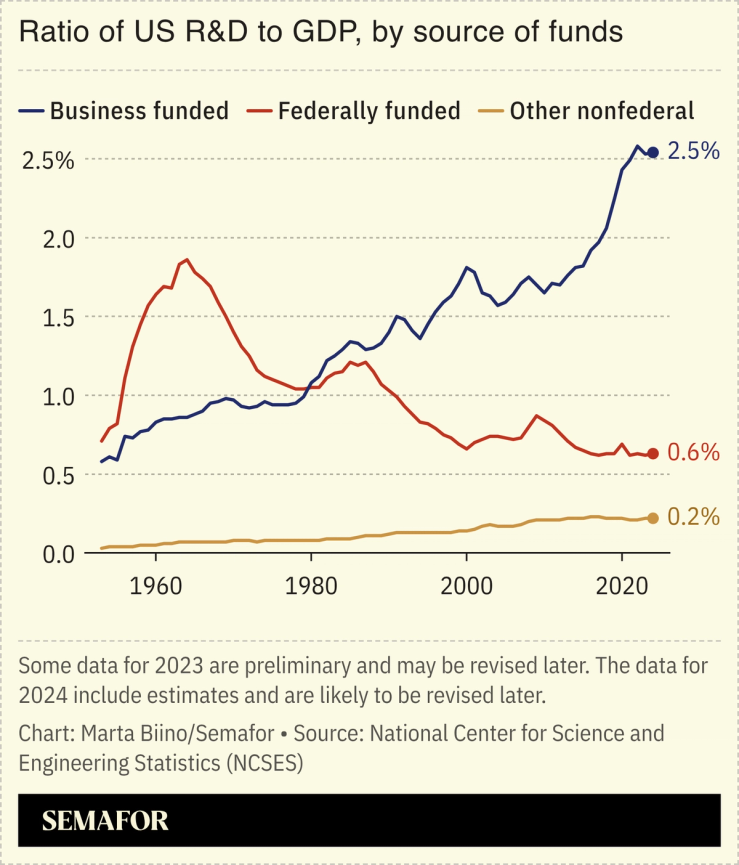
US spending on research and development as a percentage of GDP dropped from a high of nearly 2% during the Cold War to about 0.6% today. The rewards from those Cold War breakthroughs — semiconductors, lithium-ion batteries, and software automation — are starting to peter out. Moore’s law is fading away as an organizing principle and we’re trying to make up for it by making bigger and bigger computer networks. But even manufacturing enough chips is proving challenging.
The world is now facing major shortages of computer memory and old-fashioned, spinning hard drives like the ones you would slide into your computer in the mid-1990s.
Nobody has come up with anything better to help respond to AI-driven demand and the incredible economic opportunity it represents. Even the US military, which helped develop many of the scientific advances that drive the economy today, is having trouble fighting off drones made from off-the-shelf parts, and is hiring former investment bankers to help procure better technology, as my colleague Liz Hoffman scooped.
But if there’s any business the US government needs to get into right now, it’s funding for basic scientific research. We have plenty of capitalism — and capital. We have plenty of entrepreneurs willing to innovate. What we’re getting low on is scientific breakthroughs.

Notable
- A nationwide STAT survey of nearly 1,000 federally funded researchers revealed that more than a quarter have laid off lab members, and more than 2 out of 5 have canceled planned research.