




Alaa’s view
Gulf states have spent the past decade trying to reduce their reliance on oil and gas. But when they begin counting the costs of the Iran war, it is still hydrocarbons – and the vast wealth built on them — that will cushion the economic shock.
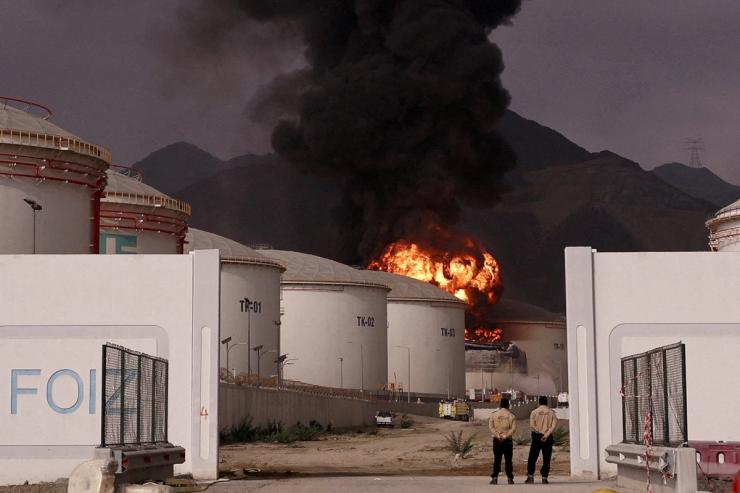
The war was not of the Gulf’s making, but since the joint US-Israeli attack on Iran set it off, the region has had to deal with the fallout. Iran’s retaliation and the disruption of the Strait of Hormuz have reduced oil output and hit sectors from tourism to financial services.
It’s still too early to assess the damage with any precision, but under the base scenario used by many analysts, the most intense military phase will last two to four more weeks, with the bulk of Gulf energy assets left largely intact.
In that situation, shock absorbers ranging from Saudi Aramco’s export pipeline bypassing the Strait of Hormuz to the vast sovereign wealth funds (SWFs) provide the buffers to prevent systemic stress on currency pegs or the banking system.
They could also speed a recovery. The region’s biggest SWFs — in Kuwait, Qatar, Saudi Arabia, and the UAE — hold more than $3.6 trillion in assets. That’s roughly 150% of the Gulf’s annual GDP. There are many smaller SWFs too, as well as hundreds of billions of dollars in central bank reserves. Debt levels are also low by global standards.
Those buffers “help in all but a scenario where the conflict is long lasting,″ said Tim Callen, a former Saudi mission chief at the IMF, who is now a visiting scholar at the Arab Gulf States Institute in Washington. “But in this scenario, the implications for the global economy will be massive as well.″
This helps explain why the bond market has remained relatively calm, according to Razan Nasser, a sovereign analyst at global asset manager T. Rowe Price. Like Callen, she stressed that the longer the disruption lasts, the higher the costs will be. The “market understands the financial firepower that these countries have, and their track record at managing shocks,″ she said. Even after accounting for domestic spending, a “large bulk of their sovereign wealth is still abroad and at their disposal,″ she added.
Resilience varies by country. Oman doesn’t rely on the Strait of Hormuz, while Kuwait and Qatar have no alternative export route. Others, like Saudi Arabia and the UAE, could offset wartime production losses by ramping up oil exports in the future. Current forecasts put average Brent crude for 2026 at between $77-85 a barrel, versus a pre-war average in the mid-to-low $60s.
The paradox is that headline GDP can shrink as output falls even while oil income rises. For governments trying to stabilize the economy, revenue matters more.
“Ultimately, oil revenue will be more critical fundamentally than the possibility of weaker real oil sector growth” caused by the potential loss in production, according to Monica Malik, chief economist at Abu Dhabi Commercial Bank. “The duration of the conflict will be vital for the overall economy.″
Malik sees a scenario in which Saudi Arabia could reduce its budget deficit to 3-3.5% of GDP, from 5.8% in 2025, if prices average $80 a barrel. This assumes the ability to accelerate exports to more than 7 million barrels a day in the second half of the year, alongside higher payments from Aramco due to elevated crude prices.
None of this means the pain will be evenly distributed.
Dubai has spent decades building the most diversified economy in the Middle East. Yet in a conflict like this, that external focus and reliance on international links can also be a vulnerability. However, judging by Dubai’s credit default swaps, a barometer of debt-market nerves, it’s hard to detect a sense of impending doom.
Bahrain, the smallest economy in the region, enters the crisis with much higher debt. Its credit rating was left unchanged by S&P Global Ratings after war broke out, on the assumption that its richer neighbors would come to its aid if necessary. (When Dubai’s economy was swept up by the global financial crisis in 2009, Abu Dhabi came through.)
The question isn’t whether the Gulf will eventually recover. It’s whether the conflict changes national priorities and economic agendas, and whether the region can find a silver lining in a much weaker threat from the Iranian regime.
The answers depend less on the Gulf than on what Washington decides to do next. The Middle East has seen no shortage of wars that promised to reshape it. Few actually did.
Alaa Shahine Salha is a senior executive at Saudi Research & Media Group and an economics contributor for Asharq Business with Bloomberg. He previously served as Bloomberg News managing editor for the Middle East and managing editor for economics in Europe.

Notable
- If the Iran war doesn’t end soon, it could trigger the worst economic slump for the Gulf’s largest economies — Saudi Arabia and the UAE — since Iraq’s invasion of Kuwait in 1990 and the first Gulf War, Bloomberg reported.