




David’s view
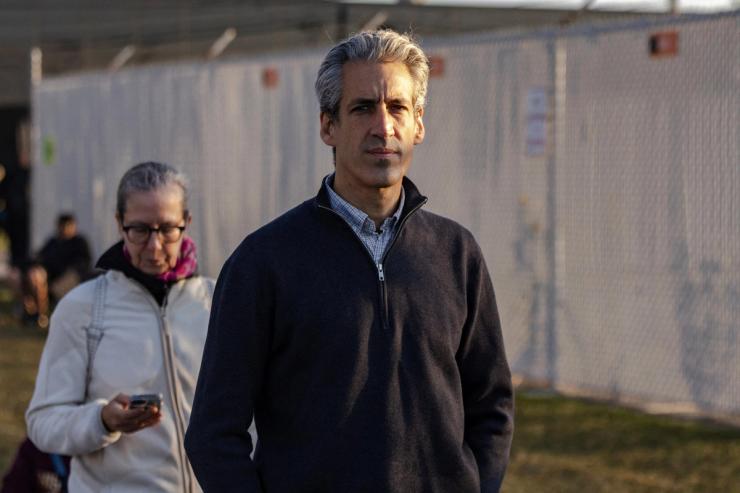
EVANSTON, Ill. — There was a clue that Daniel Biss was about to win his close, hard-fought primary: AIPAC stopped talking about him.
The pro-Israel group had hoped to take down Biss, the well-known mayor of Evanston who was running to replace Rep. Jan Schakowsky, with her endorsement. He offered a one-for-one upgrade — an elderly progressive Jewish critic of Israel under Benjamin Netanyahu replaced by a middle-aged progressive Jewish critic of Israel under Benjamin Netanyahu.
“I believe in Israel’s right to exist as a Jewish democratic state,” Biss told me after a campaign event last week, “so I think of myself as a progressive Zionist.”
AIPAC had beaten candidates like that before. Four years ago, I watched Rep. Haley Stevens, D-Mich., flatten Rep. Andy Levin with the help of AIPAC’s United Democracy Project super PAC. Levin’s identity, as a Jewish liberal who worked with Israel critics, added urgency to the campaign. “Our values spoke very loudly this evening,” Stevens said when she won the primary for the suburban Detroit district.
Whose values spoke in Illinois? After funding three different super PACs across the Democratic primaries — UDP, Elect Chicago Women, and the Chicago Progressive Partnership — AIPAC declared victory over two more avowedly pro-Palestinian candidates in the Biss race. It mocked progressives for being unable to win two other seats it invested in.
But AIPAC didn’t get into the field to beat them; it jumped in to help state Sen. Laura Fine, a rival progressive whose friendly relationship with the pro-Israel group made her unelectable once Biss brought it up. It couldn’t rescue Melissa Conyers-Ervin in the Loop; the winner in that primary, endorsed by retiring Rep. Danny K. Davis, didn’t seek AIPAC’s support because he didn’t support unconditional US aid to Israel.
Five years ago, when pro-Israel groups began spending to beat left-wing candidates, their raison d’etre didn’t really become an issue in their races. UDP and the Democratic Majority for Israel didn’t focus on the Jewish state in their advertising. Progressives, winning or losing to them, didn’t talk about it either.
But nowadays, unconditional US aid to Israel is deeply unpopular with Democratic voters, who are more likely than ever to sympathize with Palestinians over the Jewish state. That’s an existential threat to AIPAC. Why hasn’t it translated clearly into more primary victories for critics of the Netanyahu government?
One reason is that the elections are fought over other topics; none of the AIPAC-related PACs ran ads about Israel. Another is that pro-Palestinian sentiment, among people who vote in these primaries, exists on a spectrum.
It includes people who — like Biss — want the Jewish state to exist, wish it was like the one they supported before the collapse of the Israeli left, and don’t support going to war to defend it. And it includes further-left people who believe Israel should be rubbed off the map, like all “settler-colonialist” states (even the US, for some anti-Zionists).
While AIPAC spent money to defend pro-Israel candidates and fend off the most anti-Israel candidates, Israel’s critics often helped out by fighting amongst themselves.
That tension showed up in the Chicago suburbs this week, and in other races where AIPAC became a flashpoint. In the race for Senate, Rep. Robin Kelly saw an opening when neither Rep. Raja Krishnamoorthi or Lt. Gov. Juliana Stratton called the war in Gaza “genocide,” the popular view of activists and many primary voters.
But Kelly didn’t break through with that effort. It was enough for most Democratic voters that Stratton wasn’t supported by AIPAC, and didn’t support Trump’s war in Iran. AIPAC was a litmus test; having “the right” Israel stance wasn’t.
That was part of the story in Biss’ race, where he was supported by J Street, a pro-Israel group created as a middle-road bulwark against AIPAC — a group he thanked in his victory speech.
Online, where more of the political conversation happens than Democrats would prefer, Biss took fire from both AIPAC and its enemies. AIPAC Tracker, an X account that materializes in the replies of candidates with graphics showing how much they’ve taken from “the pro-Israel lobby,” went after Biss by adding up his support from J Street and “donors who have made large contributions to AIPAC.”
AIPAC commented on the results on X, but didn’t respond to a follow-up email.
In this article:

Room for Disagreement
AIPAC didn’t notch the big wins it’s claiming in Illinois. But it also didn’t repeat the primary-season blunder it made in New Jersey, where it pummeled a moderate Israel critic and helped a more left-wing candidate win the Democratic nod.
As the most powerful potential funder of moderate Democrats, it’s seen how progressives are not automatically benefiting from the base’s frustration with its DC leadership. And it has learned how to effectively goad progressives into a distracting fight over Israel.

Notable
- In Politico, Lisa Kashinsky and Elena Schneider talked to Democrats about the ups and downs of AIPAC’s strategy, which has a .500 batting average in primaries so far.
- In Jewish Insider, Josh Kraushaar argued that Illinois showed AIPAC’s “staying power,” especially when it lined up with AI and crypto PACs to stop a candidate backed by Bernie Sanders and AOC.