




The News
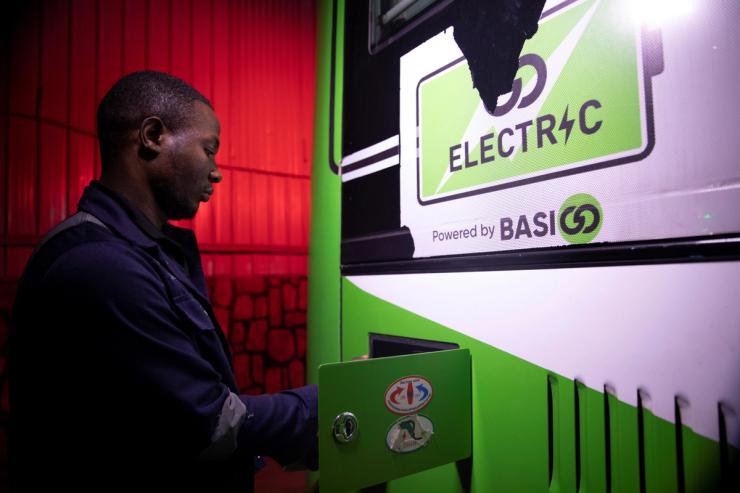
An electric bus startup in Kenya is in talks with fuel retailers to extend its services beyond the capital Nairobi in its largest expansion since launching in 2021, potentially providing a template for scaling up sustainable public transport across Africa.
BasiGo aims to roll out new charging facilities this year at gas stations along Kenya’s coastline as well as in the country’s center and west, Managing Director Moses Nderitu told Semafor, in a move to scale-up rapidly. The company currently has 11 charging stations, of which 10 are in the Nairobi metropolitan area, and more than 100 buses on the roads. The plan would require tens of new charging stations to cover key routes.
Nderitu explained that the inter-city service, which it began piloting last year, was driven by demand from its partner transport companies seeking to cover longer routes but constrained by the lack of charging infrastructure outside Nairobi. The company is also in the “very early stages” of piloting electric light trucks, he said, eyeing the last-mile deliveries market. Nderitu noted significant interest from businesses including supermarkets on electric solutions for deliveries.
Additionally, the company this month began testing a new bus commuter service in Nairobi with scheduled stops on various routes, and pre-booking completed via an app. Nderitu said the expansion into different services would enable the startup to “leverage all the infrastructure we’ve built and ensure we’re not a one-trick pony.”
In this article:

Know More
BasiGo last year raised $42.5 million in Series A equity funding and financing debt to scale its electric bus service in Kenya and currently leads the electric bus sector in the country. Total EV registrations in Kenya crossed 35,000 in 2025 from just 796 in 2022 — with the majority being electric two-wheelers sold by companies including Spiro, Arc Ride, and Roam.
Financing, however, remains a challenge, with companies struggling to keep up with demand. Nderitu said that BasiGo had nearly 500 pending orders — where deposits had been paid to reserve them. The company assembles its buses at a facility on the outskirts of Nairobi, and sells them to transport companies using a “pay-as-you-drive” model, a specialized lease with a low upfront deposit and fees charged per kilometre driven.
“We’ve been on a very fast-paced growth trajectory but it’s not fast enough for our customers,” he said. The company last year doubled its monthly bus assembly output to 20 and has grown from a two-bus pilot in 2022 to 134 buses on the roads, with the company transporting around 20,000 passengers daily. “These are complexities of raising capital while at the same time deploying capital to grow infrastructure.”
Nderitu emphasized that further adoption of EVs would not just be driven by incentives for manufacturers, but also proper public planning to upgrade road infrastructure in urban areas. He explained that poor road networks had an effect on the cost of maintaining and operating their EVs, adding costs for transport providers.

Martin’s view
Kenya’s government in February unveiled its national electric mobility policy, part of its plan to ensure 5% of all new vehicle registrations are electric by 2027. Companies like BasiGo are essential to meeting these ambitious targets, which the government is also counting on to lower its fuel import bill and reduce the strain on foreign exchange reserves.
Access to financing, however, remains a significant barrier as demand outpaces manufacturing and assembly capabilities for many companies. It is essential to provide further incentives to attract greater investment to the sector, particularly if the country is to become a continental hub for the production of EVs.
Other countries including Ethiopia and South Africa are similarly vying to lead the EV market in Kenya, both using strong tax incentives to woo manufacturers. A 150% tax deduction on qualifying capital investments in EVs took effect in South Africa earlier in March, with the country targeting 20% of all vehicle sales being EVs by 2030.
Ethiopia banned the import of internal combustion engine vehicles two years ago and is allowing duty-free EV imports through 2026. Among incentives Kenya has introduced so far are the zero-rating of VAT on electric buses, bicycles, motorcycles, and lithium-ion batteries — but more is required.

Room for Disagreement
Some analysts believe that limited funding for the sector and supporting infrastructure will slow down adoption plans, including BasiGo’s target to roll out 1,000 electric buses on the roads by 2027.
Kenya’s government, for example, has disclosed plans to invest Kes6.12 billion ($47.26 million) to establish 10,000 EV charging stations across highways nationwide by 2030, but specific timelines and detailed plans are yet to be disclosed.
“Manufacturers haven’t been able to match the sharp rise in demand for EVs and it will require significant resources and effort to change that in a short timespan as they must also build the supporting infrastructure themselves, from scratch,” argued Nairobi-based economist Ian Mwangi.

Notable
- State-run electricity utility Kenya Power reported a 188% jump in consumption of power by electric vehicles in 2025.