




Judah’s view
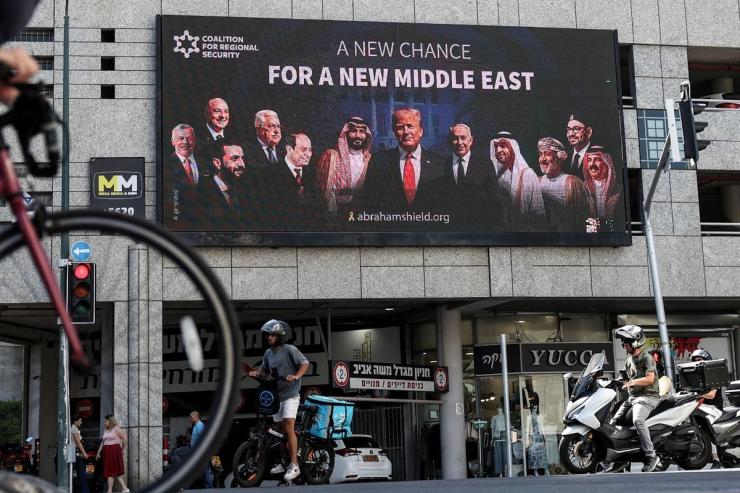
The Abraham Accords that Israel struck in 2020 with Bahrain, the UAE, and others were signed and celebrated by supporters, and almost immediately dismissed by critics as little more than ceremony. More than five years later, those critics are wrong — but not for the reasons those early supporters imagined.
The agreements go beyond tourism or cultural exchanges. They are transforming the Middle East through hardware, bandwidth, and capital, with the military taking the lead.
Military integration is already deeper than public discourse suggests. Israel and the UAE swap early-warning data, coordinate air-defense protocols, and have intelligence-sharing arrangements that would have been politically unthinkable just a few years ago.
Israel’s Arrow 3 ballistic missile defense system — developed jointly with Boeing and tested against Iranian threats in 2024, 2025 and now 2026 — has become the anchor of a layered regional air-defense concept that Bahrain, Saudi Arabia, and the UAE are seeking to integrate more permanently.
When Iran launched a drone and missile barrage against Israel in April 2024, the projectiles were intercepted via real-time coordination among American, Israeli, Jordanian, and Saudi assets. That was not an improvised response. It was the first live stress test of an integrated architecture that had been quietly assembled. We are now witnessing how this partnership has deepened.
The next step is permanence. Defense officials are discussing a regional integrated air and missile defense network with shared radar coverage, linked command-and-control systems, and preauthorized intercept protocols that do not require emergency political coordination before action is taken.
The backbone would rely on hardened fiber, encrypted satellite links, and shared cyber intelligence feeds. Israel’s Unit 8200 alumni network — which has produced one of the world’s densest concentrations of cybersecurity startups — would provide much of the technical talent supporting this ecosystem.
But the deeper transformation is economic. Defense cooperation demands interoperability. That in turn requires shared standards, supply chains, and engineering pipelines. Those requirements, taken seriously, produce something that looks less like a military alliance and more like a strategic industrial cluster.
The components already exist. Israel’s Rafael has opened a regional presence in Abu Dhabi, while Elbit maintains Gulf partnerships, and Israel Aerospace Industries is in discussions with regional sovereign wealth funds about joint manufacturing. Abu Dhabi’s G42, backed by Mubadala, is positioning itself as a regional AI and cloud backbone — and Israeli AI firms are natural collaborators.
The complementarity is structural. The Gulf brings capital and energy abundance, while Israel brings technological density, military-derived research and development, and execution speed. Shared security threats provide the incentive to integrate.
Beyond defense, the corridor’s economic logic expands. Gulf energy can power AI data centers, advanced manufacturing, and resilient logistics networks. Israeli expertise in cyber, semiconductors, grid optimization, and autonomous systems can anchor higher-value innovation layers.
At a time when major economies are searching for locations that combine sovereign capital, engineering talent, energy security, and political coordination, the Israel-Gulf corridor stands out.
Taiwan offers semiconductor dominance but faces geopolitical risks. Germany offers engineering depth but energy vulnerability. The Gulf has capital and energy. Israel has talent and innovation. Integrated, they form a cluster few other regions can replicate.
History shows how defense integration can seed durable economic advantage. The US defense-industrial base after World War II, South Korea’s industrial ecosystem built around state-backed defense demand, and Israel’s own tech sector — born from military R&D — all illustrate the same lesson: security alignment can create long-term competitive strength.
The hardware is already being installed. The question is whether leaders and capital allocators recognize that they are not merely building a missile shield. They are laying the foundation for a new regional economy that could redefine the Middle East as a strategically integrated, technologically dynamic growth corridor. The window to shape it is open now.
Judah Taub is the founder and managing partner of Hetz Ventures, an Israeli early-stage venture capital firm specializing in cybersecurity, data, and AI infrastructure.
In this article:

Room for Disagreement
The war is further evidence for many Gulf countries that Israel — after its response to Hamas’ Oct. 7, 2023 attacks — has become “a major source of insecurity and instability in the Middle East, at least on a par with Tehran,” writes Hussein Ibish, senior resident scholar at the Arab Gulf States Institute in Washington, in Haaretz. This marks a shift from the pre-Oct. 7 view among many Gulf states, which saw Israel as a contributor to regional stability amid competition with Iran and Türkiye, Ibish said. Expanding the Abraham Accords is now unlikely to advance in other Gulf countries, especially as Riyadh insists that progress on Palestinian statehood must precede normalization of ties with Israel, writes Elham Fakhro, a fellow at the Middle East Initiative at the Harvard Kennedy School.

Notable
- The Abraham Accords are ushering in a new era of defense-industrial cooperation between Israel and the Gulf signatories, according to analysis by Elizabeth Dent of the Washington Institute for Near East Policy.