




Jason’s view
As the United States and Israel confront Iran directly, most attention has focused on the Middle East. But another Iranian proxy has been quietly expanding elsewhere — and almost no one is paying attention.
Now that Tehran’s aggression is finally being challenged head-on, ignoring this proxy would be a serious mistake.
That theater lies in North Africa. The actor at its center is the Polisario Front.
For decades, Iran has been perfecting a strategy of cultivating armed nonstate movements far from its borders. These groups often begin as small insurgent or separatist movements that present themselves as political actors but in reality operate as heavily armed militant and terrorist organizations. They receive ideological guidance, training, money, and weapons from Tehran. Over time, they destabilize governments, threaten regional security, and advance Iran’s ambitions without requiring Tehran to fight directly.
The world has already seen where this strategy leads in Lebanon, Yemen, and Gaza, and the consequences have been devastating.
In Lebanon, Hezbollah evolved from a militia into a powerful terrorist organization that hollowed out the Lebanese state and subordinated the country’s sovereignty to Tehran. In Yemen, the Houthis grew from a local insurgency into a force capable of threatening global shipping while plunging the country into years of war and humanitarian devastation. Hamas has played a similar role in Gaza.
These outcomes were the result of Tehran’s deliberate strategy, and the same pattern has been unfolding in North Africa.
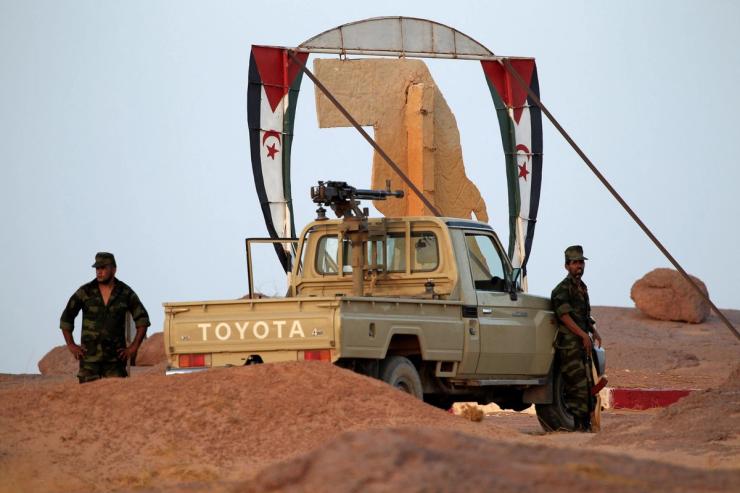
The Polisario Front operates in and around the Moroccan Sahara, sometimes referred to as the Western Sahara. It seeks to establish an independent state called the Sahrawi Arab Democratic Republic, or SADR, proclaimed in 1976 during its armed conflict with Morocco. Rabat administers most of the territory and views the Polisario as an armed militia threatening its territorial integrity and regional stability. Today, only a small number of governments recognize the SADR, and several countries that once did have withdrawn recognition.
The US made its position clear in 2020 when President Donald Trump formally recognized Moroccan sovereignty over the Moroccan Sahara. The decision reinforced Washington’s support for a longstanding ally: In 1777, Morocco became the first country to recognize the US and remains one of America’s most important security partners in North Africa.
Trump’s recognition was also part of the diplomatic breakthrough that led Morocco to normalize relations with Israel under the framework of the Abraham Accords in December 2020, a diplomatic coup that many observers once believed impossible.
Iran’s relationship with the Polisario Front long predates those developments. Tehran recognized the so-called Sahrawi Arab Democratic Republic as early as 1980, and its relationship with Polisario has deepened since.
Morocco has repeatedly accused Iran and Hezbollah of providing training, logistical support, and weapons to Polisario fighters. When Iran embeds itself with militant groups like the Polisario, the goal is not symbolic support. Tehran gains influence, operational reach, and the ability to destabilize regions through armed proxies rather than direct confrontation.
The US has not designated the Polisario Front as a Foreign Terrorist Organization and generally describes it as a separatist armed movement involved in a territorial dispute. But the absence of a formal designation does not eliminate the strategic risk.
History offers a clear warning.
For years Hezbollah was treated internationally as a complicated political actor rather than what it was becoming: a heavily armed Iranian proxy that ultimately dominated Lebanon’s political and security system while driving the country into economic collapse. In Yemen, the Houthis followed a similar trajectory before evolving into a force capable of threatening global maritime trade.
By building ties with the Polisario, Iran gained a foothold in North Africa and a means of pressuring Morocco, one of Washington’s most reliable regional partners. Morocco’s cooperation with the United States includes counterterrorism coordination and broader regional security efforts.
Undermining Morocco therefore undermines American interests.
For too long the world responded to Iran’s proxy strategy by looking away and hoping local conflicts would remain contained. That approach helped produce the crises we see today.
The world ignored Iran’s proxy strategy before. It should not make the same mistake again.
Jason D. Greenblatt was the White House Middle East envoy in the first Trump administration. He is the author of In the Path of Abraham: How Donald Trump Made Peace in the Middle East and founder of Abraham Venture LLC.

Notable
- The Horn of Africa could become a new theater in the war between the US, Israel, and Iran. Djibouti and Somaliland which sit at the Gulf Aden chokepoint are most exposed, longtime African security journalist Tomi Oladipo wrote in a Semafor column.