




The News
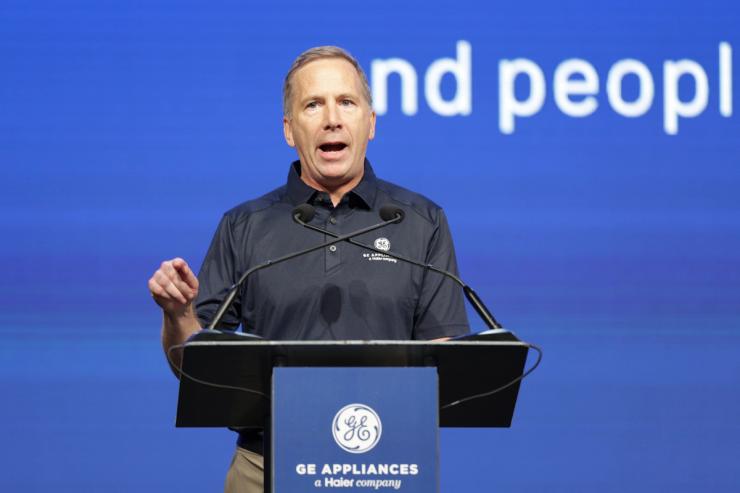
At GE Appliances, Kevin Nolan’s career looked at one point to have peaked. A circuit-breaker engineer, he was a Chief Technology Officer in an industry run by — in his words — “a bunch of bureaucratic finance people.” Then, in 2016, the Chinese appliance giant Haier bought the iconic US maker of refrigerators, cooktops, and washing machines, and made him CEO. Now he sits on the Haier board.
The way Nolan sees it, the shift in his career fortunes illustrates an essential difference between the superpowers: China reveres engineering talent; the US, he argues pejoratively, values investment bankers.
The raw data show the US is in a precarious position, in this regard: Every year, China graduates 1.3 million engineers compared with 140,000 in America. While those numbers need qualification — for instance, they don’t account for immigrants to the US filling the gaps, or speak to the quality of graduates in either country — China still has a decisive advantage in turning innovative ideas into commercial products, from kitchen tools to power turbines.
As a rare American running a Chinese-owned company, Nolan has found that when it comes to product innovation “we can outpace China.”
Indeed, GE Appliances has no shortage of bright ideas, nor does the US lack inventive minds. In Louisville, Kentucky, the company headquarters, Nolan has tapped into its own customers to crowdsource ideas, and relies in part on a scattered network of “makers” — tech geeks, tinkerers, and artisans — to produce prototypes.
But the products they create are mass produced outside the US. As Nolan acknowledged: “We don’t have a way to go from prototype to tooling.”
In this article:

Andy’s view
For the US, this is a chronic problem. The engineering skills — along with the factories — that the country needs in order to rebuild its industrial base disappeared to China a generation ago, and they’re not coming back.
In particular, a dearth of experienced tooling engineers — experts with inside-out knowledge of injection molds, dies, drills, jigs, and gauges to manufacture goods at scale — is arguably the single greatest impediment to reshoring production to the US, a central pillar of the Trump administration’s “Made-in-America” push. Apple CEO Tim Cook once explained why he, for one, can’t shift manufacturing out of China, saying that in China “you could fill multiple football fields” with tooling engineers but in the US “I’m not sure we could fill the room.”
That’s a US national security concern, a social concern — manufacturing jobs are generally well paid and come with benefits — and, for companies like GE Appliances, a competitive concern. In consumer products, “first-movers” take home the lion’s share of profits. Speed to market is everything.
In many ways, the Chinese purchase of GE Appliances has been a success. Founded by Thomas Edison, the American inventor of the electric lightbulb, the company was long an orphan in the GE corporate portfolio, kept more for sentimental reasons, some analysts believed, than commercial ones. Its Chinese owners have pumped in capital, and revamped production lines.
Yet the smart devices driving GE Appliances’ future come out of the downtown community-based innovation center called FirstBuild, which is Nolan’s own passion project. He drew inspiration for the workspace from the Chelsea Hotel in New York, a center of the 1960s counterculture movement designed as a place to inspire creativity through “forced collisions” between the poets, artists, and songwriters who stayed there. “The vibe was: Get people to meet who don’t normally meet,” he told me.
At FirstBuild, collaboration between “makers” and GE staff has produced a string of product hits, from a connected light bulb to a crushed ice-maker and a smart indoor smoker. Ironically, many are stamped Made-in-China.

Room for Disagreement
Nolan gives credit to the Trump administration for at least articulating the goal of reshoring production, although he faults its methods. Tariffs, he says, only drive up the cost of manufacturing equipment — laser cutters, 3D printers, lathes — that are often imported, some from China. But a smart national strategy would prioritize strategically important industries, like semiconductors and pharmaceuticals, over consumer products. Human talent will be a bottleneck for the foreseeable future. It will take many years to train a new generation of tooling engineers — even supposing the field can once again attract the brightest young minds.

Notable
- Breakneck: China’s Quest to Engineer the Future, by Dan Wang, argues that China is a nation run by engineers who build things, while the US is run by lawyers who stop things being built.