



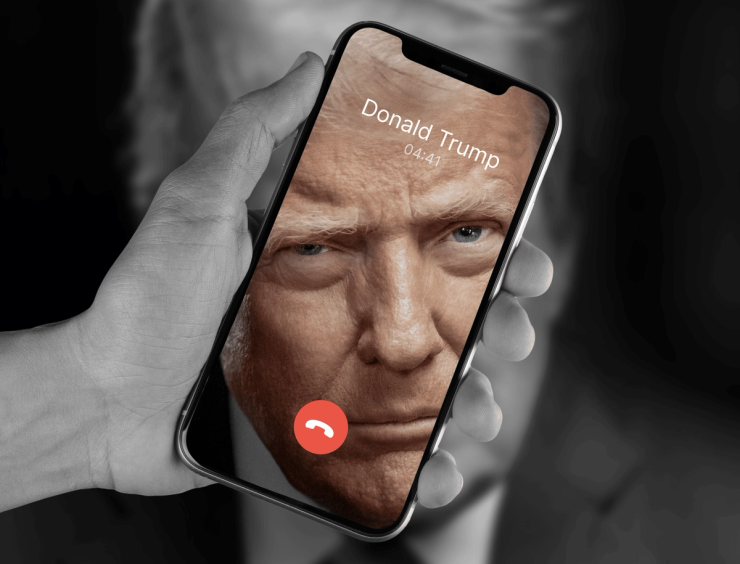

The News
The calls come in late at night, when the president can’t sleep. They come in when he’s watching TV in the evenings, and right after a game of golf, when he’s in a good mood. They come in early in the morning, as soon as he starts posting to Truth Social — but sometimes he’s a little snappy at that hour.
President Donald Trump’s iPhone won’t stop ringing because his Palm Beach number has become the ultimate status symbol in a town obsessed with proximity to power and influence.
This has produced a curious new form of journalism. In the two weeks since the US and Israel began military operations in Iran, Trump has done more than 30 cell phone interviews. He has become the presidential version of a drive-time radio host, picking up without screening his callers and conducting brief conversations with the public — in this case, journalists from outlets from The New York Times to Washington Reporter. One day earlier this month, ABC News’ Jonathan Karl and Rachel Scott each got separate interviews with Trump, in which he told them each how well the Iranian operation was going.
The president may be annoyed at the occasional early morning call, but he and his aides don’t really object all that much. Inside the White House, his new attentional strategy is a matter of some amusement.
When the president picks up, “he is often preoccupied, puts them on speaker in front of a large group of people, and he is loosely chatting and has fun messing with them,” said a White House official, who spoke on the condition of anonymity to say something that reporters ought to realize: Trump isn’t taking these calls that seriously.
“Reporters who think they are being serious journalists by calling him are frankly doing themselves a disservice.”
And journalists are also beginning to realize we aren’t entirely in on the joke. As The Atlantic dryly noted recently, “Few of these interviews have led to a lasting impact on the nation’s understanding of the war.”
And yet: How can you not?
“I feel like Frodo with the ring,” one Washington journalist who has spoken with Trump over the years said. “I know it’s dangerous, but it keeps beckoning me.”
And so early last week, after reading what felt like the 50th exclusive phone interview with Trump, this time from a reporter I’d never heard of, I set out to obtain the president’s number and call him. It would have been too easy to ask my colleague Shelby Talcott, and I wanted to test the impression number-possessors like to give out that it’s a kind of holy grail of access journalism. The Atlantic even reported that Trump’s number may be for sale to the highest bidder.
I quickly found that — like many things in this age of scams — the fact that something’s for sale doesn’t actually mean it’s particularly hard to get. Indeed, it’s the worst-kept secret in Washington.
Two minutes into the second phone call I placed in reporting this story, a national political journalist who hasn’t even used the number themself volunteered it to me, unasked. The next call I made, a reporter from another publication offered it up to me, requesting only that I not share it with anyone else.

Know More
Before there were cell phones, every New York journalist had Trump’s number. You could call his office, ask for Mr. Trump, and his secretary would quickly put you through. He’d chop it up on just about anything. Indeed, Trump quotes were so ubiquitous that The New York Observer briefly forbade their use. And those habits followed him to the campaign trail and then the White House when he was elected in 2016.
In the first term, Trump’s phone usage deviated from that of other recent presidents, who would call friends and others for counsel but rarely dialed up members of the news media just to chit-chat. The president didn’t hesitate to call media figures for advice, such as Sean Hannity and Tucker Carlson. Then-Fox News host Pete Hegseth got his preparation for life inside the administration when, as I reported in 2018, Trump dialed him into White House meetings to get his take. Trump occasionally called straight-news journalists, as well.
But while some became accustomed to the occasional presidential call out of the blue, one method of contact — his personal cell phone — remained a closely guarded secret among the select few in the media who had it. Even fewer called him.
Trump’s personal cell phone usage seemed to increase in the years between his two terms. He swapped out a series of cell phone numbers with Manhattan area codes for a Florida number that began to circulate, and started more regularly texting with friends, businesspeople, and influential Republicans.
Members of the media caught on, including NBC News reporter Garrett Haake, who got Trump’s first comments after former President Joe Biden dropped out of the 2024 presidential race by calling Trump’s cell. A stream of steady exclusive calls over the next several months, largely from television networks, signaled to people in the media that Trump’s cell phone was fair game, and he’d be willing to pick up the phone (and even, occasionally, call back).
Like any trend, once media organizations saw others calling Trump, they sought out the number and began to try it themselves. One media figure told me they got the number at some point from a Trump family member. Another said it had been shared with them by a major business figure. Journalists have increasingly shared it amongst themselves. At Semafor’s Trust in Media event in Washington in February, Meet the Press host Kristen Welker told me she’d gotten the number the old-fashioned way: asking Trump for it personally. (He gave it to her.)
But that access is hardly limited to the TV networks. Trump’s spoken with reporters at national newspapers and magazines, insider Beltway political sites, and niche conservative publications. He’s spoken on the phone with reporters from British and Israeli outlets at least four times. Axios’ Barak Ravid has reported on four separate calls, the record for any reporter.
The broad knowledge of Trump’s cell number in Washington has led to new kinds of journalistic strategizing about how to get him on the phone and what to do if he picks up. The conventional wisdom shared by most people who spoke with Semafor was to try Trump late in the evenings when he is watching TV and chatting. One person with his number said the only guaranteed way to get him was to get him on the horn in the middle of the night when he can’t sleep. Another person who’d spoken with him by phone recently said to give him a call early in the morning. Others said don’t give him a call in the morning, as that’s when he’s snapped at some reporters.
One journalist said he’s often in a good mood after a round of golf, and is more likely to give you something good then. Others have reasoned that the best time to try him is right after he posts something on Truth Social, because he’s in the mood to share his opinion. Everyone seems to consult the official presidential pool reports to see when he won’t be busy with other activities.
And the bosses are getting involved. Media organizations have also developed systems around the number to prevent it from being overused. The Atlantic’s Michael Scherer, the author of Saturday’s piece, is the keeper of Trump’s cell number for the magazine. NBC News has a small team that coordinates when someone is planning on calling Trump, as do Politico and The Washington Post (where the primary Trump cell manager is reporter Natalie Allison).
If you’re lucky enough to actually get him, a few elements seem to generally apply to all calls. They’re almost always a few minutes long or less, which media outlets have described, in charitable shorthand, as “brief.” Two journalists who have interviewed him in person in recent years said he has stopped their interviews at multiple points to field phone calls from other journalists and various public officials and business figures.

The Call
I brought this distilled wisdom back to Semafor’s office Thursday to strategize. If the president picked up, my editor and I discussed, how should I begin the call? Before we could decide, one senior colleague had a suggestion: bring up someone you know in common. Despite the noise, our Trump White House reporter Shelby Talcott (who has called Trump) told me it didn’t matter when you called, so I decided to try him Saturday afternoon when his schedule seemed a bit lighter.
Two people who have spoken with him by phone or watched him answer his phone told me he doesn’t screen his calls and answers his phone with no introduction, and a simple, inquisitive “Hello?”
So I braced myself and dialed. He didn’t pick up.
I consoled myself that I wasn’t missing much. The brief Trump interviews have not produced particularly edifying journalism, I told myself.
There’s both an element of cope and some truth to this. For instance: In a series of nine phone interviews about the war in Iran, Trump gave nine different, vague answers that offered little insight about when the White House may actually end the war. On Feb. 28, he said the war could be over in two or three days. A day later, he told ABC that it would actually be four or five weeks, most likely. On March 2, he told Jake Tapper that the US was “a little ahead of schedule” of its 4 week window. But two days later, he told Time magazine it had “no time limits.”
The Washington Examiner put an exclusive tag on the scoop: Trump doesn’t know if Iran war will nab him elusive Nobel Peace Prize. The Washington Free Beacon’s Jon Levine called Trump and broke the news that that he was feeling “fine” about Operation Epic Fury.
Now, some Washington journalists have begun to sneer at the practice.
One television insider called the breathless Trump phone exclusives “shameless.” Another said they thought it was “silly and doesn’t add much value.” Another said the interviews were “useless.” Of course, all three acknowledged that they had at one point or another called Trump on the phone and reported out the details. But they suggested that the real offenders were others who were abusing the privilege for largely meaningless interviews and, let’s face it, clout.
“He’s having a good time and saying whatever he wants having gotten softball questions,” one journalist who has spoken to Trump told Semafor.
Eric Schultz, who served in former President Barack Obama’s White House, marveled at the number of reporters who had Trump’s cell phone, a situation that he said would be inconceivable in Obama’s White House. He told Semafor that Trump was a “master at offering access in exchange for favorable coverage,” but said the interviews had “no truth value”; most Washington reporters who called Trump for quotes were just “reprinting his nonsense.”
“What is the end goal? Is it to get the president on the phone, make a video about it, and everyone retweets it?” he said. “Or is to hold powerful people to account. Is it access or truth?”

The View From Pennsylvania Ave.
Trump’s team hasn’t always been thrilled about his cell phone usage. People Semafor spoke to said the White House communications shop has gently tried to encourage reporters who call Trump to go through proper channels for interview requests.
According to two people familiar with the comments, Trump had suggested at various points that he would stop using his personal cell. At one point in the time after the 2024 campaign, some close to Trump believed that the plan was for him to ditch it after he returned to office. The Atlantic reported last year that Trump’s team let him know that calls on his personal phone could likely be heard by foreign intelligence agencies.
“President Trump is the most transparent and accessible president in history, and he’s truly his own best messenger,” White House press secretary Karoline Leavitt told Semafor in a statement. “The press cannot get enough of him, and they know it.”

Max’s view
Nearly 12 years into the Trump political experience, the former host of The Apprentice is still finding new ways to mutually benefit himself and the news media he has a love-hate-relationship with.
Years after reporters stopped breathlessly writing up every tweet or crazy moment, the Trump phone exclusive is a new trick that makes news organizations parrot his views, this time under the guise of major scoops. Some interviews have offered insights into Trump’s thinking, but most are less revealing than the average Trump Truth Social post.
Still, he has set a new expectation for contemporary politicians, a level of spontaneous accessibility that is notable in an age where some public figures are highly managed and expose themselves to the media as little as possible.
And it’s certainly working better than the last guy’s strategy. Joe Biden’s team believed they were gaming the system by giving out interviews to select influencers and TV personalities while avoiding legacy outlets like The New York Times and The Washington Post. The dubious strategy backfired spectacularly as the then-president stumbled through questions during his presidential debate with Trump.
Biden wasn’t in a state to go toe-to-toe with Trump. But he was also rusty from largely avoiding confrontational questions, a criticism which many Democrats raised in the aftermath. And when Times reporter Tyler Pager called Biden’s personal cell phone number, Biden’s aides called to berate him over it.
On Sunday, I ran into California Gov. Gavin Newsom backstage after his interview with podcaster Vivian Tu. When I asked him what he thought about Trump’s accessibility via cell phone, he jokingly offered to give me Trump’s number, adding that he “thought he was special” when I informed him that I had it already. Newsom said Trump was simply feeding his need for attention.
“I can barely handle my job today with the cell phone and everyone calling and ringing every single day,” Newsom told me. “You need someone to actually think for a moment, not impulse. It’s impulsive, it’s all made up on the fly because this guy hasn’t taken a breath. It’s all ‘you haven’t talked about me in 10 minutes,’ it’s a malignancy of narcissism.”

Notable
- Aidan McLaughlin first detailed Trump’s growing cell phone habit last year, noting that regular Trump caller Piers Morgan described the personal cell phone as a “weapon.”
- Trump understands the power of releasing a private phone number. During the 2015 campaign, he read South Carolina Sen. Lindsey Graham’s cell phone number out loud during a campaign rally.
- In some ways, Trump’s interviews are a return to an old media debate: During the 2016 campaign, Trump phoned into the television news networks, a practice that many eventually prohibited because critics said it allowed him to read off his notes during the interview and otherwise steamroll reporters. The current practice, calling him up and getting a single quote or sound bite, hardly seems any better.
Lauren Morganbesser contributed to this report.