



The News
As the war in Iran spikes oil prices, the Trump White House and its allies are offering reassurances similar to how they marketed tariffs and tax cuts: The short-term pain will be worth the long-term gain.
After President Donald Trump launched his massive “Liberation Day” tariffs, Republicans told consumers that temporarily higher prices would be a small price to pay for reshoring US manufacturing and balancing global trade. After Republicans enacted their megabill, they countered warnings that its Medicaid cuts would land badly by telling voters to hold out for fatter tax refunds and faster economic growth.
But the war in Iran will be the party’s toughest sell yet — not just because midterm elections are drawing closer. Americans are hypersensitive to cost increases after years of price spikes. Voters will also have an easier time connecting the dots between the price at the pump and conflict in the Middle East, making it harder than ever for the administration to convince voters that it prioritizes domestic affordability above foreign policy.
One poll this week found that almost half of Americans blame Trump for more expensive gas, even as the president rolls out a host of new proposals to keep oil flowing worldwide.
“The war has obviously caused the price of oil to go up and the price of gasoline to go up — and the longer that stays up, the more electoral danger there is for Republicans,” Sen. Rand Paul, R-Ky., told Semafor. “I think that’s why you’re seeing rumblings of: ‘Maybe we’ve hit all the targets we need to hit.’”
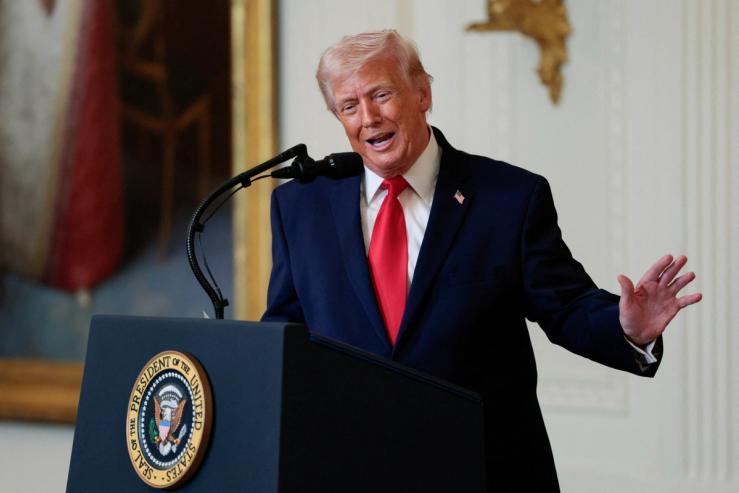
Trump suggested last week that oil prices could eventually “drop … lower than even before” as a result of his war. White House press secretary Karoline Leavitt made similar comments this week, telling reporters that “Americans will see oil and gas prices drop rapidly, potentially even lower than they were prior to the start of the operation.”
Asked to elaborate on how the war ultimately might lower oil prices, White House spokesperson Taylor Rogers pointed to the role “Trump’s energy and dominance agenda” played in boosting production — and lowering prices — before the US and Israel began bombing Iran.
“Frankly, long-term, once we get this resolved, I think energy prices come down probably to a level below where it was before this all started,” Sen. Bill Hagerty, R-La., told Semafor. “So, if you’re willing to look to the medium- and long-term, this is going to be very positive from an inflation perspective.”
His forecast could turn out to be correct, even as the price of oil repeatedly breaks $100 a barrel despite efforts from the US and other nations to ease the pain. Markets had priced in the war in Iran before it began, so prices could reset lower once it ends. More important, oil supply was on track to outpace demand, according to JPMorgan — which might drive them down further still.
But economists say that all depends on when the Strait of Hormuz can be reopened and whether oil infrastructure survives unscathed. And right now, there’s little guarantee of either, even as the White House continues to insist the war will end soon.
Oil prices “might continue to fall after the war, if — if — oil production infrastructure is not damaged by Iran’s rockets and drones, and if — if — Iran allows free passage through Hormuz,” High Frequency Economics’ Carl Weinberg said. “None of that is assured. ”
The longer the war lasts, “the less certain that future becomes,” said Alex Jacquez of the progressive group Groundwork Collaborative. One reason: supply chains may have to “completely reorient” to account for a closed Strait of Hormuz, he said.
Even Republican backers of the war agree with him on that.
“We’re not getting caught with our pants down on this, and so I don’t think it’s gonna be a wild swing,” Sen. Cynthia Lummis, R-Wyo., said. “Now, if this Iran conflict drags on and on and on — then that could make for a different scenario.”
Said Hagerty: “The most important lever” the administration has to lower oil prices “is to resolve the situation in Iran as soon as possible.”

Know More
The Trump administration took a far different view of oil resources when it ousted the leader of Venezuela in January. Back then, Trump immediately moved to take control — even setting up a Qatar-based account for oil sales revenue to be distributed back to the country through the US government. Controlling Iran’s oil in any similar fashion has not been a main topic of conversation inside the administration, people familiar with the situation told Semafor.
Part of the reason for that is the far more complicated regional security situation surrounding Iran, as one person close to the White House explained.
“In Venezuela, you’re operating in a more stable hemisphere where the goal is to neutralize the Maduro threat while also supporting economic rebuilding that ultimately benefits the region and our own national security. Iran is different,” the person said. “There the mission is squarely about national security — stopping a regime pursuing nuclear weapons and funding terrorism.
“Oil in that region is the international affairs third rail, and if you’re going to touch it, you have to make sure the aftershock isn’t lethal,” the person added.
Asked whether the administration plans to assume a more active role in Iran’s oil market in the future, Rogers said only that the administration’s “focus is on achieving” objectives Trump has already outlined. Among those objectives are preventing Iran from obtaining a nuclear weapon and decimating the country’s naval capabilities.
The Trump administration is weighing new ways to help the war feel kinder to American wallets, including temporarily allowing foreign ships to move fuel between US ports and to insure and escort ships through the strait (though neither of those options have officially materialized yet).
Democrats aren’t waiting to see how things pan out before going on the offensive. Already, lawmakers are plotting how to point the finger at Trump on the campaign trail.
“House Republicans promised Americans lower prices, but instead families are stuck paying more at the pump thanks to another one of Donald Trump’s reckless endeavors,” Aidan Johnson, a spokesperson for House Democrats’ campaign arm, told Semafor.
The president has worked to keep selling his efforts on domestic affordability. GOP lawmakers said they’re well-aware of the political risks.
“It’s something we’ve got to keep an eye on,” Sen. Shelley Moore Capito, R-W.Va., said. “Gas prices are something people are especially sensitive to.”
Sen. Lisa Murkowski, R-Alaska, warned the war could also exacerbate tariff-fueled economic uncertainty.
“One thing that we do know is when there’s volatility in your economy, lots of things go out of whack,” Murkowski told Semafor.

Notable
- Energy inflation is becoming a massive global liability, Semafor’s Tim McDonnell wrote this week.