




The Signal Insight
Hayden Brown has seen some unusual visitors recently to Upwork, the freelancer marketplace she runs. Clients’ AI agents have been posting job ads to its platform, trying to hire humans to carry out tasks they cannot complete on their own.
They’re not having much success so far, Brown says, even as she predicts that demand from these agentic bosses will grow — a bet that other companies are also making, including a startup called RentAHuman. But she also believes what’s happening in the workforce is more nuanced than the “overblown headlines” predicting a world where human labor has been shunted aside. Few businesses want to vibe-code critical operations like their website, she argues. Instead, Upwork is seeing intense demand for “AI orchestrators” — individuals who combine tech fluency with human judgment and problem-solving skills.
Brown was named Upwork’s CEO in January 2020, and has recast the company as a “human- and AI-powered” marketplace, connecting businesses with the people they need for simple tasks or long projects. Soon after OpenAI launched ChatGPT in November 2022, she called her staff together to debate whether to stick with its previous plans or rethink them, given the technology’s potential for reshaping workplaces.
“It was a divided room,” she recalls, but she felt strongly: “We cannot wait for others to figure this out for our customers.” So she tasked a small team with reimagining what Upwork would be if it were “built on AI.”
The exercise led, among other things, to the creation of an agent on Upwork’s platform, called Uma, which assists users with tasks from writing job descriptions to conducting interviews. Brown also struck a partnership with OpenAI to offer AI training certifications. Freelancers are more likely to take up such opportunities to update their skills than companies’ full-time employees, she believes. “Freelancers are the ones who move fastest to adopt new technologies and upskill, because it really does put food on their table.”
This interview has been edited for length and clarity.
Andrew Edgecliffe-Johnson: Upwork’s mission is “to create opportunity in every era of work.” How much harder is that in the AI era, when much of the conversation is about technology being in competition with human jobs?
Hayden Brown: There’s a lot more nuance to what’s happening. AI is redefining the nature of the firm. In the past, businesses were this huge pool of full-time employees who were kind of captive to the organization, doing bespoke workloads. The new firm, as is being redefined by AI, is a much smaller corpus of full-time employees, because those are the least flexible workers in your talent pool. AI agents are taking up more workloads, and firms are realizing they need flexible talent to work alongside those agents, and it can’t be a full-time job that’s very rigid and defined through the traditional norms. [They’re breaking jobs down into] atomic units of work [and] shifting their workforce dollars away from full-time workers towards flexible and contingent talent pools.
I would expect you to be telling companies they need a more flexible workforce, because that’s your business. But are the numbers supporting that?
We talk to clients, and 63% of them are saying a lack of AI skills is the major blocker for their AI transformation, and they cannot get those workers through full-time models and their local talent sources. One of our recent surveys showed that 70% of business decision-makers are expecting to increase their use of flexible talent because of AI. On our own platform, [AI-related jobs] grew more than 50% year over year in 2025. And specific skill groups that are AI-powered are growing at a phenomenal rate: AI video generation and editing was up 329% in 2025.
What are the agents you’re launching now going to do?
We ran some experiments in 2025 where we built a preliminary experience for clients to invoke AI agents to execute work for them within our platform. What we learned was that AI agents alone were highly incapable of completing work on their own. But when we brought a human freelancer into the mix to work with that AI agent, the completion rates went up by 70% or more. So we will be rolling out that experience more broadly to our customers, where they can now hire human and agent pairs, because we see huge demand for these human orchestrators. This is like a new class of professional: human talent that’s equipped to work with AI, but is also bringing creativity, judgment, and vision, all of these uniquely human skills to bear on an AI solution.
What are people willing to pay for the agent versus the human?
The professionals who are doing this AI-enabled work are commanding 36% premiums in their hourly rate wages. On the agent side, depending on the complexity of the work and the amount of agent involvement, clients are very willing to pay for that. We’re also seeing AI agents and AI agent developers eager to participate in our ecosystem, because it’s an amazing training ground for them to get a full feedback loop on what their agent is delivering and how that agent work goes from incomplete to complete with human involvement.
Do you have any agentic clients?
We actually see agents hitting our website and trying to hire humans to get work done. It’s a small volume, but AI agents are getting asked to do things that often they cannot execute on their own. So they come to Upwork, they try to post a job, they try to create an account, and they try to execute tasks through our platform.
So we really are going to be working for the robots?
We’ll be working alongside them, not for them. That is our strong point of view.
Are people answering those job ads? Are agents successfully hiring human beings?
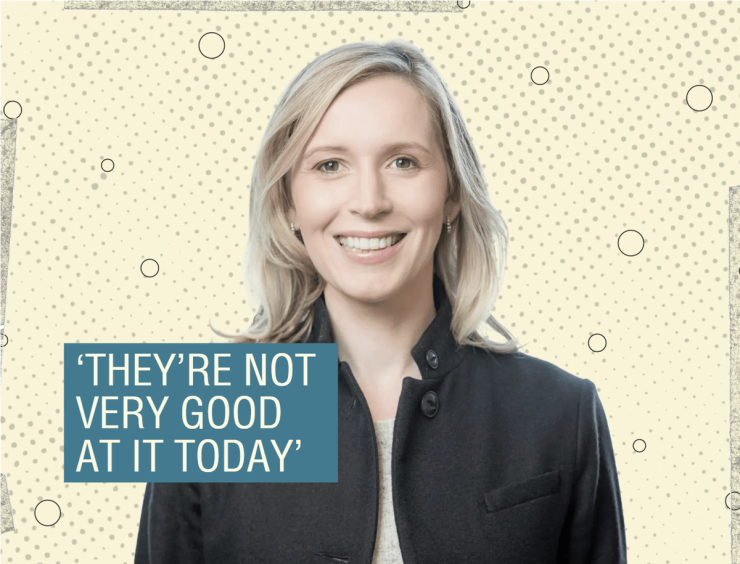
They’re not very good at it today, because they lack a lot of the clarity and comprehension of the work that’s required.
You practice what you preach; about 1,500 of Upwork’s 2,000 people are freelance. What’s the biggest challenge of managing a workforce with that many freelancers?
To get the most out of this model, companies have to break down work into more atomic units around tasks and skills. Because when you’re engaging freelancers, it’s not like you’re just taking a full-time role and then putting it into the freelance ecosystem. It’s usually something different, and we’ve become very good at that. The exciting thing for Upwork is that AI is now forcing every business to look at their jobs and reconsider, what is it really that this full time employee does? What does this job entail? Can I break that down, give some to AI, and give some to a flexible or part-time worker?
What do CEOs typically get wrong about the freelance world?
CEOs who are less familiar with this model often don’t understand the level of skill that these folks provide. It also takes them a few reps to understand that this can be a new operational backbone for them that opens up completely different ways of working. A lot of people have this mindset [that] every job is in the shape of a full-time employee. [With our model], they can literally spin up talent in hours and then also spin it down. They’ll do a pilot or test a product and if it doesn’t work, OK, move on to the next thing.
What we see today is companies are becoming more ambitious in what they can accomplish because they know they have access to AI and access to these flexible workers. It’s not just about doing the same with fewer humans, it’s about doing more with a different mix of humans and machines.

Notable
- CEOs know AI will displace some jobs and create new ones. The question most are wrestling with right now is, how long will the lag period — and friction — between these two cycles last? Semafor’s Rachyl Jones looks at the history of the telephone operator to argue that it will take longer than we think.
- Advances in Claude, Anthropic’s large language model, have shaken several industries this year. But the AI firm itself says LLMs are still far from reaching their theoretical capability to displace human labor. Its research found no evidence of rising unemployment in the most exposed professions, but noted that the people in the most vulnerable jobs tend to be older, female, more educated, and higher-paid.