




David’s view
Every Democrat agrees that the next election will hinge on which party is better at lowering the cost of living. They’re starting to disagree about how to make their case.
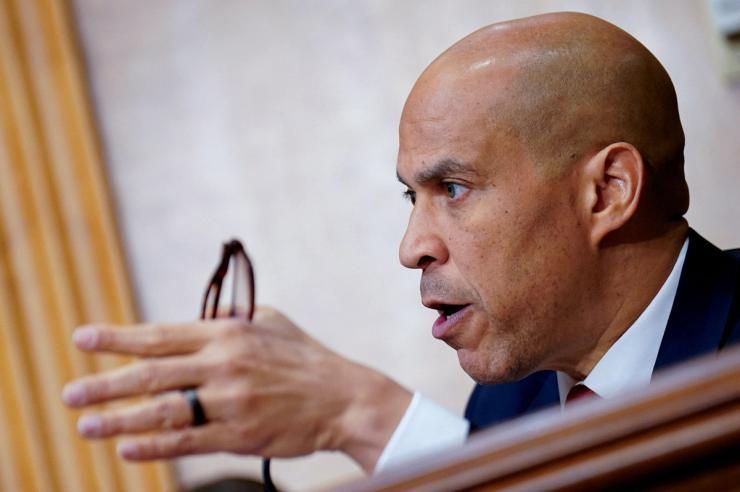
For Sen. Cory Booker, D-N.J., it means a new tax cut that would double the standard deduction and push millions of people off the income tax rolls. Sen. Chris Van Hollen, D-Md., is preparing to outdo Booker and propose an even larger income tax cut, nearly doubling the number of people who could ignore the IRS.
“Overwhelmingly, the response has been positive,” Van Hollen told Semafor.
Booker and Van Hollen are both dream presidential candidates for some Democrats, but they’re stuck below the first tier of early 2028 hopefuls. Neither might run in the end. Still, the two senators’ tax plans have sparked the first real debate about what Democrats should stand for when they next face voters, beyond saying “affordability” and prioritizing health care.
Critics of Booker and Van Hollen’s plans, including older-line progressives at the Center for American Progress and newer post-Biden players on the left, argue that the party’s mission depends on doing good things with public funds — not pitching taxes as a pox that people need “relief” from.
While populism is gaining steam with Democrats, exempting huge numbers of people from taxes struck many on the left as “slopulism,” stirring voter passions without advancing the party’s vision of government.
Backers of the tax relief ideas see them differently, as a way to channel President Donald Trump’s talent at marketing memorable ideas — affordable or (typically) not, while Democrats fumble with their spreadsheets.
“Trump can make a phrase stick in ways that the rest of us can’t,” said Sen. Brian Schatz, D-Hawaii, when asked about the Booker and Van Hollen plans.
“One frustration with Democrats is that we have been working on and promising certain things, but we need to focus on how to actually deliver those things, more than how to deliver the message in a snappy, TikTok-friendly way,” he added.
Democrats never explained how they lost the country between Trump’s two terms. (Bet on them never doing that.) But one popular theory is that the liberal groups over-sold the power of “deliveryism” — for example, that the Teamsters would appreciate the bailout of their pensions (nope) and college-educated voters would be thankful for student debt relief (hah).
An adjacent theory is that Trump promised more memorable, digestible benefits to voters than Democrats did, with “no tax on tips” as a case in point. Democrats are haunted by their failure to formalize a tax cut for tipped workers before Trump did, and they’ve studied how Sen. Jacky Rosen, D-Nev., ran far ahead of the presidential ticket after endorsing the Trump plan.
The tax benefit for tipped workers made it into the GOP’s omnibus spending bill last year, and Democrats have been comfortable with their votes against it. But they don’t talk about repealing it, as James Carville recommended. For decades, they’ve run on keeping Republican tax cuts and reforms for lower-income people intact while raising taxes on the wealthy.
A third new Democratic tax proposal this month, rolled out by Sen. Bernie Sanders, I-Vt. and Rep. Ro Khanna, D-Ca., would “Make Billionaires Pay Their Fair Share.” Nobody else would pay anything.
Democrats who still believe in the New Deal-era promise of government helping the public are a bit depressed by the idea that the solution to their party’s problems is generating less money for that purpose.
“This is just totally playing on Republicans’ turf,” said Adam Jentleson, a former senior Senate Democratic aide and the founder of the Searchlight Institute.
Democrats have run for the White House on middle-class tax credits, he noted, but not a major tax realignment that would likely take over a future president’s agenda: “It’s accepting that the best way to get benefits to people is to massively cut their taxes.”
Yet Booker, Van Hollen, and their allies are winning the early fight. More and more Democrats are defining “affordability” as fewer tax burdens.
On Monday, Sen. Mark Kelly, D-Ariz. became a co-lead sponsor of the Gas Prices Relief Act, a bill that would suspend the 18.4 cents-per-gallon fee (unchanged since 1993) until shortly before the midterm elections. On Tuesday, Gov. Kathy Hochul reiterated her support for a version of “no tax on tips” in New York.
“It’s very interesting,” House Speaker Mike Johnson told reporters this week in Doral, Fla., adding that Democrats could have supported “the most transformational tax cuts in American history” — Trump’s.
In this article:

Room for Disagreement
There are notable exceptions to the trend: A millionaire’s tax in Washington state, a “billionaire’s tax” ballot measure in California, a fight over a higher-income tax hike in New York. The Sanders/Khanna proposal is, in part, a response to the immediate problem with those policies: Wealthy people can move to other states.
But the broader Democratic trend is cutting the same way: shrinking the tax base while making the wealthy pay more.

Notable
- Arthur Delaney and Igor Bobic talked with the tax plans’ progressive critics for the Huffington Post. Booker was unpersuaded, calling his plan “the biggest unrigging of our tax system that there is.”
- In The Bulwark, Joe Perticone asked whether the tax-cutting Democrats were “Reaganmaxxing.”
- In The Wall Street Journal, Richard Rubin delved into the tax changes Democrats are talking about and who’d be affected.
Nicholas Wu contributed reporting.