




The News
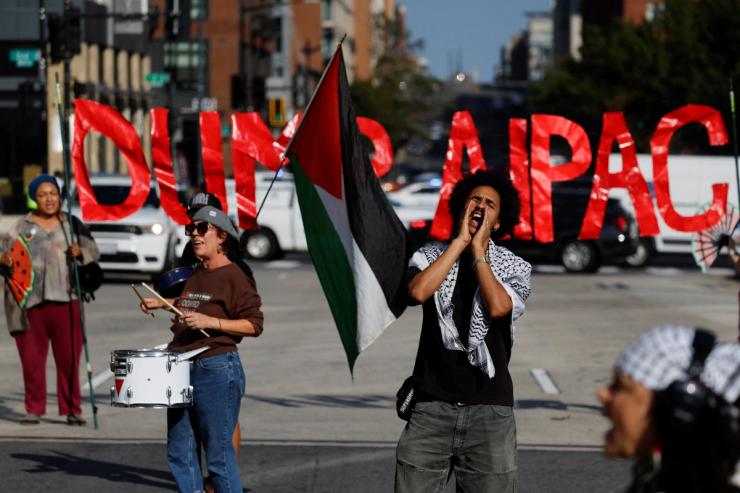
Democrats who have long sought to counter AIPAC’s political influence finally got a super PAC of their own, right as early voting started in North Carolina this month.
American Priorities launched with a half-million-dollar investment in the race between Democratic Rep. Valerie Foushee and progressive challenger Nida Allam, highlighting Allam’s opposition to more war funding for Israel. It didn’t quite work; a pop-up super PAC rushed in and helped Foushee prevail by 1,172 votes.
But a smaller investment helped an Israel critic win another safe-seat primary, in Texas. Now the PAC intends to spend “at least $10 million” on the midterms, according to founder Hannah Fertig.
Fertig talked with Semafor about the PAC’s origin, goals, and strategy, and this is an edited transcript of the conversation.

The View From HANNAH FERTIG
This conversation has been edited for length and clarity.
David Weigel: Can you lay out the PAC’s basic strategy? We’ve seen pro-Israel PACs start pop-ups that don’t mention Israel at all in their targeted races, but it looks like American Priorities is messaging on Israel.
Hannah Fertig: We want our foreign policy views to reflect where the Democratic base has moved, particularly on Gaza, and on unconditional U.S. military to Israel. We’re seeing this as a generational inflection point, and we launched because there’s a huge gap in the progressive spending ecosystem. We simply want to make sure that someone’s there to protect candidates who question these policies.
I don’t know if you saw the Gallup Poll back in February, but Democrats and all Americans are feeling incredibly sympathetic to the plight of the Palestinian people. We want people’s lives in the United States to be better. We don’t think that spending a bunch of money abroad for foreign wars helps with that.
How do you pick where to spend?
We are looking for candidates who are very strong on our issues, both foreign policy and domestic policy, and who have a clear path to viability and victory. So we ask two questions. One: Is there a strong, credible, progressive challenger in this race? Two: Has the incumbent taken AIPAC money?
What’s your after-action view of what happened in North Carolina?
We came within less than 1,200 votes of defeating a sitting member of Congress in a race where, the last time these candidates matched up, Valerie Foushee won by nine points as a non-incumbent. We demonstrated here that a well-funded progressive challenger who has clear foreign policy messaging can really give an incumbent the fight of her life.
But we’re still taking stock of what worked. Our super PAC and the progressive coalition entered the race pretty early compared to Foushee, who initially started with very little money.
How do you plan for that? When you enter a race do you have a plan if millions of dollars come in for the other side, at the last minute?
I personally make the assumption that there’s going to be adversarial spending in just about every race that we’re in. I’ve seen them abstain in races previously where it doesn’t look like their candidate has a good path to victory challenger in that race that didn’t quite ever take off. But an interesting dynamic we have right now, compared to other cycles, is that some of these candidates have begun to speak up on the issue of unconditional aid to Israel.
In North Carolina, we simply showed who Valerie Foushee was taking money from. Despite the fact that she swore off APAC money in 2026, she’d taken it before, and we saw in polling that voters really didn’t like that. If people have ever taken AIPAC money, it will be a liability for them. If you’ve previously taken money from a PAC with corporate ties — Foushee was also taking money from defense contractors — then that’s a candidate that we’re going to be looking at.
How does the war in Iran change what you’re doing? Allam ran the very first explicitly anti-war ad, right before the primary, but I haven’t seen this play out yet.
Oh, it’s very relevant to the conversation about AIPAC. They’re obviously very supportive of the war in Iran. They’ve praised Trump. They’re really excited about what’s happening there. And this is the most unpopular war we’ve ever seen, according to the polls. AIPAC is putting the Democratic primary candidates that they’ve endorsed into the position where they either are forced to toe the line on the war or defy them.
It’s going to take a lot of mental gymnastics for Democratic primary voters to look at an AIPAC-endorsed candidate who’s like equivocating on if we should be going to war with Iran or not, if we should be supporting President Trump’s war more broadly.
Voters think the war is bad. They want more money to stay in the US, so we can have strong domestic programs that are tackling issues like affordability.