



The Scoop
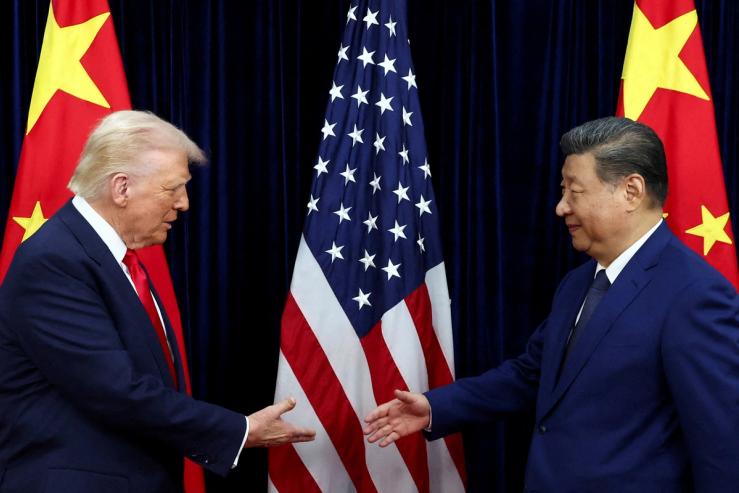
Planning for US President Donald Trump’s state visit to China remains scattershot with barely three weeks to go, people familiar with the preparations said, with no final list of officials and executives joining the American leader in Beijing.
The March 31-April 2 visit was expected to build on a trade truce agreed to in October, when Trump last met with Chinese leader Xi Jinping. The upcoming trip — the first of four potential meetings between the pair this year — could yield a deeper reset in a turbulent relationship, some analysts had said.
But the lack of particulars around the meetings reflects the significant gulf that remains between the countries and a stark difference in approach between the generally last-minute preparation of the Trump administration and the careful planning of Chinese officials.
The White House and Trump have also been focused on the US-Israel war in Iran and, prior to that, the operation to oust Venezuelan President Nicolás Maduro. But the people, some of whom requested anonymity in order to discuss details of the visit, acknowledged that the ambition and the planning of the visit could kick into overdrive were the president to demand it.
In this article:

Know More
In particular, the list of CEOs of US companies tapped to accompany Trump is up in the air. Officials from the US Commerce and Treasury departments, which are jointly handling the arrangements, haven’t decided whether to even include a business delegation, often a centerpiece of state visits, two US sources with knowledge of the trip’s planning said. German Chancellor Friedrich Merz had 30 executives in tow when he arrived last month, while British Prime Minister Keir Starmer brought an entourage of almost 60, spanning business, sports, and culture.
At least one Wall Street firm has been in talks with the Trump administration about participating in a private-sector delegation that would formally accompany the president or convene on the sidelines, according to another person familiar with the talks. There’s also been discussions of putting together a CEO dinner on the ground in Beijing, this person said, but outreach to potential attendees has been spotty and a guest list hasn’t been finalized.
A White House official, speaking on condition of anonymity, said a list of invited companies hadn’t been compiled but that the trip remained several weeks out and considerations over which companies to invite and what sectors to prioritize are underway. It is not unusual for the administration to wait until later in the planning process to send invites for a foreign visit and there is “no disagreement internally” about inviting CEOs on the trip, the person said.
Instead, the two sources with knowledge of the trip’s planning said, US officials are focused on promoting the notion of “managed trade,” an idea touted by US Trade Representative Jamieson Greer that involves US and Chinese politicians negotiating purchases in a barter-like arrangement, deciding on products, prices, tariff levels, delivery schedules, and other details through bureaucratic channels.
China, for its part, has offered proposals that would represent a far-reaching shift in economic relations, including a large Chinese fund, possibly involving sovereign wealth, to invest in American companies in industries such as batteries and EVs, the US-based sources said. But US officials haven’t engaged, these sources added. One noted that Chinese operational control over any fund for US investments was a non-starter: “Between what China wants, what the US wants, and what politics will allow — it’s not a huge universe,” this person said.
China is aiming high, according to Scott Kennedy, trustee chair in Chinese business and economics at the Washington-based Center for Strategic and Economic Studies and a regular at so-called Track II bilateral meetings that involve think tanks and experts with government ties. Between the fund and big-ticket Chinese purchases — Boeing aircraft, soybeans, LNG — “it’s not hard to get to, overall, over a trillion dollars,” he said. One benchmark, according to Kennedy, is the $550 billion of investments that Japan has promised to make in the US; China will want to top that.
The US has been “sluggish in doing its part to nail down deliverables,” said David Meale, a former deputy chief of mission at the US embassy in Beijing, and now the Washington-based head of Eurasia Group’s China practice. Ryan Hass, a strategy advisor in the Obama and first Trump administrations who is now at the Brookings Institution, said that events in Iran, along with time pressures, “seem to be squeezing the level of ambition for this state visit.”

Andy’s view
This degree of disorganization so close to a hugely important summit will likely be creating anxiety among working-level officials in Beijing — who, I’ve found in my decades working in and visiting the country, expect summits to be highly choreographed set-pieces negotiated far in advance.
It’s also worrying American executives in the auto, agriculture, aviation, and finance industries, who want a seat at the table if deals are going to be struck.

Room for Disagreement
Chinese Foreign Minister Wang Yi struck a surprisingly upbeat tone at a press conference in Beijing on Sunday, saying he hopes 2026 will be a “landmark year” for US-China relations, urging both sides to “foster a suitable atmosphere, manage existing differences, and eliminate unnecessary distractions.”
Ultimately, China has leverage at the summit through its control over rare earths – a critical chokepoint – but the US still controls much of the technology that China needs for its high-tech manufacturing. In that sense, both sides have a loaded gun at the table, although neither wants to reach for it: Trump is eager to be embraced by Xi at a time when Western leaders are turning away from him; Xi needs to keep his visitor happy to buy himself time as he wrestles with serious economic problems at home.
Additional reporting by Shelby Talcott.

Notable
- “Beijing appears to be prioritizing the success of the summit over its concerns about U.S. military operations targeting Chinese allies Venezuela and Iran,” Politico’s Phelim Kine wrote, as Foreign Minister Wang Yi promised a “big year” for US-China relations.
- Trump will not be leaving Beijing during his visit due to security concerns, the South China Morning Post scooped.