


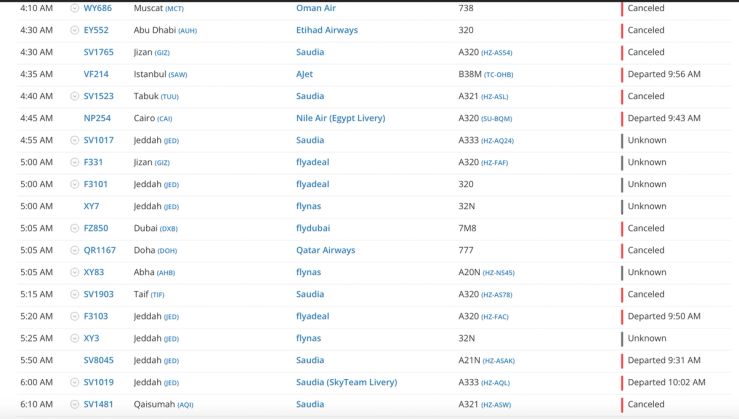
Saudi Arabia’s airports have felt the effects of regional airspace disruptions, even as the kingdom has been one of the few viable routes in and out of the Gulf.
At Riyadh’s King Khalid International Airport, employees told Semafor that most flights were cancelled last night as airspace restrictions and threats took hold. Operations have since largely returned to normal, with staff working through a backlog of delayed flights. Domestic routes to Dammam in the east and Najran near the Yemen border remain affected, but passengers are still using Riyadh as a route out of the region.
The disruption has been modest compared with elsewhere in the Gulf. Airports in Kuwait and Qatar remain shut, while operations in Abu Dhabi and Dubai were halted for several days before a limited service resumed on Thursday. Against that backdrop, Oman and Saudi Arabia have become the fallback option for anyone wanting to travel. An unwelcome discovery for many is that their travel insurance won’t cover new flights or longer hotel stays, as most policies exclude war-related claims.
And while tens of thousands heed their governments’ warnings and flee the Gulf, some local residents and citizens who were abroad on holiday or business are heading in the opposite direction. One UAE resident who works for commodities trading giant Glencore told Semafor he chose to fly from London to Oman and then drive to Dubai, in order to be close to his family rather than be stuck abroad.
The instinct to head back to a war zone may seem puzzling, but the reality on the ground generally isn’t as dire as the headlines suggest. Air defenses have held, and states like Saudi Arabia and the UAE are ranked among the top five globally in the Edelman government trust index. Patriotism is also a factor, and expressions of fear can be seen as undermining a nation under attack.