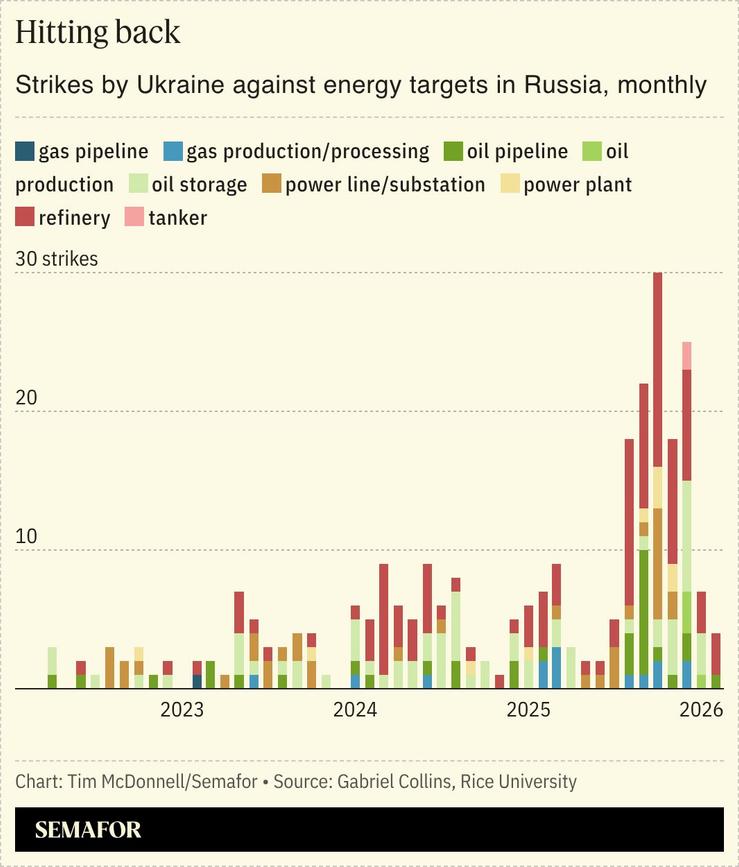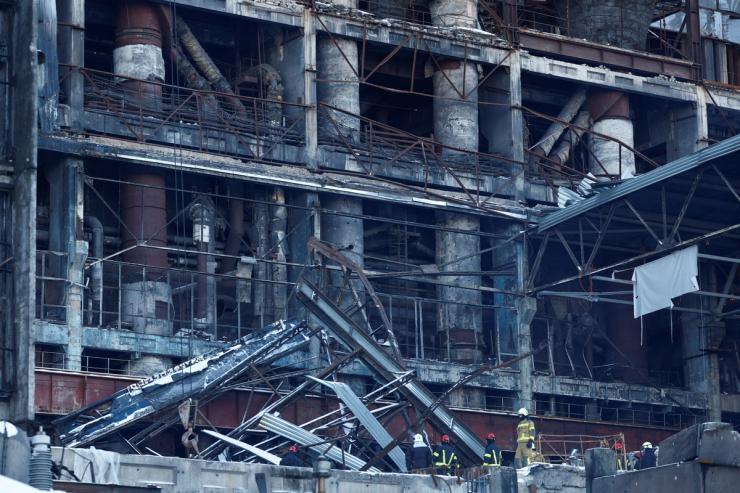
Middle East countries should look to Ukraine for guidance on how to defend their energy infrastructure against drone and missile attacks, security experts said. No country in the world has as much experience as Ukraine in both managing an onslaught against its power plants, and finding creative ways to strike its adversary’s energy infrastructure.
For now, air defense systems around the Gulf have been reasonably effective in blocking many Iranian attacks. But the chief lesson of Ukraine is about modern military economics, said Gabriel Collins, an energy security researcher at Rice University who this week published an in-depth study of Ukraine’s energy counterattacks against Russia: It quickly becomes unsustainable to take down $50,000 drones using multimillion-dollar missiles. By the same token, using a few dozen drones to strike an economically vital oil refinery is a great deal, and energy infrastructure will continue to be a top-tier military target in most future global wars, Collins said.
Ukraine’s experience has shown that many energy assets are simply too big to defend completely. But the country’s multi-layered defensive system — from simple concrete barriers around substations, to the widespread use of electronic signal jamming, to teams that rove around on pickup trucks fitted with 50-caliber machine guns to shoot down drones — has significantly tilted the cost balance in Ukraine’s favor, Collins said: “What you want to do is move that exchange ratio against them as much as you can.”