



The News
Almost every Democrat in elected office opposes President Donald Trump’s war in Iran. Their explanations could quickly become an electoral litmus test.
The subtle split among Democrats began emerging minutes after the first US strikes on Saturday. They reacted in three ways: Some couched their criticism of Trump in widely held bipartisan opposition to the Iranian regime, others prefaced their negativity with calls for congressional authorization of the war — and a smaller number of progressives more clearly called military action the worst option for Americans.
All three camps of Democrats are now trying to align around a doomed push to challenge Trump’s war powers that threatens to expose deeper internal divisions on Middle East policy that hurt them in 2024.
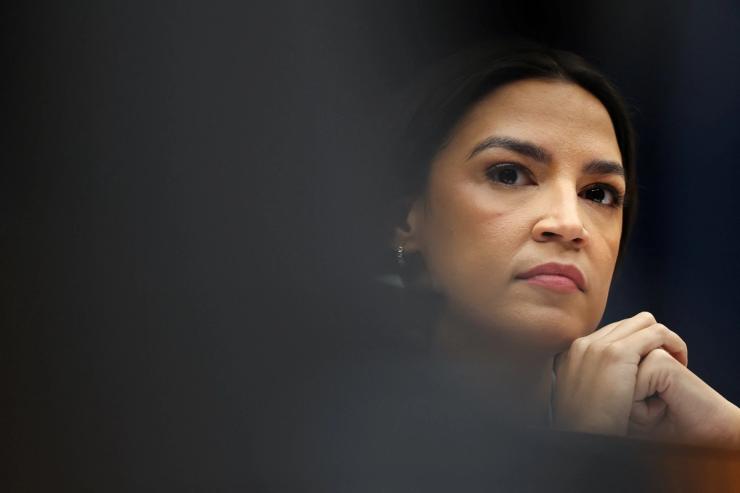
“I of course, personally, substantively, and vocally oppose war with Iran. We know that the Iranian regime is brutal, and war is not the way that we’re going to resolve that issue,” said Rep. Alexandria Ocasio-Cortez, D-N.Y. “The war powers resolution is about congressional authority, and we have to be very, very assertive about that question as well.”
Ocasio-Cortez’s simultaneous membership in all three Democratic camps when it comes to talking about the Iran war, as she remains in the mix for 2028, illustrates the challenge for the party’s highest-profile members. They each want to strike a position on Iran that can differentiate them from potential rivals while managing to not alienate the left or center, all while drawing a clear contrast with Trump and his party.
No one considering the 2028 presidential race is openly acknowledging the tension yet. On the Hill, however, it’s affecting this week’s votes to curb Trump’s Iran war in both the House and Senate. House Democrats are facing an internal split, with centrists who are circulating an alternative plan while remaining noncommittal or opposed to their leaders’ war powers measure.
And Senate Democrats, whose leader has faced barbs from the left even as he shifted further left on US-Israel policy than ever before, aren’t entirely aligned either when explaining their opposition to Trump’s war. Senate progressives are trying to keep it simple.
“I do think this is a moment that begs for moral clarity, and I don’t know any of my constituents who understand what we’re trying to accomplish there. And so yeah, the more clearly you can say this seems like a really stupid f*cking idea,” said Sen. Martin Heinrich, D-N.M. “I think the more people will appreciate what you’re getting at.”
Meanwhile, the days-old Iran war is already becoming an issue in Democratic primaries.
Progressive groups are vowing to mount challenges from the left to any lawmaker who opposes the war powers vote, Axios reported. Rep. Valerie Foushee, D-N.C., took last-minute heat on the war from a progressive challenger before she narrowly held on to her seat this week.
Iran is likely to stay highly relevant come 2028, too. Jonathan Cowan, president of the centrist Democratic group Third Way, told Semafor this week that moderates in the party shouldn’t fret about opposing Trump’s war.
“You should decide your positioning on a war based on what you believe, not on politics,” he said. “I do not see a scenario by which, in 2028, what Trump has done here is popular. I don’t see it as popular enough among swing voters that it would decide the 2028 general election.”
And on the left, Matt Duss, executive vice president at the Center for International Policy and a former aide to Sen. Bernie Sanders who has worked with Ocasio-Cortez, said: “I don’t think any Democrat can credibly claim to lead the party or the country without opposing Trump’s reckless, lawless war. Honestly, it shouldn’t even be a tough call.”
In this article:

Know More
The House war powers vote on Thursday is the most urgent opportunity for Democrats to try to unite against the war, even as the ongoing split persists about how to talk about it.
And the likelihood of several Democrats breaking ranks voting to support Trump’s military authority in Iran doesn’t sit well with many of their colleagues. For most House Democrats, the war powers question is a critical first step to getting on the same page about the existential Middle East policy issues they’ve confronted since Israel’s military action in Gaza began in 2023.
“It is a really, really dangerous precedent if any Democrat votes against the war powers resolution, because it is not a matter of conscience,” said Rep. Pramila Jayapal, D-Wash. “Whether you think the goals of the war are right, it is a matter of constitutional obligation, and that is about Congress having the power to determine when and where we go to war.”
Rep. Ami Bera, D-Calif., said Thursday’s House vote “will say a lot to where we are. So I would urge most of my colleagues to stop for a second and think about that.”
Rep. Delia Ramirez, D-Ill., called the centrists’ alternative measure “unacceptable.”
The war powers resolution is unlikely to pass in the end. A Senate war powers vote on Wednesday drew only one Republican defection, from Kentucky’s Rand Paul. Rep. Thomas Massie, R-Ky., is also expected to cross the aisle to vote with most Democrats on Thursday.
Despite the frustration within the Democratic caucus, not every vocally pro-Israel lawmaker is openly wavering on the war powers question.
“For me, it’s about protesting executive encroachment on a core congressional power,” said Rep. Ritchie Torres, D-N.Y., a vocally pro-Israel lawmaker who was planning to support it.
ROOM FOR DISAGREEMENT
Democrats who are backing the alternate proposal, like New Jersey Rep. Josh Gottheimer, hail from a more pro-Israel wing of the party. They describe their unease with the war powers bill backed by Democratic leadership as more logistical than substantive.
“I’m concerned that the way it’s constructed, it’s an immediate withdrawal, and I don’t want to do anything to put the servicemen or women in harm’s way, or our embassies, or American citizens abroad,” said Gottheimer.
He and a half-dozen other Democrats are circulating a war powers measure that would require the president to end military action within a month and prohibits the deployment of ground troops without congressional authorization.

Nicholas Wu’s view
Democrats are able to set war powers votes on their own terms right now. They likely won’t have that option if — or more likely, when — the Trump administration sends a request to Congress for money to fund the war and replace weapons stockpiles, or to assist regional allies.
If Democrats think the current war powers debate is tense when it comes to clearly opposing Trump, they should prepare for even more stress on a future war supplemental vote. That would come with troops already engaged in combat operations for what could be a prolonged conflict, and it could reopen old fights over funding Israel.
Burgess Everett and David Weigel contributed to this report.