




what’s at stake
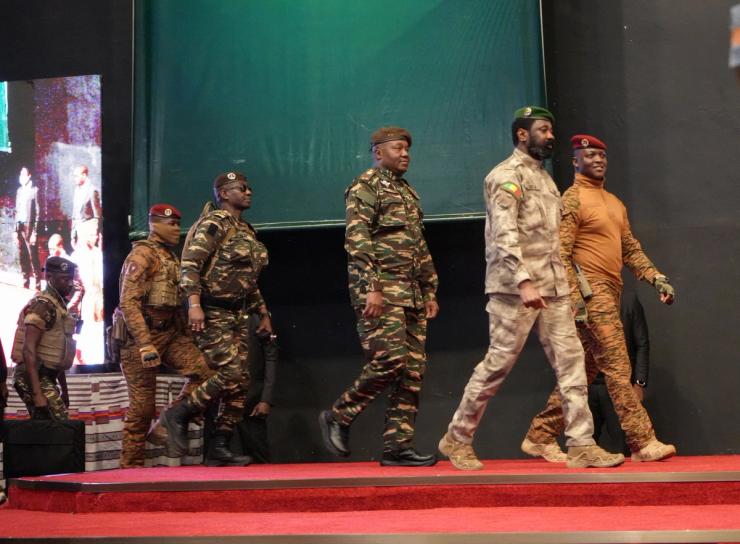
President Donald Trump’s administration is quietly reshaping US policy toward Africa’s junta-led governments, reviving a long-running debate about the degree to which the US should prioritize democracy promotion over its strategic interests. Recent moves — including the removal of sanctions on Malian junta officials — suggest Washington is actively rebuilding ties with these military-run nations.
This shift comes amid rising government instability in Africa. There have been 10 successful coups in the 2020s along with several failed attempts and alleged plots on a continent increasingly defined by military seizures of power.
Some in Washington argue that it’s necessary for the US to attempt to partner with military rulers, while others contend that abandoning its democracy advocacy will undermine partnerships in the long-term.
In this article:
who’s making the case
Nick Checker, the head of the State Department’s Bureau of African Affairs, said the shift in policy reflects pragmatism in the administration’s Africa approach:
“Our efforts toward normalization with the transitional governments in the Sahel are not an endorsement of how the authorities came to power. While the United States continues to support the gradual transition to accountable governance, we recognize that lecturing on democratic norms in the midst of complex local realities is ineffective; our focus reflects pragmatic cooperation based on shared interests and preserving the space for a credible transition over time.”
Alexander Noyes, a fellow at the Brookings Institution and author of the forthcoming book Compromised Coalitions: The Paradox of Postconflict Power Sharing in Africa, argues that dropping democracy considerations will simply encourage military takeovers:
“There has always been a tension between interests and values in US foreign policy. Yet the Trump administration has upended the decades-long, bipartisan consensus to support democracy globally. This is a mistake that will substantially decrease America’s hard and soft power. Democracies are more reliable and more effective security partners. And US democracy support has a better track record than a casual observer might think. Academic research shows that US support has helped countries transition to and consolidate democracy in Africa and beyond.
“That said, Washington is right to reopen dialogues with coup-born governments in West Africa. Engagement is almost always good. But US policymakers must make a return to civilian rule a prerequisite for any real rapprochement or security assistance.
“When coups occur, the United States and like-minded countries should be quick and consistent in calling out and sanctioning these undemocratic actions. Just as importantly, coups are all-too-often the result of more subtle and longer-term forms of democratic backsliding, including flawed elections and power grabs by executives to stay in power beyond their term limits, as is taking place right now in Zimbabwe. Condemning and punishing these types of democratic decay would help prevent coups in the first place.”
J. Peter Pham, a distinguished fellow at the Atlantic Council and former Trump administration special envoy for the Sahel, argued that renewing relations serves US interests:
“I applaud the constructive engagement that the administration has undertaken with governments in the Sahel. It is long overdue course correction from the virtue signaling and diplomacy-by-hissy fit that we saw during the Biden era that directly resulted in opening the door to Mali for Russia’s Wagner Group mercenaries and the loss of two strategic U.S. airbases in Niger.
“The first priority of US foreign policy should always be American interests. While, very frankly, US interests in the Sahel are limited, they are not entirely absent and include maintaining the capacity to monitor terrorist groups that threaten America and our allies and, where necessary, to act against them ourselves or assist partners more directly impacted to do so. This is only possible with good relations with the governments and peoples of the region — and, however much we may dislike coups (and I was the very first person in the US or any government to publicly condemn the 2020 coup in Mali), we have to be honest enough to acknowledge the reality that the populations of the West African states with successful coups in recent years have largely rallied behind the new regimes.
“Moreover, if we are concerned about the malign influences of outside state actors like Russia or China, our response should be to engage with the Sahel states and to offer a better alternative, especially when the failure of these other powers to deliver on the top priority of the governments of the region, security, gives us a new opening.”

Notable
- Some African governments are rejecting American health funding agreements over data and privacy concerns. Notably, junta-led Burkina Faso and Niger have each signed a health deal with the US.
- Senator Cory Booker, D-N.J., criticized the withdrawal of sanctions on Malian officials at the hearing for Frank Garcia’s nomination to become Assistant Secretary of State for African Affairs on Thursday.