



The News
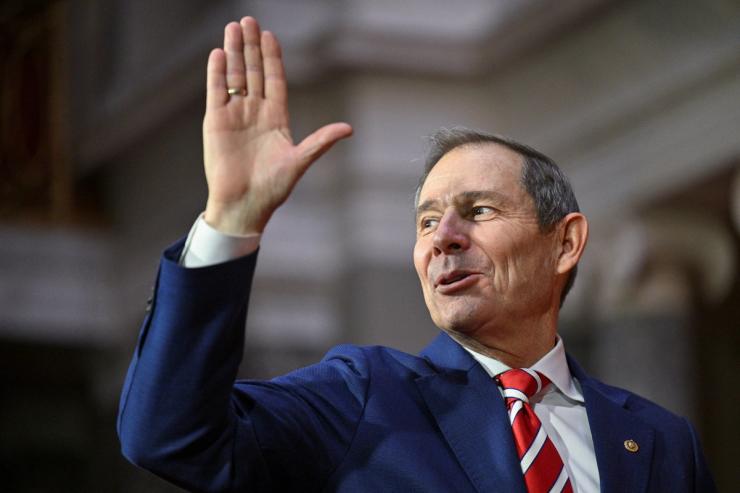
Sen. John Curtis would have liked to vote on the US war in Iran before it started. Now that Congress is voting on President Donald Trump’s war powers after the hostilities began, he’s not trying to curtail them.
“If I could do this all over again, of course I would love a vote in Congress before we go. But this is a train that’s left the station,” the Utah Republican told Semafor. “It would not be in our best interest at all to stop what’s already started.”
Curtis isn’t alone among Republicans who are openly processing their own views after Trump joined Israel in starting what’s become a widening war with Iran. Many in the GOP spent years railing against Iran’s oppressive regime and urging a more aggressive approach after the country’s record of coordinating terrorist attacks — leaving few Trump critics in his party, at least in the early days of the conflict.
Sen. Josh Hawley, R-Mo., who had voted to advance a resolution intended to rein in Trump on Venezuela but voted against the final product, said Monday he would oppose a similar war powers resolution on Iran. GOP Sens. Susan Collins of Maine and Todd Young of Indiana both declined to say how they would vote on it later this week. Sen. Mike Lee, R-Utah, told Semafor he needs to hear the administration’s briefings for Congress on Tuesday before deciding.
That uncertainty suggests GOP leaders have some work to do to defeat the war powers resolution from Sen. Tim Kaine, D-Va. Yet it looks, for the moment, like top Republicans are up to the task.
Sen. Joni Ernst, R-Iowa, told Semafor she called up Trump to praise him on Sunday
“I am overjoyed. And I spoke to the president yesterday and I told him,” Ernst said.
Senate Majority Whip John Barrasso, R-Wyo., said he would do “everything I can to make sure the president has full authority to do what he has done” and defeat the Kaine resolution. It’s supported by Sen. Rand Paul, R-Ky., but needs 51 votes to pass in a Senate where Republicans control 53 seats. (Sen. John Fetterman, D-Pa., is likely to also vote no.)

Know More
Trump’s pursuit of war with Iran deflated the noninterventionist image he campaigned on, but it also animated the party’s hawkish wing.
And Republicans who occasionally break from Trump are careful to give the hawks room, even as they digest the situation.
Hawley said that because Secretary of State Marco Rubio told Congress on Monday that no US troops on the ground were being used, the administration is in “compliance” with the War Powers Act.
He added that ground troops would remain the red line for him over the next 60 days, after which law prohibits military action without approval from Congress, save for a 30-day withdrawal period.
That legal deadline came up with several other Republicans who said that, while they are comfortable with the Trump administration’s war thus far, it could be something they revisit. Senators appear to have noticed Trump’s public vacillation about the length of time he’d commit to military operations.
Sen. Mike Rounds, R-S.D., told Semafor after Monday’s briefing that “at this point, it’s just a matter of [administration officials] reaffirming that this is probably going to be a pretty short-term deal.
“It’s not designed to be a long-term plan,” he said, but “things can change. And at that point we’ll have to reassess.”
The House is set to take up its own war powers measure on Thursday, too, but GOP leaders believe they have the votes to defeat it. Speaker Mike Johnson told reporters after the closed-door briefing that it was “dangerous” to take away the president’s authority to wage war and that he was “hopeful” they could sink the resolution.
Still, GOP lawmakers like Rep. Warren Davidson of Ohio are signaling they’ll wait for all of Congress to be briefed Tuesday evening before they decide how they’ll vote.

Room for Disagreement
Not all GOP lawmakers see a need for any time limits. Sen. John Kennedy, R-La., said Monday that he doesn’t “think it’s fair to ask [Trump] exactly how long” it will take “to stop political leadership in Iran from getting a nuclear weapon.”
“I mean, these people are weapons-grade crazy,” Kennedy said. “I don’t want America to be the world’s policeman but, but I don’t want … whoever replaces Khamenei to be the world’s policeman either — and that’s, to me, what this is all about.”

Burgess, Eleanor, and Nick’s View
Action against Iran is politically riskier than Trump’s capture of Venezuelan leader Nicolás Maduro, but it’s also more popular among Republicans.
The GOP eviscerated then-President Barack Obama’s nuclear deal with Iran in 2015, and many cheered on Trump’s destruction of that agreement a few years later.
That explains why even Republicans who acknowledge undercertainty about what happens next in Iran are showing no sign yet of a rebellion against Trump.
We expect fewer GOP defections on the Iran war powers vote than Trump saw on the Venezuela one — which at its peak only numbered five senators.

Notable
- Rubio told reporters that the US strikes on Iran were designed to head off a threat to the US from Israel’s plans to attack Iran, according to The Hill.