




Andy’s view
Over an ice-breaker dinner with Xi Jinping at Mar-a-Lago, early in his first administration, Donald Trump sprung a surprise on his guest: Just as the chocolate cake arrived, the American leader told his Chinese counterpart that he was unleashing a missile barrage against Syria.
Once again, Trump has caught Xi off guard, this time by deploying lethal military force against Iran, another of Beijing’s friends in the Middle East — only weeks ahead of a planned bilateral summit in Beijing.
But so far, Xi appears to be absorbing the wreckage of the Khamenei regime exactly as he did the prior message about US military power: calmly. The Chinese foreign ministry has offered only boilerplate criticism of the US and Israeli aerial bombardments.
Nothing would give Xi more satisfaction than watching the US bog itself down in another Middle East quagmire, diverting Washington’s attention and resources from China’s own backyard. That helps to explain in part why China hasn’t extended practical help to a regional partner that supplies more than 13% of its imported crude oil, offers a landbridge to Europe for its trillion-dollar Belt & Road Initiative, and is the Middle East hub of an anti-American “Axis of Upheaval that also includes Russia and North Korea.
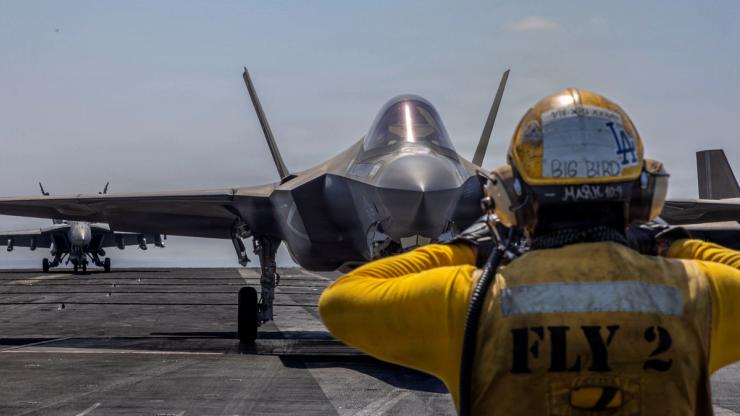
Already, the massive air campaign has pulled US military assets from the Asia Pacific — the USS Abraham Lincoln aircraft carrier steamed to the Gulf from the South China Sea — and is rapidly depleting Washington’s limited stock of munitions, adding to doubts about whether the US has the industrial base to sustain a far more intense conflict with China in the event of a Taiwan contingency.
Online, giddy takes on Operation Epic Fury described it as a checkmate move against China, rather than a war of choice against Iran.
According to this argument, the US is taking out a Chinese strategic asset in the Middle East so it can refocus its military forces on East Asia. Zineb Riboua, an analyst with the Hudson Institute, wrote that Trump “appears to understand that the road to the Pacific runs through Tehran.”
A more sober analysis suggests that US strategic options in the Asia Pacific are, in fact, narrowing, precisely because Washington keeps getting distracted.
“The pivot to Asia has failed,” Zach Cooper, a Senior Fellow at the American Enterprise Institute, wrote recently in Foreign Affairs, referring to a strategy first outlined in the Obama administration for the US to invest more in the region’s political, economic, and military stability. Today, the question in regional capitals, Cooper argued, “is how far the United States will pull back.”
Indeed, Xi views the US as being in long-term decline, and Trump’s military adventures — removing Nicolás Maduro in Venezuela, throttling Cuba, claiming Greenland, and now striking out at Iran — as the actions of a weakened power, lashing out.
In the short term at least, the US president’s military interventions are a clear risk to Chinese global interests. They expose the hollowness of Beijing’s security guarantees, point to China’s lack of “hard power” — it may outgun the US in East Asia but only Washington can act militarily with impunity anywhere in the world — and threaten China’s infrastructure investments.
The loss of Iranian oil, carried on “dark fleets” to avoid sanctions — and bought on the cheap with Chinese currency — is also a blow, albeit a manageable one: China has huge reserves, and access to global oil markets like any other country.
But by far the bigger worry for Beijing will come if US efforts at regime change in Iran succeed. The spectre of “color revolutions” toppling autocrats haunts the Chinese Communist Party, ever vigilant about threats to its survival.
So far, there’s no suggestion that Xi will cancel his summit with Trump. On the contrary, he might believe it’s more important than ever to engage the US president when he’s at his most dangerous. At a Chinese banquet table, it may be Trump who will have to behave.
In this article:

Room for Disagreement
Some experts argue the Trump administration is curbing Chinese influence around the world using a mix of aggressive measures that include military action, diplomatic pressure, and tariffs. As part of an “America First” doctrine, Washington has intervened in Venezuela, a beachhead for Beijing in Latin America, throttled Cuba, one of China’s oldest socialist friends, and reasserted dominance in Panama, which had been drifting into China’s orbit. The Trump administration’s “reassertion of American primacy in the Western Hemisphere will likely hinder the steady rise of China’s economic and diplomatic interests in the region,” a senior fellow at the Brookings Institution argued.
Trump has also threatened tariffs against Canada, Mexico, South Africa and other countries to pressure them into limiting their trade with China and use of the Chinese currency. Beijing’s response to these pressure tactics has been restrained: the Western hemisphere is still peripheral to China’s “core interests”, and it wields a powerful retaliatory tool – the threat to cut off supplies of critical minerals and rare earth magnets.

Notable
- The idea that China is the big loser from the bombing of Iran is “wishcasting,” even though China once styled itself as a new power broker in the Middle East, The Economist wrote.