


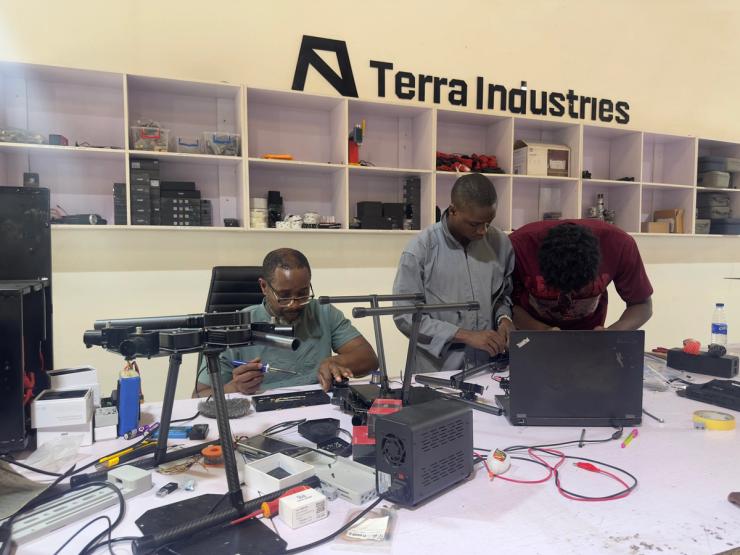

The Scene
Inside a sprawling factory in Idu, an industrial town 10 miles from the center of the Nigerian capital Abuja, a masked engineer welds metal to assemble an armored robot. Nearby, young technicians box drones ready for delivery to customers. They are at the front lines of a growing startup operation to supply Nigeria’s defense industry with surveillance technology as it grapples with multiple security crises.
In less than two years, Terra Industries, which sells drones to African government agencies and private companies, has caught the eye of US investors too: The firm raised $34 million in January across two funding rounds led by Silicon Valley venture capital firms 8VC and Lux Capital.
Nathan Nwachuku, Terra’s co-founder and CEO, told Semafor that the money raised speaks to “the current momentum, new contracts won, the rapid expansion of our factory’s capacity and new factories we have in construction.”
The spike in US investment in Terra coincides with heightened interest in Nigeria’s security crises from Washington, as the Trump administration increasingly pressures Abuja to stem a wave of kidnappings — which the US claims mainly affects Christians — that are attributed to militant groups. Nigeria’s response in recent months has included overhauling the military’s top brass and greater openness to working with American intelligence.
Encouraging the use of drones is a growing feature of US security partnerships in Africa, said Michael O’Hanlon, co-director of the Brookings Institution’s Africa Security Initiative. The vast Sahel region is “a problematic area for extremist violence,” he said, and drone technology becomes “all the more important” to cover the large swaths of this terrain. Another reason for growing drone use, he added, is that the US seeks “to limit the physical footprint of American military personnel” in Africa, while their numbers are already small.
Last month, Terra announced that it had formed a pact with an arm of the Nigerian military to form a joint venture company that will produce “high-technology systems” within the country for security and surveillance.
In this article:

Know More
Nigeria’s military has struggled for years with gaps in operational capacity, a weakness that “unfortunately has only continued to deepen with every administration in Nigeria,” said Oge Onubogu, Africa Program lead at the Center for Strategic and International Studies.
Following pressure from US President Donald Trump and his allies in Congress, Nigeria has welcomed help from foreign military forces in combating terrorist violence. The US Africa Command conducted airstrikes on Christmas Day last year against supposed Islamic State militants in the northern Nigerian state of Sokoto, a move that Nigerian authorities said was in line with “existing bilateral security cooperation frameworks” with Washington.
Over the past year, Nigerian President Bola Tinubu and his aides have spoken frequently of the need to attain self-sufficiency in defense equipment production. Tinubu’s defense minister said in January that it the country was pushing to “ensure that all required defense and security equipment are produced locally,” ending imports “in two to five years’ time.”
This is the nascent scene that Terra hopes to lead, at least as far as drones are concerned. The majority of the startup’s revenue comes from equipment supplied to African government agencies, but its clients also include oil, mining, and power companies in Nigeria, Ghana, and Kenya, the company said.

Alexander’s view
Terra’s rise is a public proof of concept for home-grown solutions to Nigeria’s crises, especially militant insurgency and kidnapping for ransom. Its early strides point to a willingness by eager, young technology innovators to push boundaries beyond software needs into the more tedious but lucrative work of building machines.
On a walk through the startup’s factory floor in early February, I was struck by the sheer youth of those involved in making critical and sophisticated equipment for use in high-risk operations. Maxwell Maduka, the chief technology officer, said Terra carefully optimizes for technical competence in its search for talent. But ultimately, they lean towards those willing to be plugged into the company’s assembly-line production process that is detailed on a blackboard sign on a wall close to a lineup of finished drones.
Nigeria’s security crises have stretched on for so long that current high school-level students barely know a time before kidnappings by jihadist group Boko Haram, which has been active since 2009. But watching the people at Terra work stirs a feeling that solutions to these crises may indeed come from young people spurred to think up solutions by their proximity to — and in some cases, perhaps, personal experience with — the crises.
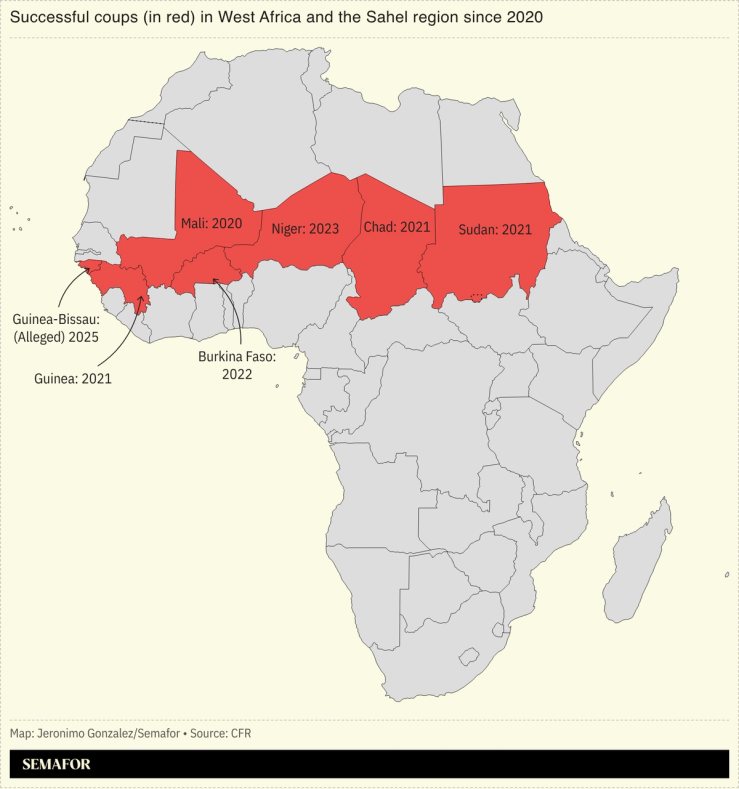
The region’s security problems also extend beyond Nigeria’s borders. The series of coups in countries around the Sahel in recent years have stemmed from the instability caused by insurgents. Nwachuku, Terra’s CEO, hopes to raise more money to fund new hires and factory expansions beyond Nigeria. “Defence is a very expensive industry and what we are trying to solve is so huge that it is going to need a warchest — quite literally”.

Room for Disagreement
The danger of drones falling into the wrong hands worries some Africa security watchers. “There is a lot of concern and interest in extremist groups picking up these drones and using technologies in innovative ways,” a former US Department of Defense official told Semafor.

Notable
- Nigeria’s defense headquarters said the security assistance being provided to it by the US comes “at no cost” to the government.