




what’s at stake
At the center of the feud between the Pentagon and Anthropic is a heated debate over whether there should be more constraints on the military’s use of artificial intelligence.
Anthropic, which has a $200 million contract with the Defense Department, wants guarantees that the Pentagon won’t use its technology for mass surveillance or autonomous weapons.
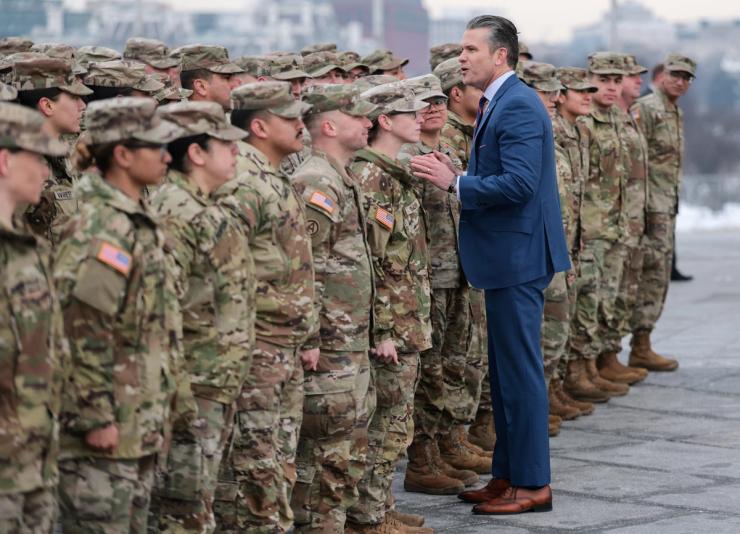
But Defense Secretary Pete Hegseth wants unfettered access to Anthropic’s Claude model, and has given the company until Friday to drop its demands for guardrails or risk losing out on its lucrative contract. The Pentagon has simultaneously threatened to use the Defense Production Act to compel the company to cooperate.
“These threats do not change our position: We cannot in good conscience accede to their request,” Anthropic chief Dario Amodei said in a statement Thursday.
In this article:
who’s making the case
Sen. Angus King, I-Maine, a member of the Senate Armed Services and Intelligence Committees, argued that there should be more constraints around the use of AI by the military and domestic national security agencies:
“It has the potential to turn us into a police state. In Maine, for example, people were threatened by ICE who were just watching and they said, ‘Oh, now you’re going in the terrorist database.’ ICE denies there is such a thing, but this is what the agent said. And the potential for AI — combined with access to all the government’s data, taxes, Social Security, health care, combined with identification — is very scary and something we do need to pay attention to. And I’m afraid the Congress is sort of stymied by the complexity of it, and therefore not doing anything, and it’s going to be a real problem.
“What the company [Anthropic] is talking about is some limitations on the use that I think are common sense.”
Sen. Mike Rounds, R-S.D., who was part of a bipartisan Senate working group on AI, said it’s too early to determine whether the technology should have more limitations placed on it:
“We’re doing some research on it. We’re still learning about it. It’s a very serious issue but we want to make sure we’ve got the tools available for our young men and women in uniform. But I also recognize that each of these organizations has concerns that they just simply want to express. I get that. Where it ends up yet, I don’t know.”
Sen. Tommy Tuberville, R-Ala., a member of the Armed Services panel, said that the potential benefits associated with AI should outweigh any calls to restrict it:
“It’s kind of like when we first came upon the internet, and nobody knew what to expect, and it’s turned out to be a good tool for everybody. AI is going to do the same at a more enhanced rate. I think AI is going to enhance the military, advance our manufacturing, but also enhance taking the fraud out of the big budget that the military has.”

Notable
- In its AI action plan released last year, the White House encouraged the Pentagon to “aggressively adopt” the technology in order to maintain the US military’s edge.
- King referenced allegations that are now subject to a lawsuit in his home state of Maine, as the Portland Press Herald reported.
- Semafor’s Reed Albergotti has written extensively about the Pentagon’s feud with Anthropic.