




The Scoop
Geopolitical tensions between Beijing and European capitals will not stop Chinese wind turbine manufacturers from expanding into Europe, the international head of one of China’s biggest wind turbine manufacturers said in an interview, characterizing their arrival as coming “sooner or later.”
The remarks by Yu Feng — the newly appointed chief executive of Windey International, the global arm of China’s state-owned Windey Energy Technology Group — come with Beijing and Brussels appearing to tamp down a long-running row over Chinese green exports to the European Union. The Hangzhou-based company’s ultimate goal is to cover the entire European market. In Yu’s view, persistent geopolitical tensions, ranging from trade rows to questions over supply-chain dependency, do affect the company’s plan, but their impact is expected to be short-term.
Chinese wind turbines, he said, are “irreplaceable” to the world.
In this article:

Xiaoying’s view
The question of Chinese clean-tech imports is a divisive one in Europe. My conversations with a wide range of experts point to the crux of the problem: Should Europe prioritize its green goals or economic competitiveness?
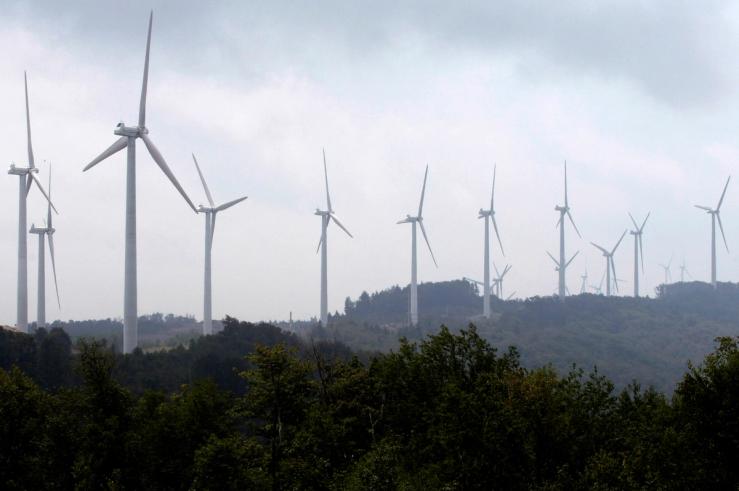
China’s solar panels already dominate global production, but even though its wind turbines are a major force in international supply — the four biggest global manufacturers are Chinese, according to data compiled by BloombergNEF — the country’s companies have made limited inroads in Europe, where turbine suppliers such as Vestas play a major role. Though China’s wind turbines are cheaper to install and can have much higher capacity, European governments have been reluctant to use them, both prioritizing domestic companies in order to maintain a home-grown supply, and fearful of perceived security risks tied to using Chinese technology.
Chinese wind turbine makers currently have limited production in Europe, a factor that also leads to distrust and protectionism, Yu said. He is confident that if they boost their presence, things will change: “As long as Chinese companies localize their business, European politicians and European culture are bound to accept it.”
“How to enable the general public to access cheap and renewable energy is a question no European politician can escape. And this is where China can come in,” Yu told me.
Chinese firms expanding in Europe bring other benefits, too, he argued: They can bolster Europe’s industrial competitiveness by combining Chinese manufacturing prowess with European technical and innovative expertise. Making Chinese devices in Europe will also help to alleviate Europe’s security concerns, Yu noted.
Equally, Europe is “highly important” to Windey, he stressed, because the continent has a traditional wind market with mature operations. Strict European regulations in areas such as environmental rules and technical specifications can help Windey improve, Yu said: “The European market is like a school for us, making us better.”
But executing its strategy won’t be easy. Chinese renewables manufacturers currently face huge uncertainty — and often hostility — while doing business in Europe.
A case in point: Mingyang, another Chinese wind turbine maker, intends to build a $2-billion factory in Scotland, but its plan triggered national security fears in the UK after Washington reportedly warned London over possible Chinese surveillance — allegations Beijing rejects.

Know More
Although it may be little known outside of China, Windey was the world’s third largest wind turbine maker in 2024, laying claim to around 10% of the global market. It trailed two other Chinese firms, Goldwind and Envision, and sat just above Mingyang.
Thanks to their massive home market, Chinese manufacturers’ performance was so strong that year they pushed European wind powerhouses, Vestas and Siemens Gamesa, to fifth and eighth place, respectively.
But oversupply and brutal price wars at home have forced them to find new markets. Like many of its peers, Windey began its global venture close to home, bagging major orders in Vietnam and Kazakhstan in 2019. The company used a strategy described by Yu as “going overseas on borrowed boats.” That essentially means being a supplier to Chinese developers or construction contractors that had won wind power projects abroad. “But that can only get you so far,” he noted.
When entering a new region, Windey’s strategy is to put down roots in one country and branch out to neighbors. In Europe, the company’s entry point is Serbia, a country with close ties to China: Windey has supplied turbines to several projects in Serbia since 2023 and opened a regional office there. It recently delivered its first order to Serbia’s neighbor Bosnia and Herzegovina and is considering opening a plant in Turkey.
Ultimately, Yu sees a future with a standalone Europe operation, to be carried out in three steps. The company will start by participating in the research and development of solutions that cater to local markets, then design and produce components on the continent, and eventually assemble entire wind turbines there. So far, it has set up a European research and development centre in the British city of Bristol, partnering with other international firms to work on cutting-edge technologies.
Alongside wind turbines, Windey plans to produce energy storage systems, renewable hydrogen, ammonia, and methanol in Europe, Yu said.

The View From Brazil
Windey is quickly expanding into South America, too. In June 2025, it opened a research and development center in Salvador, Brazil, shortly after Brazilian President Luiz Inácio Lula da Silva visited Beijing.
The center is part of wider economic cooperation between the two countries, and spearheads Windey’s effort to boost its presence in Brazil. The company plans to help Brazil improve its power grid, adopt renewable energy in the agricultural sector, train up engineers, and so on. Its next step is to build a factory producing energy storage systems in Brazil, Yu said.

Notable
- Europe aims to more than double its offshore wind capacity between now and 2030, but it faces supply chain bottlenecks. In an October report, Michal Meidan and Anders Hove of the Oxford Institute for Energy Studies laid out “the good, the bad, and the unknown” of Chinese participation in Europe’s offshore wind sector.