




Ben’s view
The cynical journalists in Davos like to say that there’s a consensus formed there every year — and every year it’s wrong.
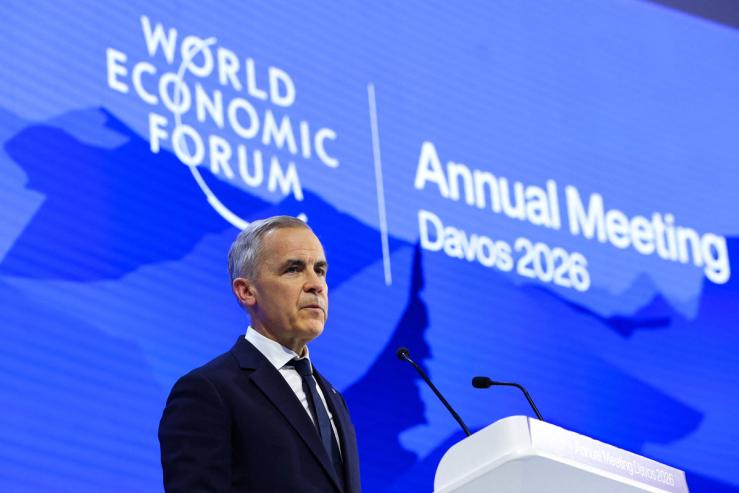
But this January, even the cynics came rolling out of the Swiss mountains wide-eyed at Canadian Prime Minister Mark Carney’s declaration of a global “rupture,” splashing him across front pages.
It was the first of a few big, provocative, viral ideas to captivate the chattering classes in 2026. These highbrow memes are useful political tools — particularly for President Donald Trump’s energized enemies. There’s no requirement, however, that they make sense.
So I thought I would raise a few questions about these big ideas, before you get too comfortable with them.
1) The Carney speech
Carney captivated Davos by calling for a clear and definitive end of the pre-Trump era and defining a new one in which “middle powers” — say, for instance, Canada — must lead.
The speech invoked a Václav Havel essay about the hollowness of Communist ideology, embodied by the revolutionary slogans in shopkeepers’ windows that nobody actually believed.
“We are taking the sign out of the window,” Carney declared. “We know the old order is not coming back. We shouldn’t mourn it.”
Wait a second. First, it was an odd analogy: What were the enforced slogans of global capitalism? The Golden Arches are pretty sincere.
But more important, the notion that one of the world’s great banker politicians wouldn’t mourn, or resist, the passing of a half-century of capitalist prosperity was a “false note,” as the Financial Times’ Janan Ganesh noted. Carney’s speech was an amazing bid for global leadership by a Canadian prime minister, and a hit in the moment. I texted a copy to my kids. But on some reflection, it was merely a brilliant piece of politics — not a definitive prediction about the world order, or even a clear vision for it.
2) The ‘Epstein class’
The phrase, HuffPost reports after an extensive dive, has been kicking around for a while, but Sen. Jon Ossoff, D-Ga., and Rep. Ro Khanna, D-Calif., are the ones who popularized it. The phrase’s political appeal is obvious: It’s a way to extend the guilt-by-association sweep through the Epstein emails to members of the global elite who never met Epstein and to keep the pressure up on Trump. The flames are certainly high: The armed intruder killed at Mar-a-Lago over the weekend was reportedly “fixated” on the Epstein files.
And the emails are, in fact, a fascinating map of elite (and human) temptation and corruption. They sweep in Davos-y elites and Trumpy counter-elites. They are also, perhaps more than anything else, a window into profound misogyny, as the Sunday Times columnist Heather Rumbelow noted.
But the “Epstein Class” inverts the Epstein story, suggesting these (mostly) men comprised a secret society before Epstein found them. Epstein had his targets: He realized that elite scientists were a relatively inexpensive path to prestige, and he seduced them — but I’m not sure scientists are actually more prone to elite failings than, say, the film executives around Harvey Weinstein. Tina Brown, who literally comes off better than any other person in the Epstein files, had been in business with Weinstein.
The notion that there is a “class” that includes Noam Chomsky and Howard Lutnick makes little sense except to lunatic antisemites. But hustlers of various sorts have long targeted elites for their own purposes.
Take the crypto founder Sam Bankman-Fried, who contributed to Ossoff and Khanna’s political campaigns. It would be absurd to see Ossoff, Khanna, Tom Brady — a paid spokesman for Bankman-Fried’s crypto exchange — and me as part of an “SBF class.” (Bankman-Fried was an investor in Semafor.)
As Zeteo’s Mehdi Hasan said, in partial defense of Chomsky: “He’s only human — power and wealth corrupt, there’s a reason we say that phrase.” Epstein, a career criminal and con artist, saw weakness in the rich and powerful and exploited it, and his emails are an incredible map of elites, and of their wealth and power. The outline of a class they reveal is a Rorschach inkblot.
3) AI ideology
Finally, I’d like to suggest a moratorium on definitive proclamations about artificial intelligence before things get out of hand. Two of the greatest tech salesmen since Steve Jobs — OpenAI’s Sam Altman and Anthropic’s Dario Amodei — are raising money again, and as my colleague Reed Albergotti notes, they tend to sync up the catchiest proclamations with those fundraising rounds.
Over the weekend, Altman offered a new winking provocation in India: If you think it takes a lot of energy to train an AI model, just think about how much energy it takes to train a baby!
“At some point, the only option will be for everyone to pipe down,” Alphaville wrote recently.
Always-polarized American politics, meanwhile, has produced a counter-reaction at a similar scale, moving slices of the Democratic Party into a reflexive hostility to the technology. Some have decided that AI is either simply fake (this is not the experience of the software engineers now using it at remarkable scale), while others have substantive qualms about its impact on culture, politics, and labor that seem to be captured in support for local opposition to data centers.
But as the Substacker Noah Smith wrote recently, Democrats will have to engage the technology if it really does begin to raise questions about the value of human labor and if an AI investment bubble bursts. (It’s possible, even likely, that both will happen.) Those are interesting, detailed questions. But the intensely ideological debate about AI has pushed them into the background.

Room for Disagreement
Good reporters are, I think, a little suspicious of ideology and open to true surprise. At Semafor, we’ve tried to resist the temptations of the big, simplistic narratives of our age, in part by including a “room for disagreement” section in our articles. And in that spirit, three strong disagreements with these arguments.
- “It was the only one of the leader speeches that I saw that, with weight and moral earnestness, expressed the shock which many of us are feeling here,” the writer Adam Tooze told Ishaan Tharoor, who catalogued admiring reaction in Davos to Mark Carney’s address there.
- The “Epstein Class” reveals “a power elite practiced at disregarding pain,” Anand Giridharadas wrote in the New York Times. “What his correspondents tended to share was membership in a distinctly modern elite: a ruling class in which 40,000-foot nomadism, world citizenship and having just landed back from Dubai lend the glow that deep roots once provided; in which academic intellect is prized the way pedigree once was; in which ancient caste boundaries have melted to allow rotation among, or simultaneous pursuit of, governing, profiting, thinking and giving back.”
- “I think that most people are underestimating just how radical the upside of AI could be,” Anthropic’s Amodei wrote in his 2024 Machines of Loving Grace, coining the notion of a tool that is the equivalent of a “country of geniuses in a datacenter.”