




The Signal Insight
The CEO of one of the biggest US ports is making a $3 billion bet that President Donald Trump is wrong.
Noel Hacegaba, who last month took the helm of the Port of Long Beach, has greenlit the largest capital-spending plan of any port in North America. He has committed $3.2 billion over 10 years to expand a complex that was barely edged out last year by the nearby Port of Los Angeles in terms of the volume of containers handled.
The spending is based on forecasts that imports will continue to grow faster than the US economy as a whole, and that Trump’s push to make America more self-reliant won’t change that. Long Beach expects to double its import volume by 2050.
“I’m an eternal optimist,” Hacegaba said in an interview with Semafor, predicting that a growing US population’s appetite for products will outstrip the country’s manufacturing capacity for years to come.
But the effects of Trump’s tariff policies and a broader reshaping of global supply chains have been felt at the port, which is a department of the City of Long Beach. As the share of its imports coming from China falls and Southeast Asian countries pick up the slack, shipments are spending more days in transit time, bringing pressure from retailers to make that up at the docks. So part of Hacegaba’s planned investment is going to build ship-to-rail capabilities that get imported goods on shelves faster — while keeping unionized longshoremen in their jobs.
This interview has been edited for length and clarity.
Liz Hoffman: What is driving your new growth goal? Is it global GDP growth, US GDP growth, or are you trying to steal share from the Port of LA?
Noel Hacegaba: It’s a combination of all those elements. To me, a vision brings alignment — internally with our staff, and externally with our customers, stakeholders, and partners. The feedback we’ve received so far shows a lot of excitement. People feel energized because there is clarity on where we’re headed.
A line I keep repeating is that we’re going to clarify our vision, simplify our mission, and amplify our impact. These slogans help bring alignment and help us put together our investments and strategies.
When you’re making these decade-long bets, is there a chance you’re spending a ton of money on a world that is going to be increasingly less connected?
We are bullish on the future, no matter the short-term volatility or uncertainty. The US population is not going to shrink; it will continue to grow. As the economy grows, people have more disposable income. Demand for products will outstrip the US’ ability to manufacture them here for the foreseeable future. If we make these investments now, we will be more competitive 24 years from now.
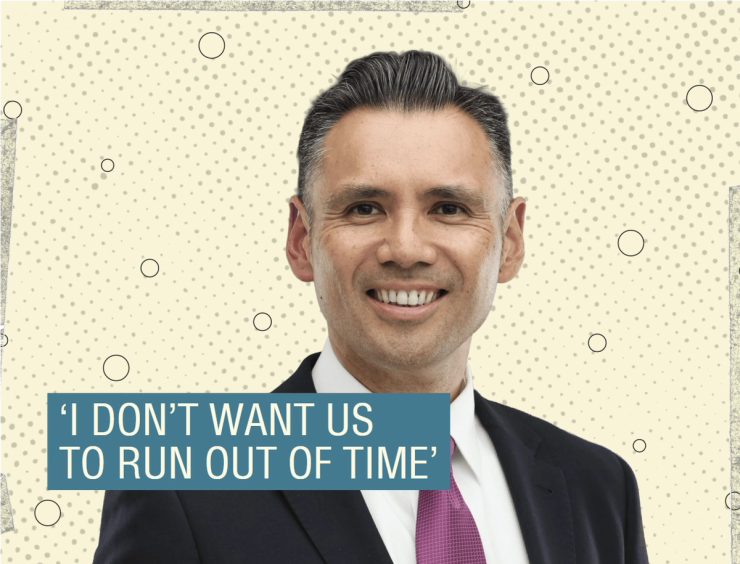
Vince Lombardi, the Hall of Fame [football] coach, once said he never lost a game; he just ran out of time. I don’t want us to run out of time. I want us to be first.
Even if US manufacturing takes off, it will take a long time to offset products manufactured overseas. Furthermore, US manufacturing is often advanced — we aren’t talking about clothes and shoes; we’re talking about expensive components. We will still need ports to import the machinery, parts, and supplies those US factories need. It also means we’re going to export more, which is good for the economy.
How has Trump’s trade war, and a broader fracturing of global supply chains, impacted your business?
The shift in manufacturing from China to Southeast Asia is a big deal for us. Ninety percent of our cargo comes from Asia. In just the last seven years, we’ve seen a significant shift from China to countries like Vietnam, Thailand, Malaysia, and Cambodia. In 2019, China alone accounted for 70% of our total business. Today, China accounts for only 60%.
On a map, that shift may not seem big, but it adds two to three days of transit time on the water. That shift to Southeast Asia adds pressure on us to make up for those extra days.
This is where the $3.2 billion investment comes in. About $2 billion of that is going into rail, which will enable us to triple our “on-dock” rail capacity — meaning that the container is transferred directly from the ship to a train. It doesn’t leave in a truck. Today, the average time to get a container from a ship to a train is just under four days. With [our new investments], we can get that down to 24 hours.
How have the trade tensions changed your export business?
Our top export destinations are China, Japan, Korea, and Vietnam. When the US and its partners engaged in rounds of tariffs, our agricultural sector got hit hard by retaliatory tariffs. In one year, we saw a 95% decline in US soybean exports to China. We helped our agricultural sector shift those exports to places like Thailand instead. We export a lot of agricultural products, waste paper, and supplies used overseas to manufacture the goods that eventually come back to us as imports.
You are a heavily unionized shop. What are you hearing from the union bosses regarding the anxiety over being replaced by robots?
We have a very good working relationship with the ILWU, the longshoremen. We’re taking a holistic approach — the idea is to leverage technology in a way that lifts everyone. We will be investing aggressively in upskilling and reskilling our workers. Technology is just a tool; it becomes a solution when it’s properly integrated into a business system.
One other project I announced last month, which we are exploring with Brookfield, is building the world’s first conventional, net-zero container terminal. By conventional, I mean it will be human-operated — a win for labor, a win for the environment, and a win for speed.
Why invest so heavily in a human-operated facility right now?
It shows our commitment to our workforce and to our zero-emissions goals. It also signals to our e-commerce partners that we are focused on being fast, efficient, and reliable.
Do you worry that we’re reorienting the US economy around my desire to have a single Christmas ornament delivered tomorrow?
It’s possible, but the critical mass is still shippers moving product at scale. Speed to market is the key to our success, and rail connectivity is the key to our future.

Notable
- China’s commitments to buy more US agricultural products have yet to materialize, cutting cargo volumes at the Port of Los Angeles to almost a three-year low, CNBC reports. Total processed cargo volume at the busiest US port in January was down by about 12% year over year.
- The Supreme Court is mulling the legality of Trump’s tariff regime and could rule as soon as today.