




The Signal Insight
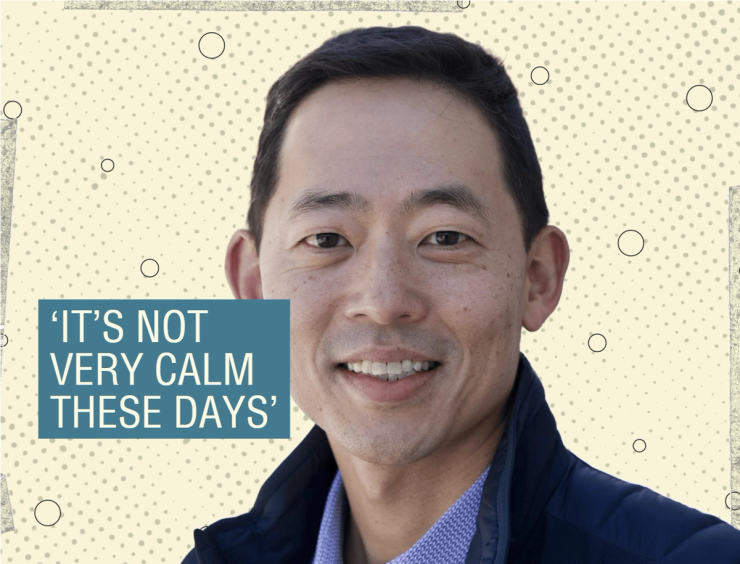
“As CEO of Calm, I would tell you, it’s not very calm these days,” says David Ko. His company is best known for a meditation and sleep app that has been downloaded by 180 million consumers. But it has also built an enterprise business that now counts 5,000 companies as customers, and a health care operation that works with insurers covering 50 million Americans.
Ko’s pitch to corporate partners is that the take-up rate for Calm’s branded app can be 10 times higher than the adoption of mental health offerings in a traditional employee benefits plans. His message to insurers is that his company can save costs in an overwhelmed health care system by identifying early whose anxieties can be eased with an app and who needs professional help.
But Calm’s push beyond the consumer business has also given Ko insights into the fraying mental health of the people in charge of those employees. When Calm surveyed executives last September, it found many were stressed and sleep-deprived. CEOs are struggling to switch off, Ko says, and making high-stakes decisions while their mental batteries are drained. And that, he says, is affecting their companies.
This interview has been edited for length and clarity.
Andrew Edgecliffe-Johnson: What insight are you getting through your relationship with enterprises into how seriously they’re now taking employees’ mental health?
David Ko: I gave a speech last year and afterwards all these CEOs came up to me and said, “I’m super stressed. I’m having a tough time sleeping.” So we polled over 250 C-suite executives last September. What we found was 87% said they were OK. We asked the question again, because when you ask it twice in a different format, people get a little bit more honest. And then 48% of them said, “Actually, I’m feeling a bit overwhelmed,” and 24% said they were feeling anxious or feeling some form of depression.
When we kept diving into the numbers, only one out of four said they were sleeping well. Many of them thought they had to show the strength to shield their employees, but it was coming at the expense of their own health, because they had no one to go talk to. There’s a struggle at the top, and it’s being felt amongst a lot of the employees as well, because there’s a trickle-down effect.
So what are you telling CEOs?
I often tell them, it’s OK to talk about your own [mental health] journey, because it will build a more resilient workforce. And you’ll seem more human, because everybody is struggling in their lives with mental health, because we built an always-on [work culture]. We can’t turn off the phone, we can’t turn work off anymore, and that’s being felt pretty much by everybody.
I was in a room with a number of execs not too long ago, and one of the execs said to me, “Is this generation too soft?” I [asked him,] “When you were their age, were you on a laptop or desktop?” And he said, “Desktop.” I asked, “So could you physically carry that home?” And he said, “No.”
[Technology now] never turns off. It is on with us 24-7 for most execs. I ask [executives], “What’s the last thing you look at before you go to bed, and what’s the first thing you look at when you wake up?” Nobody says it’s their spouse. Almost 100% say it’s their phone.
But they feel a sense of responsibility in a volatile world, so what’s the alternative?
One hundred percent. But it’s about how present you feel. As CEOs, you’re expected to make some of the hardest decisions in your company, but your battery, in terms of where your mental health is, is probably running at 20% if you’re not recharging the right way.
I always say, if you feel your battery getting lower, look out the window. Grab a glass of water. Take a walk. Three Ws. But most will just sit there. If you were a professional athlete, would you go out at 10% and expect to perform at the highest level? The answer is no. But we are making all these huge decisions, in the age of AI, and we’re doing them with our batteries at 10% to 20%.
Does the company stop for you to take a walk?
No, it doesn’t. But what I find is I’m much more productive and I’m much more present [when I return].
Do you think technology is making us sicker?
Well, I can answer this for us. People have often asked me, “How could Calm make more money?” And I think if I were to open it up and have likes on it and create social pressure, I could absolutely make more money. But this is a product for you. I love the fact that when my kids or their friends use the product, they often tell me they feel better about themselves, not a little bit worse about themselves. And there are lots of apps out there today that make you feel a little bit worse about yourself.
What is AI changing for you?
AI has changed pretty much everything for most companies I work with. I think the more strategic questions are how will you create product experiences that leverage that technology, where people feel safe and trusted?
Right now, people who are feeling fragile might turn to a chatbot, and the fear is they will get sucked into a self reinforcing cycle and something terrible might happen. Are you planning a Calm chatbot?
At some point, when we know we can release a product that we have full confidence over, we’ll do that. Right now, we’re not there yet. What’s one of the biggest barriers? I think with a lot of the [large language model] products, we find that we can get to about 80% to 85% efficacy. And for me, that’s not enough.
If the advice we’re giving to somebody is about their mental health, I don’t want to be just right 85% of the time. We’ve had conversations with pretty much every [LLM company], [but] we want to make sure that we’re in a position to do it the right way.

Notable
- Calm branched out into hardware recently, partnering last year with a maker of high-tech sleep earbuds.