




The News
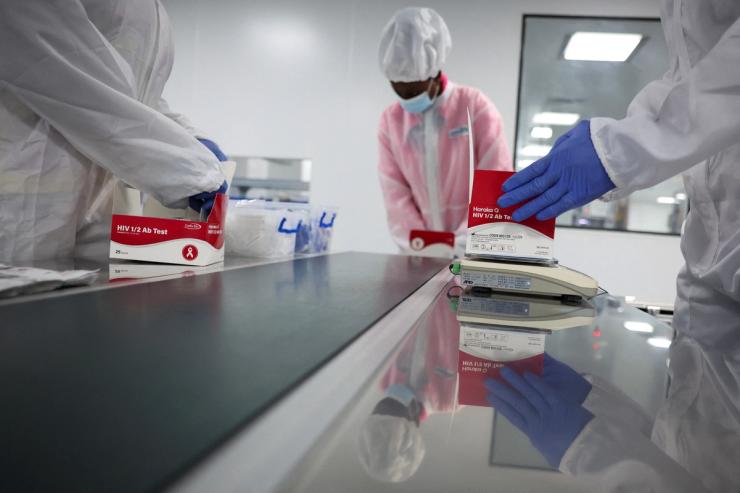
Botswana is in talks with international pharmaceutical manufacturers to produce generic drugs locally as it recovers from a public health emergency triggered by Western aid cuts and a hole in public finances caused by low diamond prices, its health minister told Semafor.
The southern African country, which is the world’s top diamond producer by value, declared a public health emergency last August because of a shortage of essential medicines and medical equipment. The government, which said it owed around $75 million to private health facilities and suppliers, deployed the military to oversee a distribution drive to repair medical supply chains.
Health Minister Stephen Modise, in an interview, said that while medicines are now more widely available, nationwide the focus is on building strong supply chains with locally manufactured drugs to overcome the high cost of importing medication.
He said his government was in talks with manufacturers in India with expertise in producing generic versions of drugs to set up operations in Botswana for a fixed period of time and training locals who would then take over. Health ministry officials and the ministry of trade are also devising tax breaks to incentivize local manufacturing, said Modise.
The minister also said work was already underway with other southern African countries to manufacture drugs locally and pool resources across borders. “We’ve been talking to our neighbors to see if we can work together because we share a number of similar vulnerabilities,” he said, adding that discussions had been held with South Africa, Zambia, and Zimbabwe.
“Pooled procurement is a very effective way of getting medicines as a bloc because you’re able to leverage on that to get competitive pricing and buy for a larger amount of people,” he said “It’s a conversation that our neighbors are pretty much on board with.”

Know More
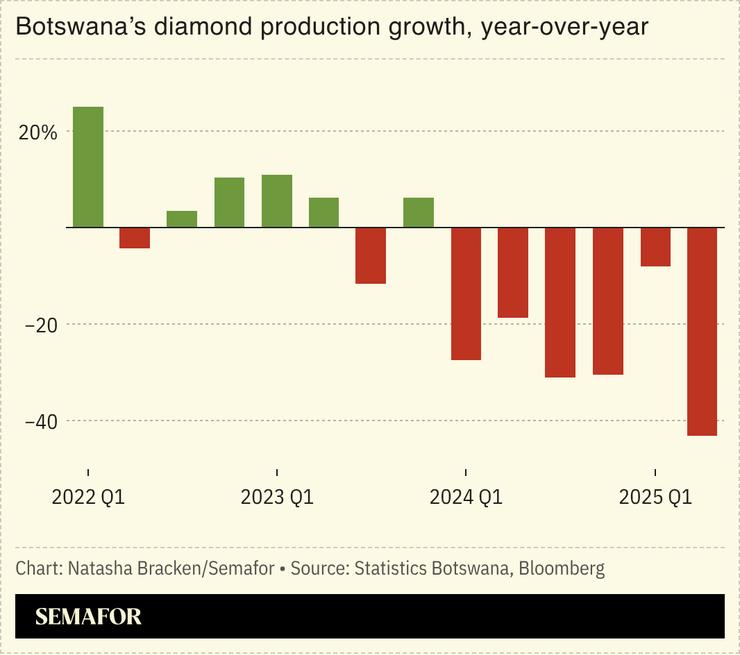
Botswana’s economy has been hit by a prolonged downturn in the precious stone’s international market. The country relies on diamond sales for about 80% of foreign exchange earnings and around a third of national revenue. However, global diamond sales have been hit by oversupply and the rising popularity of lab-grown gems.
This month the budget minister said Botswana’s economy is projected to grow by 3.1% this year after two successive years of contraction, but debt is expected to rise beyond the government’s statutory ceiling because of another large budget deficit.
Modise told Semafor that the government was now looking to increase revenues from its agriculture and tourism sectors after many decades as a “monosectoral economy.”
The economic strain was exacerbated by the impact of the US cutting aid that supported the country’s health sector — Washington funded a third of Botswana’s HIV response, according to UNAIDS. “Over-reliance on aid is not helpful because then you’re vulnerable and reliant on who comes in as the leader of that government,” said the minister. “We cannot be perpetual beggars.”

Alexis’s view
Botswana’s health crisis is significant because it’s a cautionary tale for other African countries. It shows what can go wrong when a country is overly-reliant on a commodity and international aid.
The southern African country has for years been lauded as a model of good governance. And it has benefited from its decades-long diamond mining arrangement with De Beers. Unlike other countries that merely export their commodities, Botswana has created jobs by developing a local diamond-cutting and polishing industry, alongside jewellery manufacturing.
Despite its successes, it’s now clear that Botswana’s economy was built on shaky ground. An effective government must ensure its citizens are healthy and well educated. That combination makes for a happy society and ensures a populace that drives a productive economy for years to come. That is why Botswana’s failure to provide adequate health care for its population should not be underestimated.
The solutions pursued by the government are sensible and show that it has learned — not just from the twin crises of plunging diamond prices and aid cuts, but also the global COVID-19 crisis. The scramble for vaccines, in which advanced economies quickly gobbled up urgent pandemic supplies, highlighted the need for local drug manufacturing. That approach cuts the costs of medicines, creates local jobs, and instills reliance to better cope with global shocks. As a country with just 2.5 million inhabitants with similarly small neighbours, such as Eswatini and Lesotho, it also makes sense to pool resources.

Room for Disagreement
Cloudius Ray Sagandira, principal researcher at the Council for Scientific and Industrial Research, a South African research and development organization, pointed to several challenges that hold back local drug manufacturing in an article for The Conversation. African countries still import most of the raw materials needed to make the ingredients, which makes local production expensive and vulnerable to foreign pricing, he wrote. He also pointed to a shortage of skilled workers, limited access to capital, outdated infrastructure, and unreliable electricity access.

The View From London
Botswana’s heavy reliance on Botswana is not an isolated case in Africa. David Omojomolo, Africa economist at Capital Economics, in London, said a number of other African economies rely heavily on specific commodities. “Nigeria particularly stands out on reliance,” he said, because about 90% of its export revenues are derived from oil and gas. By contrast, he pointed to Ghana, the continent’s top gold producer, where about 55% of export revenues came from precious metals and 16% from oil & gas.

Notable
- Botswana needs “higher and sustained productivity growth” to escape the “middle-income trap,” economy experts wrote in a World Bank blog.